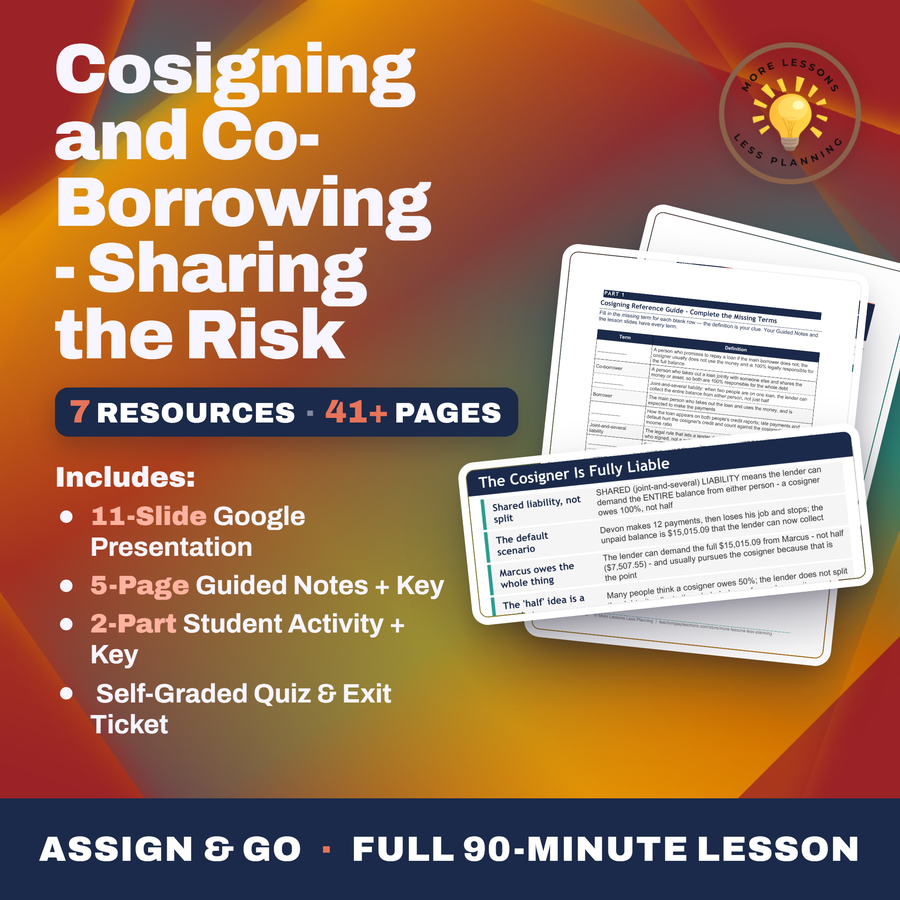
Cosigning and Co-Borrowing - Sharing the Risk
Quality reviewed September 2026
- Grades
- Grades 9-12
- Time
- About two 50-minute class periods
- Includes
- 11 ready-to-teach files
- Format
- Word (.docx) · PowerPoint (.pptx)
- Slide deck
- Guided notes
- Guided notes teacher key
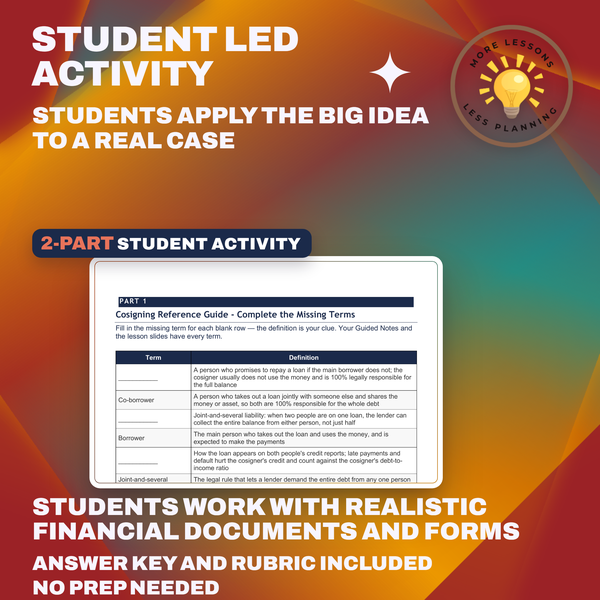
- Activity + answer key
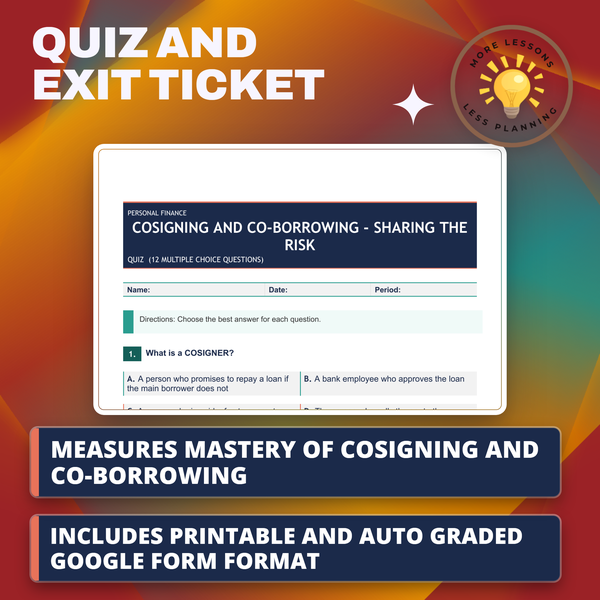
- Quiz + answer key
- Exit ticket + answer key
- Teacher guide
- Teacher presentation notes
What students do
- Calculate the total cost and interest on an $18,000 car loan, then price the unpaid balance after a default
- Read a bar chart proving the cosigner owes the full balance, not half, under joint-and-several liability
- Explain how a cosigned loan shows up on the cosigner's own credit report and debt-to-income ratio
- Write a recommendation on whether to cosign a specific loan, using a calculated dollar figure
What it covers
- The difference between a cosigner, who does not use the money, and a co-borrower, who shares the asset
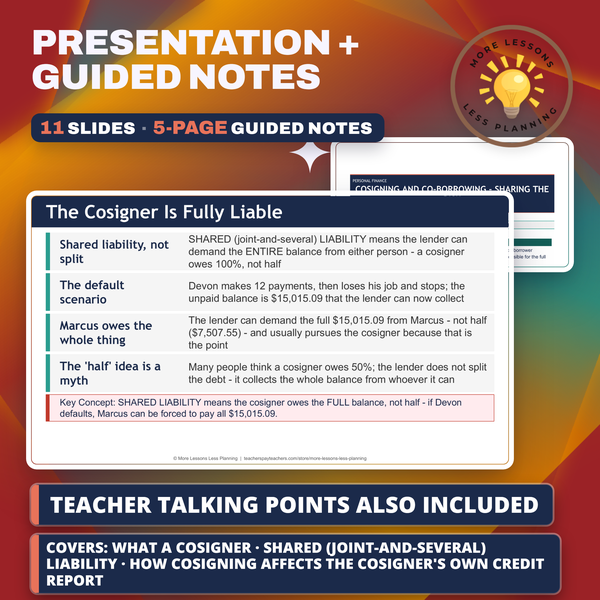
- Joint-and-several liability, and why the full default bill goes to the cosigner, not half of it
- The credit-report and debt-to-income hit a cosigner takes even if the borrower never misses a payment
- The rule of thumb: only cosign an amount you could comfortably repay yourself
Learning targets
- Explain what a cosigner is and does, and how a cosigner differs from a co-borrower
- Explain shared (joint-and-several) liability - why a cosigner is 100% responsible for the full loan balance, not half
- Describe how cosigning affects the cosigner's own credit report and debt-to-income ratio
- Explain the risks of cosigning a loan for someone else and decide when it is smart to say no
Peek inside
✔
Cosigning is a favor with teeth
When you COSIGN, you promise a lender you will repay a loan if the main BORROWER does not - it is a legal promise, not just a good word
✔
You share the risk, not the reward
Cosigning Is a Legal Promise
A COSIGNER is a person who promises a lender to repay a loan if the main borrower does not - the cosigner usually does not use the money but is 100% legally responsible for the full balance. It is a legal promise, not just a good .
The BORROWER is the main person who takes out the loan and uses the money, and is expected to make the payments. The cosigner takes on the full if the borrower stops paying.
Marcus's Decision
Devon asks Marcus to cosign an $ car loan at 9% for 5 years; Marcus never drives the car, but his name is on the debt.
A cosigner who does not understand the risk can end up paying thousands for a loan they never benefited from, and hurting their own .
1. A person who promises to repay a loan if the main account holder stops paying, and is 100% responsible for the full balance, is a .
Why this matters
Somebody's parent or older sibling will get asked to cosign a loan someday, and the decision usually gets made on the spot with none of the math this lesson forces students to run first. An $18,000 car loan that defaults after 12 payments ends up owing the cosigner the full remaining balance, not half of it, no matter how the favor got framed when it was asked.
The quieter part students miss is that the loan lands on the cosigner's own credit report and debt-to-income ratio the moment it is signed, whether or not the borrower ever misses a payment. The rule of thumb I leave them with is simple: never cosign more than you could repay yourself, the conversation I would rather they have now than the one families have after a default.
From one teacher to another
Most of my students think a cosigner owes half the loan if things go bad, so I let them sit with that wrong answer for a minute before the chart proves them wrong: when an $18,000 car loan defaults after 12 payments, the bar for what the cosigner owes is exactly as tall as the bar for what the borrower owes. They work the actual loan math first, the monthly payment and the total interest over five years, then calculate the unpaid balance themselves so the default number on the bar chart actually means something, and after that they price out the quieter cost most people never think about, the loan sitting on the cosigner's own credit report and blocking his own mortgage two years later even if the borrower never misses a payment. It ends with them deciding whether to cosign at all, which is the real conversation I want kids having with their own parents someday.
Every file in this toolkit
-
Activity (Student)
Marcus Bell's cousin Devon wants an $18,000 car loan cosigned, so students chart who owes what if it defaults, then calculate the total interest on Devon's five-year loan before Marcus decides whether to sign.
-
Activity (Answer Key)
Devon's $18,000 loan defaults at a $15,015.09 balance, and Marcus the cosigner owes that full amount, not the $7,507.55 half so many guess, a $7,507.54 gap that also lands on his own credit report and debt-to-income math.
-
Exit Ticket (Student)
What a cosigner actually promises gets defined in the opening item, and later ones ask how much of a defaulted balance a lender can chase and why cosigning stays risky even when the cosigner never misses a payment. Cosigner, shared liability, and credit impact need to show up in the write.
-
Exit Ticket (Answer Key)
Full responsibility for the whole balance, not half, is the point this rubric checks first, together with the reasoning that a cosigned loan lands on the cosigner's own credit report and debt-to-income ratio the moment it is signed.
-
Guided Notes (Student)
Marcus's cousin Devon asks him to cosign an $18,000 car loan at 9 percent for five years, and the notes trace what a cosigner promises up to the full balance Marcus could end up owing.
-
Guided Notes (Teacher Key)
$15,015.09 is the unpaid balance Marcus owes in full once Devon stops paying, not the $7,507.55 half so many people wrongly assume shared liability means, since a cosigner is never split fifty-fifty.
-
Quiz (Student)
Devon's $18,000 loan, cosigned by Marcus who never drives the car or touches the money, sets up questions testing how much of the $15,015.09 unpaid balance a lender can legally demand from him.
-
Quiz (Answer Key)
The full $15,015.09 balance, not half, is what Marcus owes if Devon defaults, and that joint-and-several liability rule is marked correct alongside how the loan counts against his own mortgage odds.
-
Slides
$18,000 is the car loan Marcus's name goes on at 9 percent for five years, and these slides trace what shared liability really means, ending on the math showing he owes the full $15,015.09 balance once Devon stops paying.
-
Teacher Guide
Joint liability is why Marcus owes the full $15,015.09 if his cousin Devon defaults on the car loan he cosigns, not half, the lesson behind this 56-point guide. Extensions send students hunting for real FTC cosigner-notice wording and sorting cosigner from co-borrower cases.
-
Teacher Presentation Notes
Joint and several liability means Marcus and Devon each owe the full $15,015.09 if the loan defaults, not half apiece, the point behind why a cosigned loan shows up on the cosigner's own credit report.
Download
Where should I send the next one?
Everything here is free and it stays that way. Leave your email and I'll send you the new lessons as they go up. You can unsubscribe from any one of them.
Related resources
Interest Explained - Simple vs Compound
Loan Default - What Happens When You Can't Pay
Payday Loans - The 400 Percent APR Trap
Student Loans and Financial Aid
The Debt Snowball vs Avalanche - Paying It Off
What Is a Loan? Principal, Interest & Terms
Every lesson on this site is free to download and use. If one of them saved you a prep period, you can chip in a few bucks toward my three kids' daycare fund. That's genuinely where tips go.