The Debt Snowball vs Avalanche - Paying It Off
Quality reviewed September 2026
- Grades
- Grades 9-12
- Time
- About two 50-minute class periods
- Includes
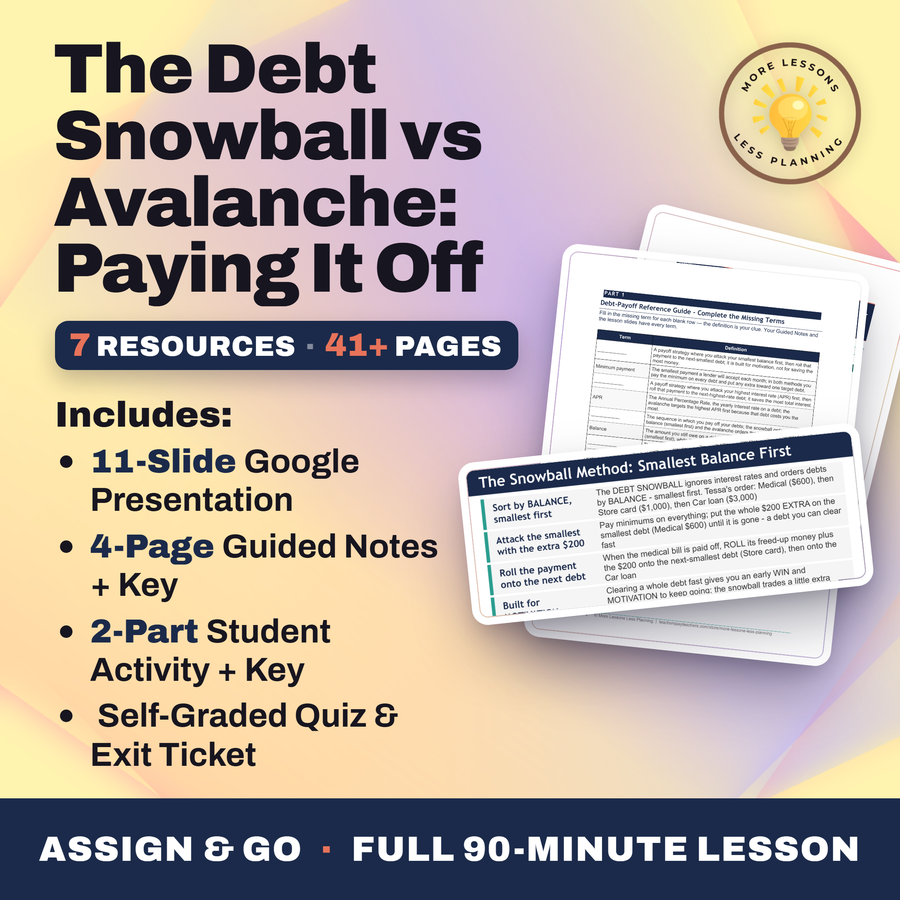
- 11 ready-to-teach files
- Format
- Word (.docx) · PowerPoint (.pptx)
- Slide deck
- Guided notes
- Guided notes teacher key
- Activity + answer key
- Quiz + answer key
- Exit ticket + answer key
- Teacher guide
- Teacher presentation notes
What students do
- List a set of debts and sort them into snowball order and avalanche order
- Calculate monthly interest on a debt using balance times APR divided by 12
- Read a bar chart comparing total interest paid under each payoff method
- Recommend a payoff strategy and justify it using motivation versus math
What it covers
- The debt snowball method, which targets the smallest balance first
- The debt avalanche method, which targets the highest interest rate first
- Why the same debts and the same extra payment can cost different amounts depending on order
- How to weigh motivation against total savings when choosing a method
Learning targets
- Define the debt snowball, the debt avalanche, payoff order, and motivation
- List a set of debts and find the payoff order for the snowball and the avalanche methods
- Read a bar chart that compares the total interest paid by the snowball vs the avalanche
- Compare motivation vs math and choose the method that is right for a given situation
Peek inside
The problem: more than one debt
Most people owe several debts at once - a card, a bill, a loan
You can only put so much EXTRA toward debt each month
Tessa has $200 extra a month and three debts to clear
So which debt do you attack first with that extra $200?
The Problem: More Than One Debt
Most people owe several debts at once, but you can only put so much money toward debt each month.
Tessa has $ extra a month and three debts to clear, so she must decide which debt to attack first.
Two Strategies, Opposite Answers
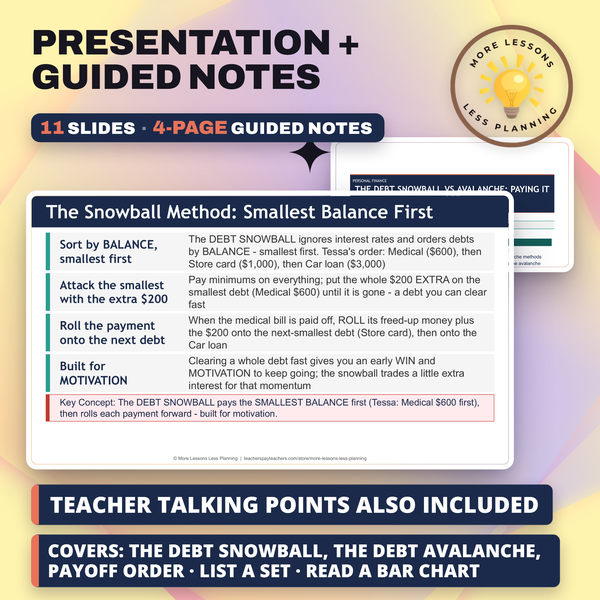
The DEBT attacks the SMALLEST BALANCE first (for motivation).
The DEBT attacks the HIGHEST INTEREST RATE first (for math).
1. Q1. The payoff strategy where you attack your SMALLEST BALANCE first (Tessa's $600 medical bill), then roll that payment to the next-smallest debt, is the .
Why this matters
Put the same three debts and the same $200 a month in front of two people and tell them to pick a payoff order, and you will get two different totals out of money that started out identical. That is the entire disagreement between debt snowball and debt avalanche, and instead of taking a side for them, this lesson makes students calculate both totals and watch the difference appear.
What surprises students most is that the method costing more money is still often the right recommendation, because a borrower who quits after two months following the cheaper math saved nothing at all. I want them holding both the calculated dollar difference and the honest fact that motivation counts as real math too, not a consolation prize for the version that costs more.
From one teacher to another
I like this lesson because it settles an argument instead of just explaining two vocabulary words. Same three debts, same $200 a month, one borrower, two orders, two different totals, and students calculate the gap themselves instead of taking my word for it. The honest answer, that the best method is the one you'll actually finish, tends to surprise them.
Every file in this toolkit
-
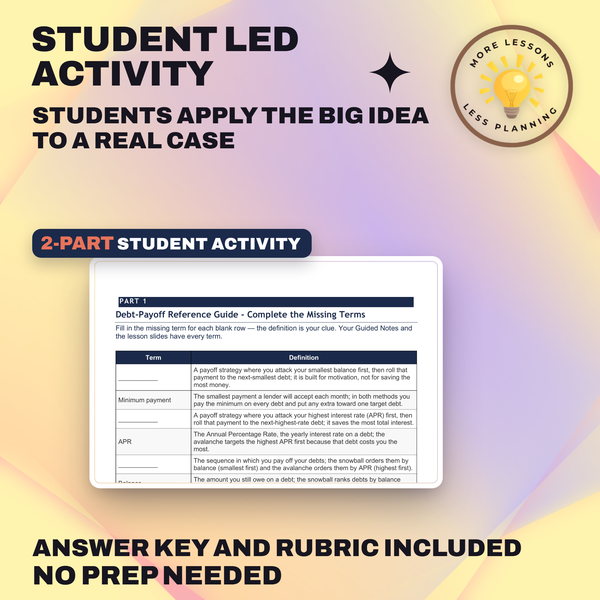
Activity (Student)
Tessa Brooks owes $1,000 on a store card at 26 percent, $600 on a medical bill, and $3,000 on a car loan, and students order her payoff two ways before a bar chart shows how much interest the ordering itself saves.
-
Activity (Answer Key)
The snowball pays Tessa's $600 medical bill first while the avalanche goes straight for her 26% store card, and running both orders against the same $200 extra a month leaves the avalanche about $90 cheaper in total interest, $608 against $698.
-
Exit Ticket (Student)
Naming which balance the snowball goes after first is the opening check, then the avalanche's own pick, before asking why the same $200 a month produces two different totals for Tessa. Debt snowball, debt avalanche, and payoff order drive the response.
-
Exit Ticket (Answer Key)
Crediting the snowball's motivation and the avalanche's $90 savings earns full marks on a four-point rubric scoring Tessa's written answer, which must also use the term payoff order correctly.
-
Guided Notes (Student)
Tessa has $200 extra a month and three debts to tackle, and the page builds both the snowball's smallest-balance-first order and the avalanche's highest-rate-first order side by side.
-
Guided Notes (Teacher Key)
The medical bill at $600 and 8 percent, the store card at $1,000 and 26 percent, and the car loan at $3,000 and 14 percent get sorted two ways, ending on the roughly $90 gap between methods.
-
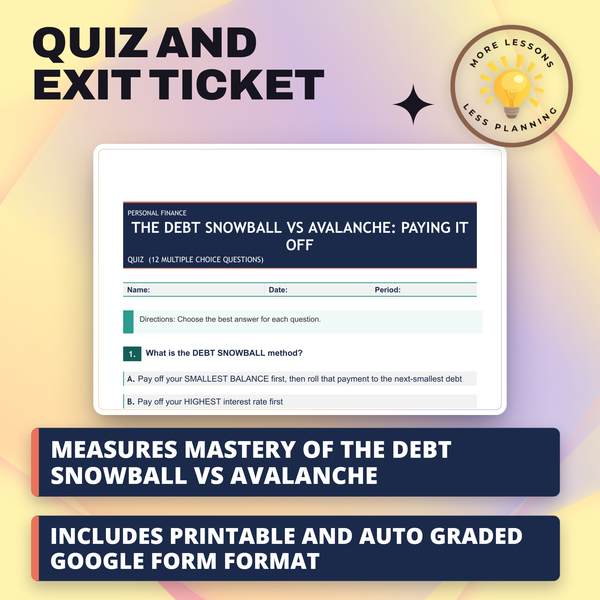
Quiz (Student)
Three debts, a store card, a medical bill, and a car loan, set up questions on the snowball and avalanche payoff orders, the monthly interest on Tessa's 26% store card, and which rule never changes.
-
Quiz (Answer Key)
Medical-first for the snowball and store-card-first for the avalanche come out as the right order, and the $21.67 monthly interest figure on Tessa's store card finishes the page.
-
Slides
Store card debt at 26 percent, medical debt at 8 percent, and a car loan at 14 percent total $1,000, $600, and $3,000 for Tessa, and these slides send her extra $200 a month two ways: smallest balance first for the snowball, highest rate first for the avalanche that pays less interest.
-
Teacher Guide
Three debts at once challenge Tessa Brooks, and paying the highest-APR one first instead of the smallest saves her about $90 in interest, the gap this 60-point guide's extensions chase with a personal three-debt list, a moved APR to find the tipping point, and a payoff decision guide.
-
Teacher Presentation Notes
A $1,000 store card at 26%, a $600 medical bill at 8%, and a $3,000 car loan at 14% make up the three debts Tessa Brooks juggles. Sorting them smallest balance first or highest rate first lands on a $698-versus-$608 interest gap.
Download
Where should I send the next one?
Everything here is free and it stays that way. Leave your email and I'll send you the new lessons as they go up. You can unsubscribe from any one of them.
Related resources
Cosigning and Co-Borrowing - Sharing the Risk
Interest Explained - Simple vs Compound
Loan Default - What Happens When You Can't Pay
Payday Loans - The 400 Percent APR Trap
Student Loans and Financial Aid
What Is a Loan? Principal, Interest & Terms
Every lesson on this site is free to download and use. If one of them saved you a prep period, you can chip in a few bucks toward my three kids' daycare fund. That's genuinely where tips go.