Interest Explained - Simple vs Compound
Quality reviewed September 2026
- Grades
- Grades 9-12
- Time
- About two 50-minute class periods
- Includes
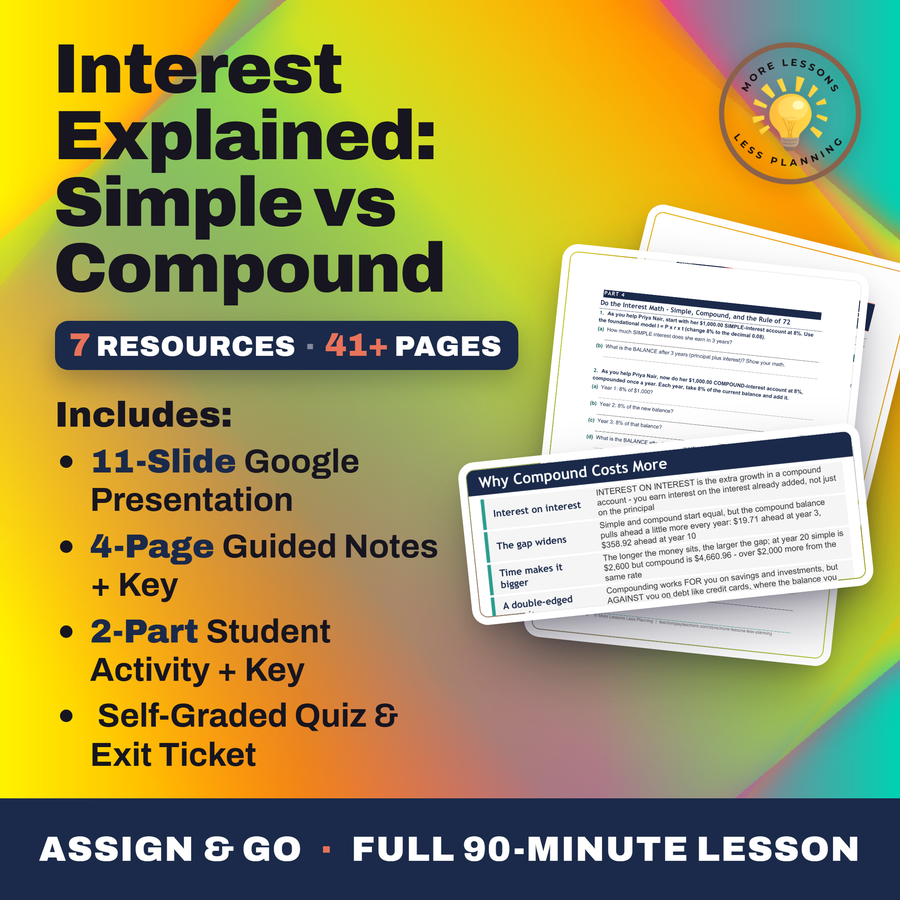
- 11 ready-to-teach files
- Format
- Word (.docx) · PowerPoint (.pptx)
- Slide deck
- Guided notes
- Guided notes teacher key
- Activity + answer key
- Quiz + answer key
- Exit ticket + answer key
- Teacher guide
- Teacher presentation notes
What students do
- Calculate simple interest using I equals P times r times t on a real deposit
- Calculate compound interest year by year, watching the yearly interest amount grow each time
- Read a growth chart comparing simple and compound interest on $1,000 at 8% over 20 years
- Use the Rule of 72 to estimate how long money takes to double at a given rate
What it covers
- Why two accounts at the identical 8% rate land at $2,600 versus $4,660.96 after 20 years
- The year-by-year mechanics of compound interest, where the yearly amount added keeps growing
- Compound interest as a double-edged sword, working for you in savings and against you on credit card debt
- The Rule of 72 as a shortcut for estimating how many years it takes money to double
Learning targets
- Define simple interest and compound interest and explain the difference between them
- Calculate simple interest on a loan or deposit using I = P x r x t
- Calculate compound interest using A = P(1 + r/n)^(nt) and reason through it year by year
- Explain why compound interest grows faster than simple interest, why that hurts you on debt but helps you on savings, and use the Rule of 72 to estimate how long money takes to double
Peek inside
✔
Interest is the price of using money
INTEREST is what you pay to borrow money, or what you earn for lending or saving it - the price of using someone's money for a while
✔
It always starts with the PRINCIPAL
Interest Is the Price of Using Money
INTEREST is what you pay to borrow money, or what you earn for lending or saving it - the price of using someone's .
The PRINCIPAL is the original amount you borrow or deposit, before any interest is added - for Priya, the $1,000 she puts in each .
Rate and the Two Ways to Figure It
The INTEREST RATE is the percent charged or earned per year; in the formulas you write it as a decimal, so 8% becomes .
The same rate can be figured two ways - SIMPLE interest (on the principal only) or COMPOUND interest (on the principal plus past ).
1. Interest figured only on the starting amount you deposit, so the same dollars are added every period, is called .
Why this matters
Two accounts can share the exact same $1,000 deposit and the exact same 8 percent rate and still land at two very different totals after 20 years, $2,600 against $4,660.96. Interest sounds like one idea until students see it split into two completely different outcomes from identical numbers.
What I want them to carry out of this one is the double-edged-sword framing turned toward their own future: the same compounding that grows a savings account quietly works against an unpaid credit card balance, so meeting that idea on paper now beats discovering it on a real statement later. The Rule of 72 gives them a shortcut they can use outside class, which is rare enough for a formula that it is worth slowing down for.
From one teacher to another
The puzzle that opens this lesson is two accounts, same $1,000, same 8 percent rate, and after 20 years one holds $2,600 and the other holds $4,660.96. Same rate, different result, and figuring out why is the whole lesson. Students calculate both accounts by hand year by year, and the moment that actually clicks is year one, when the simple and compound balances are exactly identical at $1,080, because there's no past interest yet for the compound account to earn interest on. From there the compound account starts pulling ahead a little more every year, and I make them name that growing gap as interest on interest before we ever touch the exponent formula. The part I care about most is the double-edged-sword framing: the same math that grows a savings account works against you on an unpaid credit card balance, and I want that connection made explicit before students ever carry a real balance of their own.
Every file in this toolkit
-
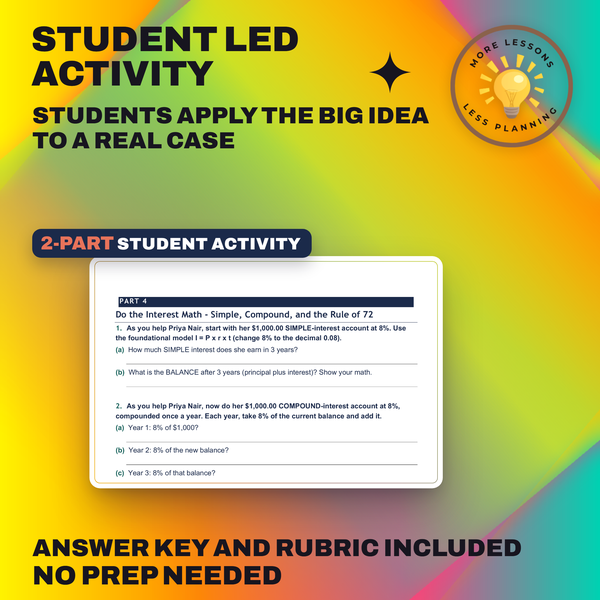
Activity (Student)
Priya Nair's $1,000 sits in two accounts at 8 percent, one earning simple interest and one compound, and the gap between the straight and curving lines on the chart sets up a second round of math on $2,000 at 6 percent.
-
Activity (Answer Key)
$1,000 in Priya's account earns exactly $19.71 more under compound interest than simple after three years, a gap that widens to about $2,060.96 by year 20 once the chart's simple line reaches $2,600 against the compound line's $4,660.96.
-
Exit Ticket (Student)
The quiz begins by telling simple interest apart from compound, then a formula item and a question probe why the same $1,000 at 8 percent grows differently depending on the method used. Principal, compound interest, and interest on interest turn up in the response.
-
Exit Ticket (Answer Key)
Defining simple interest as principal-only and compound interest as principal plus interest already earned scores points here, together with the reasoning that interest on interest is why the same $1,000 at 8 percent grows larger under compound than simple.
-
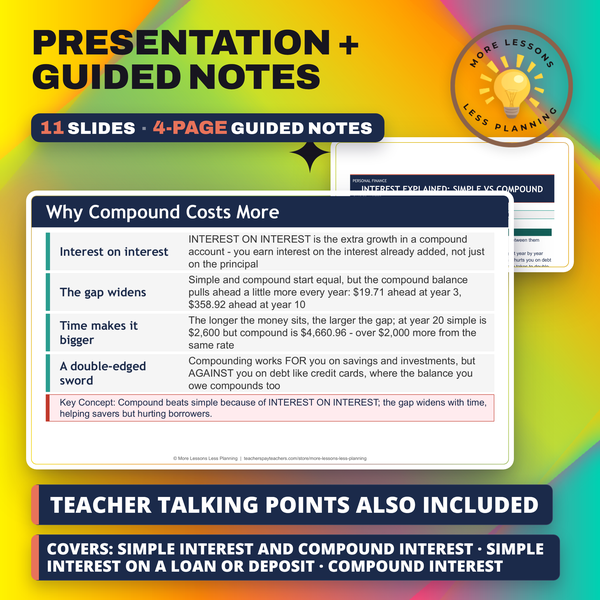
Guided Notes (Student)
Priya puts $1,000 into two accounts paying 8 percent, and her simple side's flat $80 a year gets tracked against her compound side's growing interest until it pulls ahead by year three.
-
Guided Notes (Teacher Key)
$93.31 is the compound interest Priya earns in year three, proof her account grows on a bigger balance each time while her simple side keeps adding a flat $80 no matter how many years pass.
-
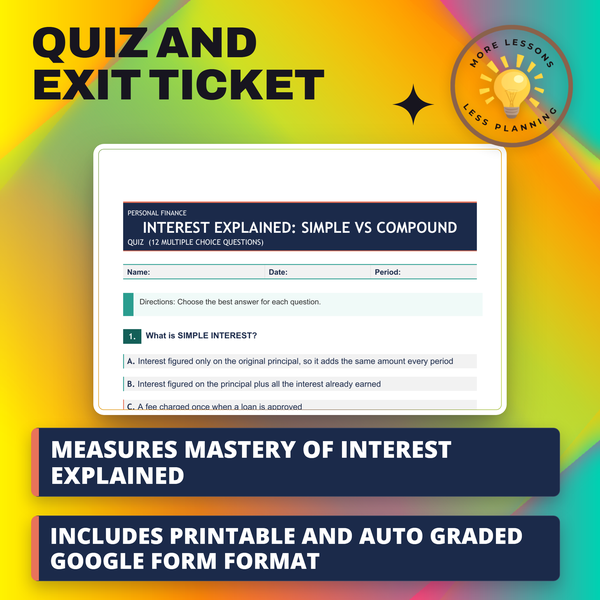
Quiz (Student)
An identical $1,080 shows up in Priya's simple and compound accounts after year one before diverging toward $2,600 versus $4,660.96 by year 20, and the questions trace exactly why that gap opens up.
-
Quiz (Answer Key)
Why Priya's two accounts tie at $1,080 in year one is confirmed correct, and the Rule of 72 pins her 8% money doubling near year nine, closing out the whole twelve-item answer set.
-
Slides
$1,000 grows two different ways across this deck, a straight line under simple interest and a curve under compound, pulling more than $2,000 ahead of it by year 20 on the identical 8 percent rate.
-
Teacher Guide
Two $1,000 accounts, both Priya Nair's and both earning 8%, show compound interest pulling $19.71 ahead of simple by year three, the gap this 56-point guide highlights. Extensions compare a saver who starts at 20 against one who starts at 30 and sort products as simple or compound.
-
Teacher Presentation Notes
At 6% for four years, $2,000 in compound interest earns $44.95 more than the same money at simple interest, the gap separating I = P x r x t from A = P(1 + r/n)^(nt) before the Rule of 72 gets a preview.
Download
Where should I send the next one?
Everything here is free and it stays that way. Leave your email and I'll send you the new lessons as they go up. You can unsubscribe from any one of them.
Related resources
Cosigning and Co-Borrowing - Sharing the Risk
Loan Default - What Happens When You Can't Pay
Payday Loans - The 400 Percent APR Trap
Student Loans and Financial Aid
The Debt Snowball vs Avalanche - Paying It Off
What Is a Loan? Principal, Interest & Terms
Every lesson on this site is free to download and use. If one of them saved you a prep period, you can chip in a few bucks toward my three kids' daycare fund. That's genuinely where tips go.