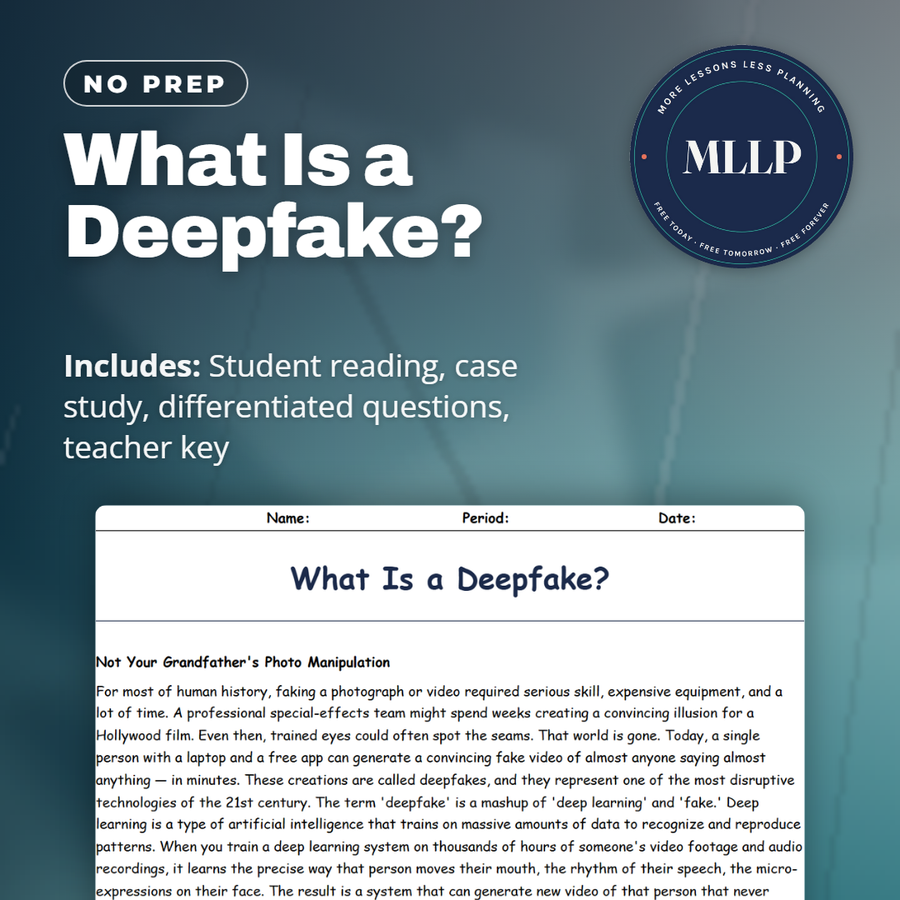
What Is a Deepfake?
Quality reviewed September 2026
Facts verified September 20, 2026
- Subject
- Career & Life Skills
- Grades
- Grades 9-12
- Length
- 9-page student worksheet
- Time
- About one 50-minute class period
- Great for
- Sub plans and independent work
- Includes
- Reading passage, comprehension questions + full answer key
- Format
- Print-and-go PDF
What students do
- Marcus spots lip-sync and blinking errors in a fake video announcing canceled tests at his school
- The harm spectrum sorts deepfake uses from museum exhibits to political disinformation
- Explain how a generator and a discriminator compete inside a Generative Adversarial Network
- Write short answers on the liar's dividend and why real evidence starts getting dismissed as fake
What it covers
- How GANs work, with a generator and discriminator competing to produce convincing fakes
- The harm spectrum from de-aged film actors to non-consensual imagery to political disinformation
- The liar's dividend, where deepfake awareness lets people dismiss real evidence as fabricated
Start reading this worksheet
Not Your Grandfather's Photo Manipulation
For most of human history, faking a photograph or video required serious skill, expensive equipment, and a lot of time. A professional special-effects team might spend weeks creating a convincing illusion for a Hollywood film. Even then, trained eyes could often spot the seams. That world is gone. Today, a single person with a laptop and a free app can generate a convincing fake video of almost anyone saying almost anything, in minutes. These creations are called deepfakes, and they represent one of the most disruptive technologies of the 21st century. The term 'deepfake' is a mashup of 'deep learning' and 'fake.' Deep learning is a type of artificial intelligence that trains on massive amounts of data to recognize and reproduce patterns. When you train a deep learning system on thousands of hours of someone's video footage and audio recordings, it learns the precise way that person moves their mouth, the rhythm of their speech, the micro-expressions on their face. The result is a system that can generate new video of that person that never actually happened, but looks and sounds disturbingly real.
How the Technology Actually Works
At the heart of most deepfake systems is a technology called a Generative Adversarial Network, or GAN. A GAN pits two neural networks against each other in an endless competition. One network, called the generator, tries to create fake images or video. The other, called the discriminator, tries to detect which images are fake. Each time the discriminator catches the generator in a lie, the generator gets better at lying. Over thousands of iterations, the generator becomes extraordinarily skilled at producing realistic fakes. Face-swapping deepfakes work by first mapping the facial geometry of a target person: every point of the face, how it moves, how light falls across different angles. The system then renders the target's face onto the body and movements of a different person in source footage. Early versions required hundreds of photos of the target to train effectively, which is why early deepfakes mostly featured celebrities and politicians who had extensive photographic archives. Modern techniques require far less data, sometimes as few as a dozen images, making the technology accessible to nearly anyone. Audio deepfakes, sometimes called voice clones, use a similar but parallel process. Given a sample of someone's voice (often only minutes of recording), AI systems can now generate new speech in that person's voice saying anything at all. These voice clones power many phone scams and are also used to create convincing video deepfakes where the audio and visual elements are both fabricated.
The Spectrum: From Harmless to Dangerous
Not all deepfakes are created equal in terms of harm. At the benign end of the spectrum, deepfake technology powers popular entertainment and educational experiences. Museums use it to 'resurrect' historical figures for interactive exhibits. Filmmakers use it to de-age actors or convincingly recreate deceased performers. Language dubbing companies use it to match lip movements to translated audio in foreign films. Mobile apps let users swap their faces into famous movie scenes for laughs. These applications raise some ethical questions, but they're generally considered low-harm uses of the technology. Moving up the spectrum, deepfakes become tools of harassment and reputation damage. Non-consensual intimate imagery (fake explicit content created using someone's likeness) is one of the most widespread and psychologically devastating uses of deepfake technology. Victims are often private individuals, not celebrities. The emotional harm can be severe and lasting. Many states have passed laws specifically criminalizing this type of content, though enforcement remains difficult when creators hide behind anonymity or operate from other countries. At the most dangerous end of the spectrum sit politically motivated deepfakes designed to spread disinformation. A fake video of a political leader declaring war, announcing a policy reversal, or committing a crime could trigger real-world consequences (panic, violence, market crashes) before anyone has time to verify its authenticity. Security researchers and election officials consider this category of deepfake one of the most serious emerging threats to democratic institutions.
Like what you read? The full reading, the case study, and every question set are in the free download below, along with the answer key.
Why this matters
Every student in this class has already seen a video they weren't sure was real, and Marcus's story is deliberately ordinary, a school rumor rather than a national news event, because that is the scale at which most students will actually encounter a deepfake first. The liar's dividend section matters just as much as the detection tells, since the reading is honest that the bigger long-term danger may be losing the ability to trust anything real, including evidence that genuinely matters, rather than simply being fooled by a fake once.
From one teacher to another
A viral video of Marcus's own principal canceling standardized tests is the hook for this reading, and it works because Marcus catches the fake using exactly the tells the reading teaches: mismatched lip sync, an unnatural smoothness, barely any blinking. From there the reading explains the technology underneath, a Generative Adversarial Network where a generator and a discriminator compete until the fakes become convincing. It maps a full harm spectrum, from museum exhibits that resurrect historical figures to non-consensual imagery to politically motivated disinformation, and closes on the liar's dividend, the way deepfake awareness now lets people dismiss genuine evidence as fabricated. Marcus's warning gets ignored by classmates before the school issues an official denial three hours later.
What you get
Download
Where should I send the next one?
Everything here is free and it stays that way. Leave your email and I'll send you the new lessons as they go up. You can unsubscribe from any one of them.
Related resources
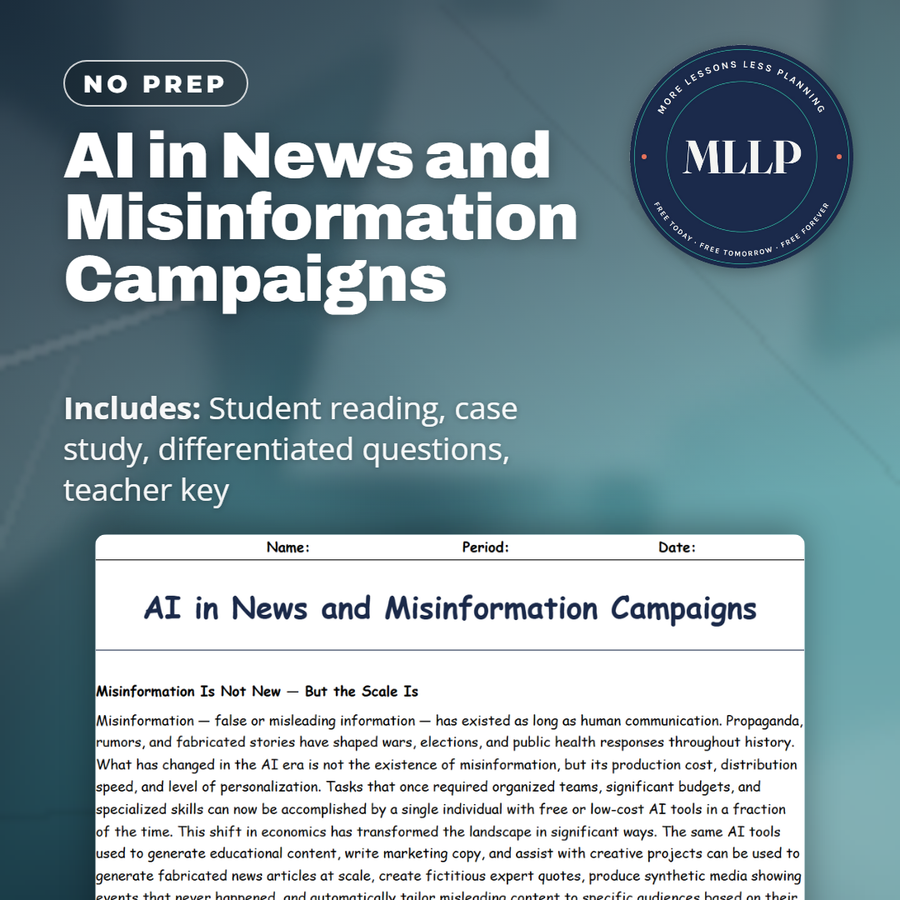
AI in News and Misinformation Campaigns
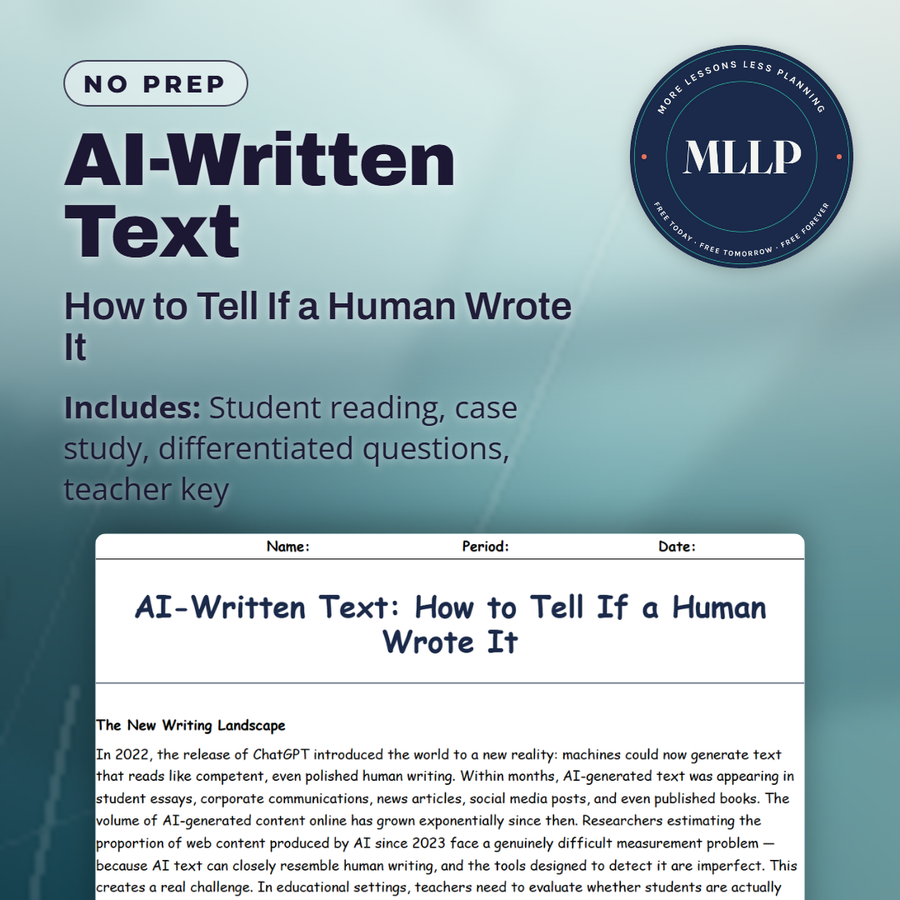
AI-Written Text: How to Tell If a Human Wrote It

Building a Personal Verify Before You Share Habit
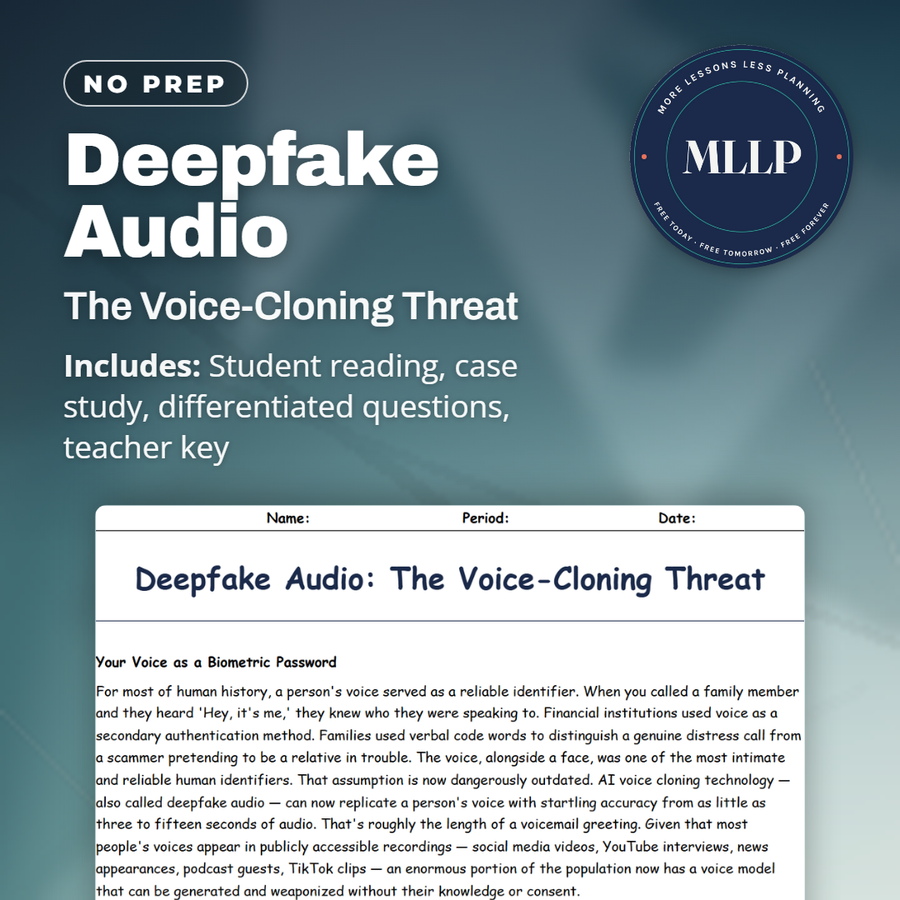
Deepfake Audio: The Voice-Cloning Threat

Lateral Reading: Verifying What You See Online

Reverse Image Search and Other Detection Tools
Every lesson on this site is free to download and use. If one of them saved you a prep period, you can chip in a few bucks toward my three kids' daycare fund. That's genuinely where tips go.