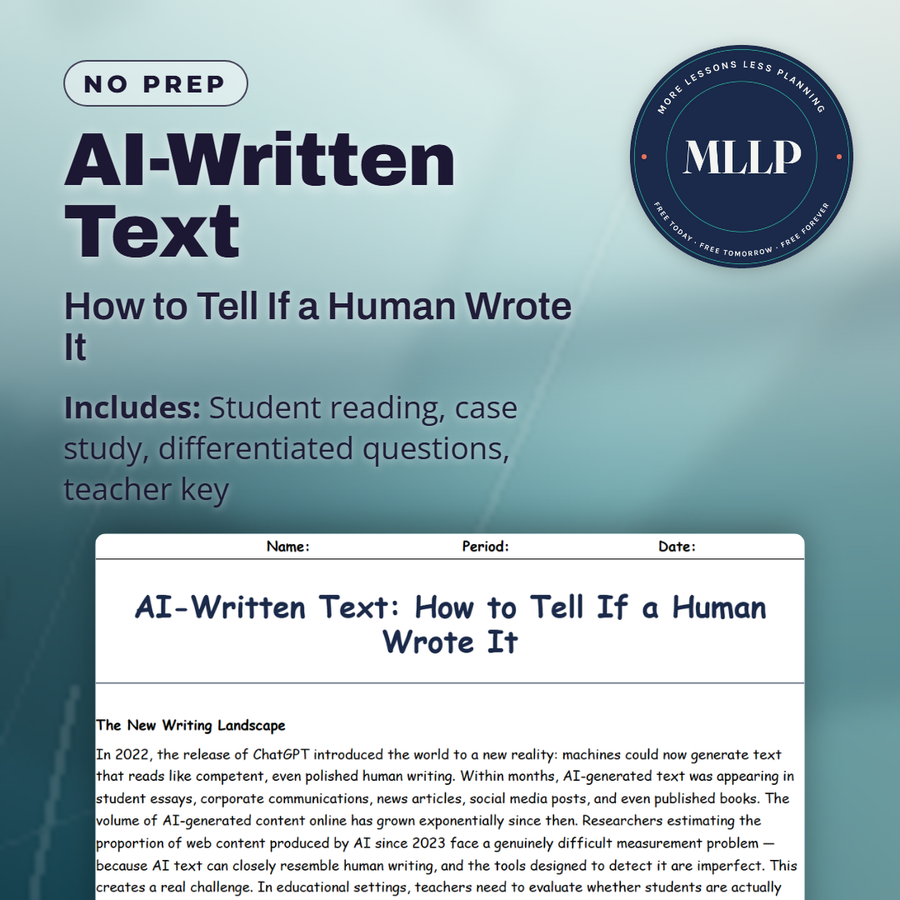
AI-Written Text: How to Tell If a Human Wrote It
Quality reviewed September 2026
Facts verified September 20, 2026
- Subject
- Career & Life Skills
- Grades
- Grades 9-12
- Length
- 9-page student worksheet
- Time
- About one 50-minute class period
- Great for
- Sub plans and independent work
- Includes
- Reading passage, comprehension questions + full answer key
- Format
- Print-and-go PDF
What students do
- Five terms, from hedging language to voice, get matched against their definitions
- Three fill-in-the-blank sentences use the reading's own language about list brain and specificity
- Answer three multiple choice questions about hedging language, false positives, and reading for voice
- Explain at least three tells in Devon's essay that suggest it may be AI-generated
What it covers
- All six passages on the tells of AI writing and the limits of detection tools
- The key info table listing eight patterns that flag AI-generated text
- Ms. Reyes and Devon's case study and its two model-answer short response questions
Start reading this worksheet
The New Writing Landscape
In 2022, the release of ChatGPT introduced the world to a new reality: machines could now generate text that reads like competent, even polished human writing. Within months, AI-generated text was appearing in student essays, corporate communications, news articles, social media posts, and even published books. The volume of AI-generated content online has grown exponentially since then. Researchers estimating the proportion of web content produced by AI since 2023 face a genuinely difficult measurement problem, because AI text can closely resemble human writing, and the tools designed to detect it are imperfect. This creates a real challenge. In educational settings, teachers need to evaluate whether students are actually learning to write or outsourcing their thinking. In journalism and research, readers need to evaluate whether content was genuinely investigated or automatically generated. In personal communications (dating apps, customer service interactions, social media), people need to understand whether they're reading a human perspective or a machine output. Developing the ability to recognize the signs of AI-generated text is a practical literacy skill for the current moment.
What AI Writing Does Well
To spot AI writing, you first need to understand what it does well, because its strengths are as telling as its weaknesses. Large language models like GPT-4, Claude, and Gemini are trained on enormous corpora of human text. They have internalized the patterns of well-structured writing: topic sentences, supporting evidence, transitional phrases, concluding summaries. The result is text that is almost always grammatically correct, logically organized, and tonally consistent. It rarely makes the kinds of errors that human writers make: run-on sentences, sudden tonal shifts, forgetting to close a point, going off on personal tangents. AI writing is also comprehensively neutral in a distinctive way. It tends to present multiple perspectives on any moderately controversial topic, hedge its claims with qualifications, and avoid taking strong personal positions. This isn't because AI models are philosophically balanced; it's because they were trained to avoid generating content that could be criticized as one-sided. The result is writing that is often described as 'safe,' 'corporate,' or 'textbook' in tone: technically adequate but lacking the committed voice that characterizes the best human writing.
The Specific Tells of AI Text
Several linguistic patterns are strongly associated with AI-generated text. First, watch for what researchers call 'hedging language' used in excess: phrases like 'it is important to note,' 'it's worth considering,' 'while there are many perspectives,' and 'ultimately' appear at rates in AI text that far exceed their frequency in typical human writing. AI models use these phrases as structural scaffolding (they signal transitions and qualifications), but a single essay that uses 'it is important to note' three times and 'ultimately' twice in the conclusion is exhibiting a statistical signature of AI generation. Second, look for the 'balanced perspective' trap. Human writers on topics they care about tend to have opinions. They may acknowledge counterarguments, but their prose usually reflects a genuine point of view. AI writing, by contrast, often presents 'on one hand... on the other hand' structures with perfect symmetry, followed by a conclusion that essentially amounts to 'both perspectives have merit.' This isn't how opinionated humans write. If an essay on a topic you know the writer cares about feels strangely balanced and noncommittal, that's a yellow flag. Third, look for transitions that are logically correct but feel mechanical: 'Furthermore,' 'Additionally,' 'Moreover,' and 'It is crucial to understand that' are all more common in AI text than in natural human prose. Human writers vary their transitions more and often use syntactic structure rather than explicit transition words to connect ideas.
Like what you read? The full reading, the case study, and every question set are in the free download below, along with the answer key.
Why this matters
Every student in this reading is going to submit writing, read writing, and eventually hire or manage people based on writing, and being able to tell a genuinely considered sentence from a confidently vague one is a skill that outlasts any single detection tool a company rolls out next year. Devon's essay is a useful gut-check because nothing about it was technically wrong, which is exactly the point: the absence of a real name, a real place, a real specific memory is a far more reliable signal than a grammar error ever was. Learning to read for voice and specificity protects students both ways, from being fooled by AI-written content and from being falsely accused when their own honest writing gets flagged by an imperfect algorithm.
From one teacher to another
Devon's personal essay had perfect grammar, careful structure, and not a single specific detail: no name, no place, no real moment his teacher could picture, just a tidy conclusion that "both the difficulty and the growth were equally valuable." This reading teaches students the specific tells of AI-generated writing: excessive hedging language like "it is important to note," suspiciously balanced on-one-hand arguments, mechanical transitions, and what researchers call "confident vagueness," authoritative sentences that say nothing specific at all. It also covers where detection tools like Turnitin and GPTZero fall short, including documented false positives against non-native English speakers and students with certain learning differences. The reading closes on the most reliable human test of all: does this piece of writing feel like it was written by someone who actually cares?
What you get
Download
Where should I send the next one?
Everything here is free and it stays that way. Leave your email and I'll send you the new lessons as they go up. You can unsubscribe from any one of them.
Related resources
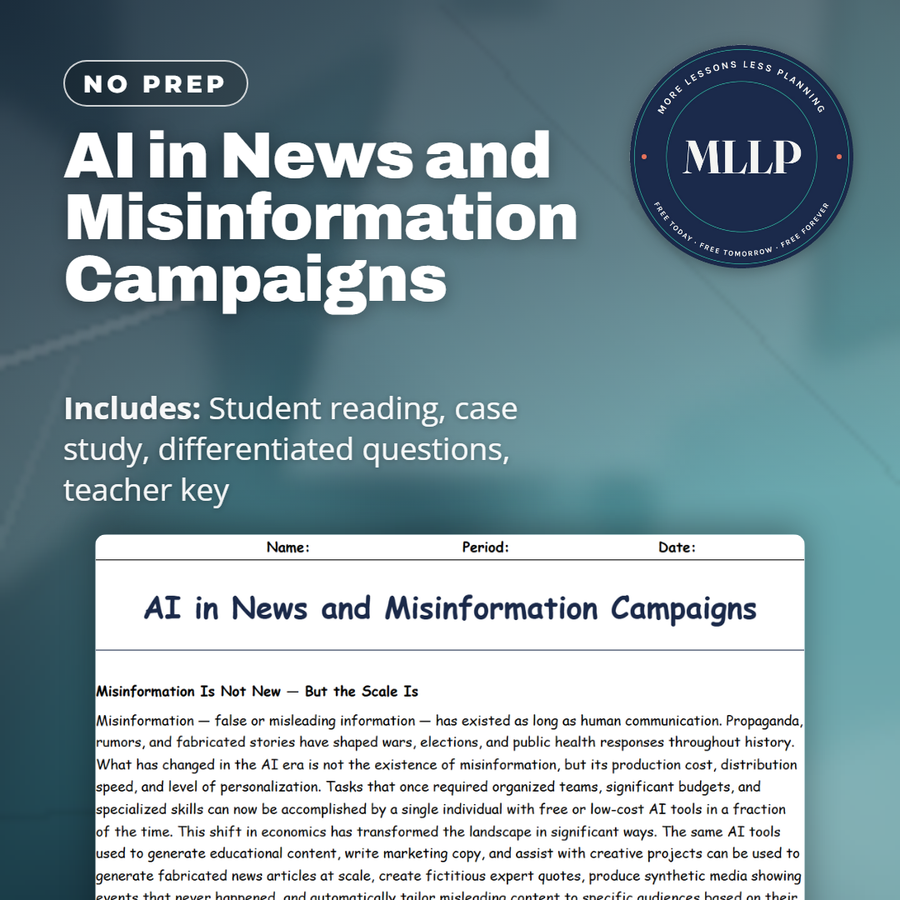
AI in News and Misinformation Campaigns
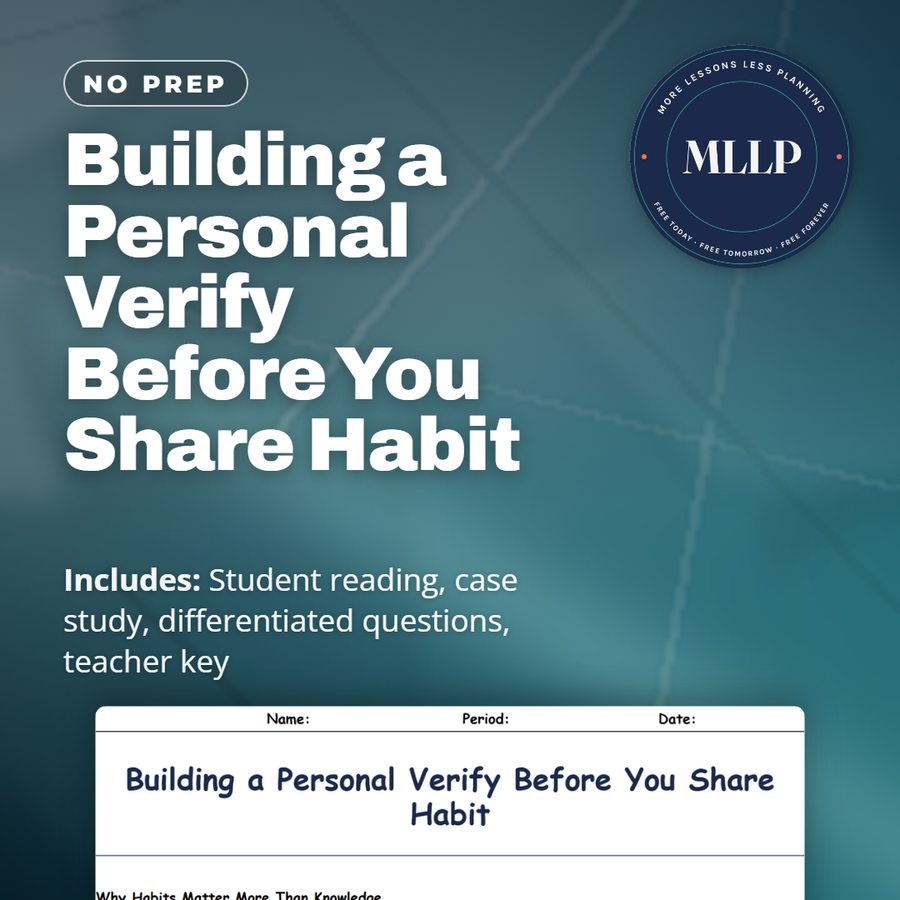
Building a Personal Verify Before You Share Habit
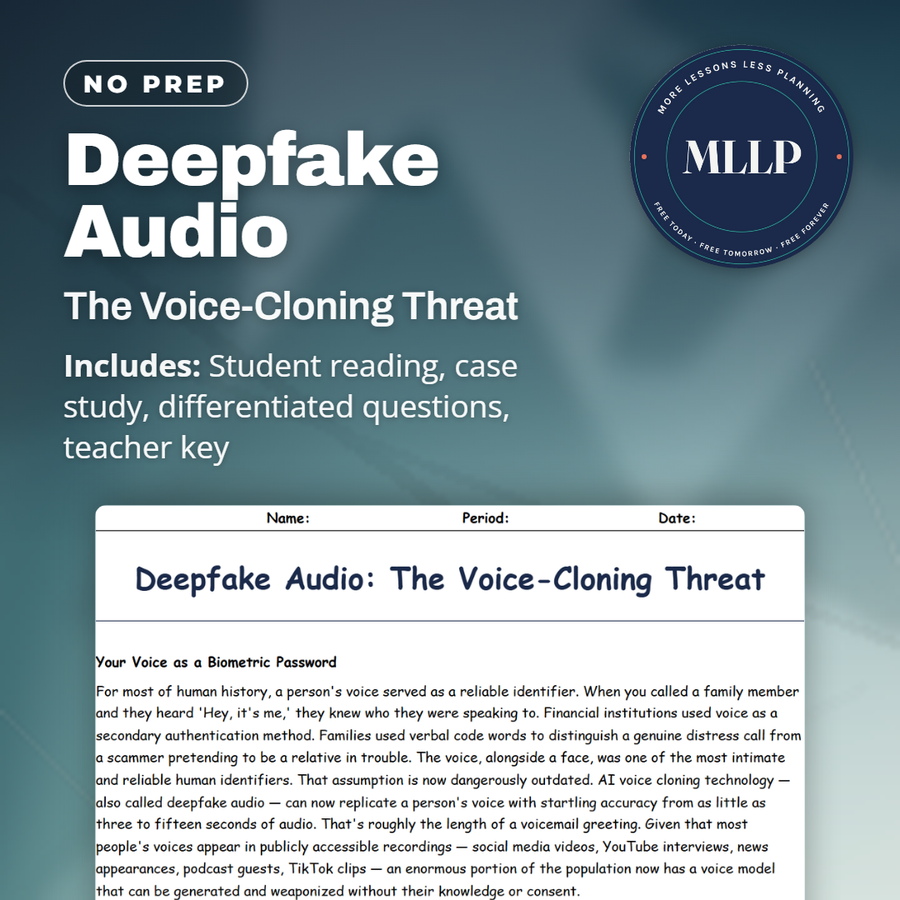
Deepfake Audio: The Voice-Cloning Threat
Lateral Reading: Verifying What You See Online
Reverse Image Search and Other Detection Tools
Spotting AI-Generated Images: 7 Telltale Signs
Every lesson on this site is free to download and use. If one of them saved you a prep period, you can chip in a few bucks toward my three kids' daycare fund. That's genuinely where tips go.