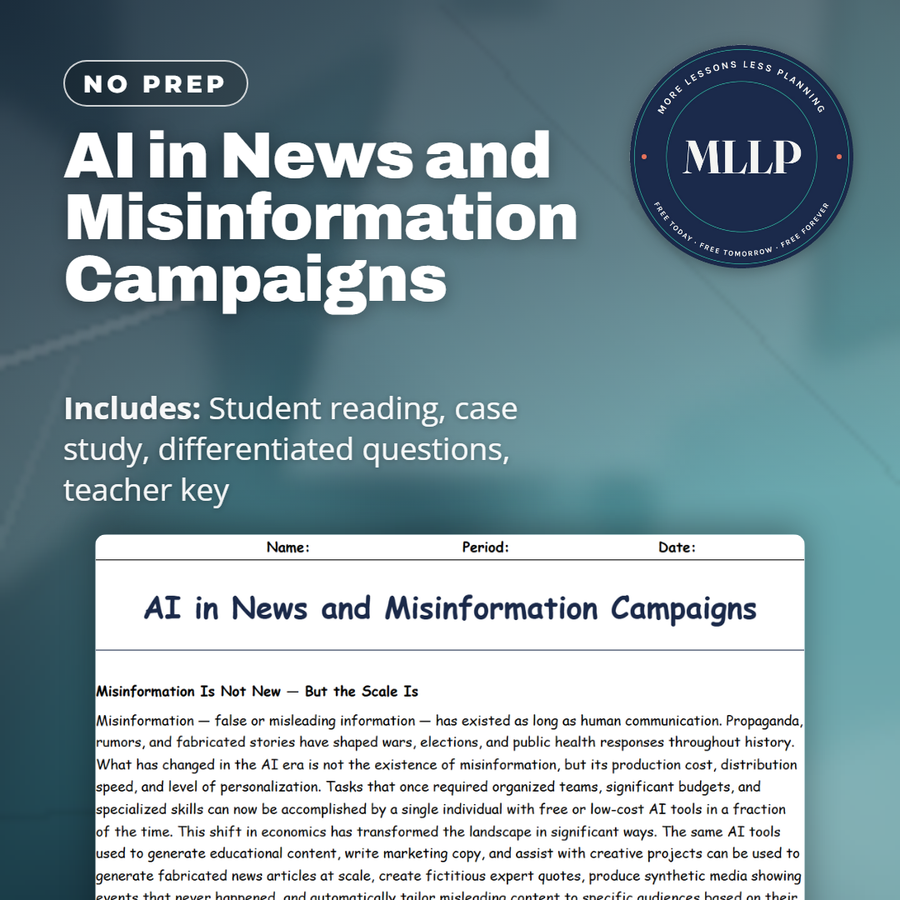
AI in News and Misinformation Campaigns
Quality reviewed September 2026
Facts verified September 20, 2026
- Subject
- Career & Life Skills
- Grades
- Grades 9-12
- Length
- 9-page student worksheet
- Time
- About one 50-minute class period
- Great for
- Sub plans and independent work
- Includes
- Reading passage, comprehension questions + full answer key
- Format
- Print-and-go PDF
What students do
- Five terms, from content farm to byline, get matched against their definitions
- Three fill-in-the-blank sentences use the reading's own language about pink slime and lateral reading
- Answer three multiple choice questions about synthetic experts, lateral reading, and micro-targeted disinformation
- Explain which two misinformation techniques the Riverside County Gazette used, and what evidence proves it
What it covers
- All six passages on content farms, synthetic experts, and pink slime local news
- The key info table defining eight AI-era misinformation techniques side by side
- The Riverside County Gazette case study and its two model-answer short response questions
Start reading this worksheet
Misinformation Is Not New, But the Scale Is
Misinformation (false or misleading information) has existed as long as human communication. Propaganda, rumors, and fabricated stories have shaped wars, elections, and public health responses throughout history. What has changed in the AI era is not the existence of misinformation, but its production cost, distribution speed, and level of personalization. Tasks that once required organized teams, significant budgets, and specialized skills can now be accomplished by a single individual with free or low-cost AI tools in a fraction of the time. This shift in economics has transformed the landscape in significant ways. The same AI tools used to generate educational content, write marketing copy, and assist with creative projects can be used to generate fabricated news articles at scale, create fictitious expert quotes, produce synthetic media showing events that never happened, and automatically tailor misleading content to specific audiences based on their known beliefs and concerns. Understanding how AI is integrated into modern misinformation campaigns is essential for anyone who consumes news and information, which, in practice, means everyone.
Automated Content Farms
One of the most impactful applications of AI in misinformation is the automated content farm: websites that use AI to generate large volumes of news-like content, typically with the goal of generating advertising revenue, manipulating search results, or serving political agendas. These sites use AI writing tools to produce dozens or hundreds of articles per day on trending topics, with minimal human oversight. The content is not necessarily entirely false; much of it mixes genuine information with selective framing, exaggeration, or fabricated details that are difficult to fact-check without dedicated research time. Researchers at NewsGuard, a media credibility organization, have tracked the proliferation of AI-enabled content farms and documented that many of these sites achieve significant search visibility and social media engagement despite being largely or entirely AI-generated. The volume-based strategy is effective: by flooding search results with content that appears news-like, these sites crowd out legitimate reporting and expose more readers to misleading framing, even when the individual claims are technically defensible.
Synthetic Experts and Fabricated Quotes
A specific and dangerous technique in AI-assisted misinformation is the creation of synthetic expert sources. This involves generating fake biographical profiles of experts (complete with academic credentials, institutional affiliations, publication lists, and profile photos created by AI image generators) and then attributing fabricated quotes to these nonexistent people. The quotes are then used in fabricated articles, social media posts, and even presentations. This technique exploits the human tendency to trust information attributed to credentialed experts. A false claim attributed to 'a concerned citizen' triggers more skepticism than the same false claim attributed to 'Dr. Sarah Chen, Associate Professor of Epidemiology at Stanford Medical School.' Creating Dr. Chen (her photograph, her CV, her institutional webpage) used to require sophisticated infrastructure. Today, it requires about fifteen minutes and free tools. Fact-checkers have identified multiple cases where synthetic expert profiles were used in vaccine misinformation, financial fraud schemes, and political astroturfing campaigns.
Like what you read? The full reading, the case study, and every question set are in the free download below, along with the answer key.
Why this matters
The fake news site in this reading is not an exaggerated example, it describes exactly the kind of site now showing up in real local elections, complete with a masthead logo and a quote from a professor who was invented in fifteen minutes with free tools. Students who can spot a synthetic expert, recognize a content farm's flood-the-search-results strategy, or apply lateral reading before sharing a claim are protecting themselves and their families from manipulation that is only getting cheaper to produce. This matters most exactly where the reading says it matters most, in local communities that have lost their real newspapers and have nothing left to compare a fake one against.
From one teacher to another
Keisha found an article accusing a city council candidate of financial misconduct, quoting a professor whose university profile, physical address, and even his own face turned out not to exist. This reading covers how AI has changed the economics of misinformation: automated content farms that publish dozens of articles a day, synthetic experts with fabricated credentials and AI-generated headshots, and micro-targeted disinformation that shows two people in the same city two completely different false claims. A passage on "pink slime" news sites explains why fake local outlets are especially effective right now, filling a real void left by the decline of genuine local journalism. The reading ends with a practical checklist and the technique researchers call lateral reading: checking what other sources say about a claim instead of reading deeper into the suspicious one.
What you get
Download
Where should I send the next one?
Everything here is free and it stays that way. Leave your email and I'll send you the new lessons as they go up. You can unsubscribe from any one of them.
Related resources
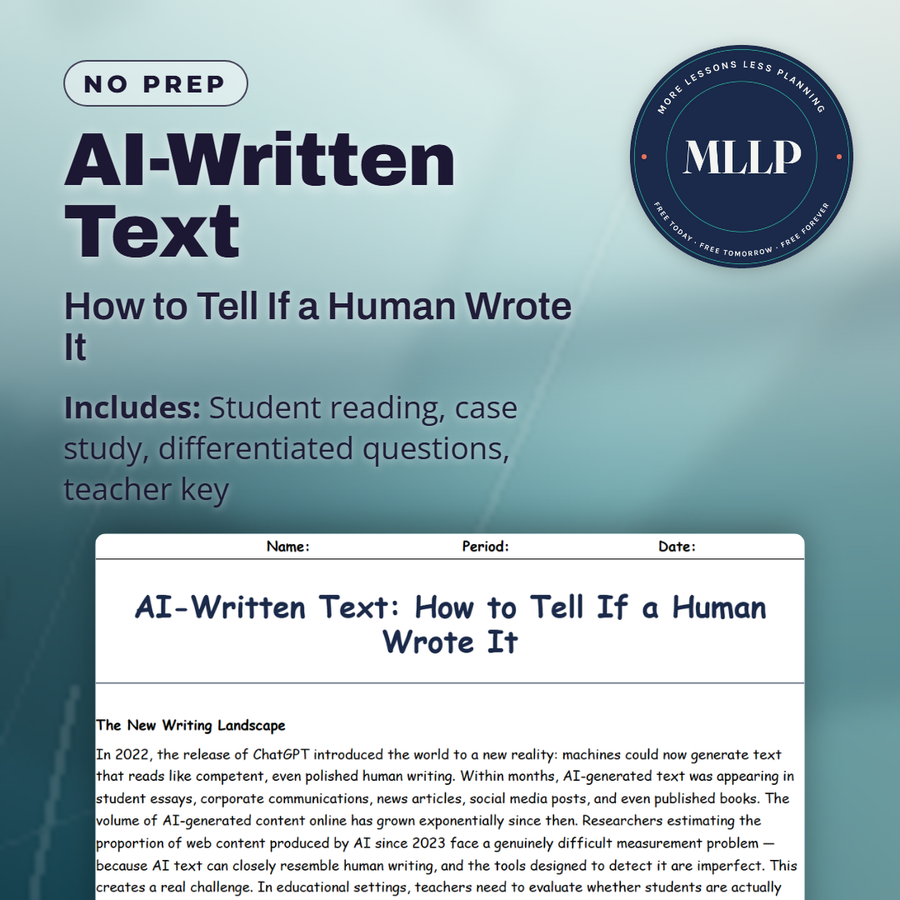
AI-Written Text: How to Tell If a Human Wrote It

Building a Personal Verify Before You Share Habit
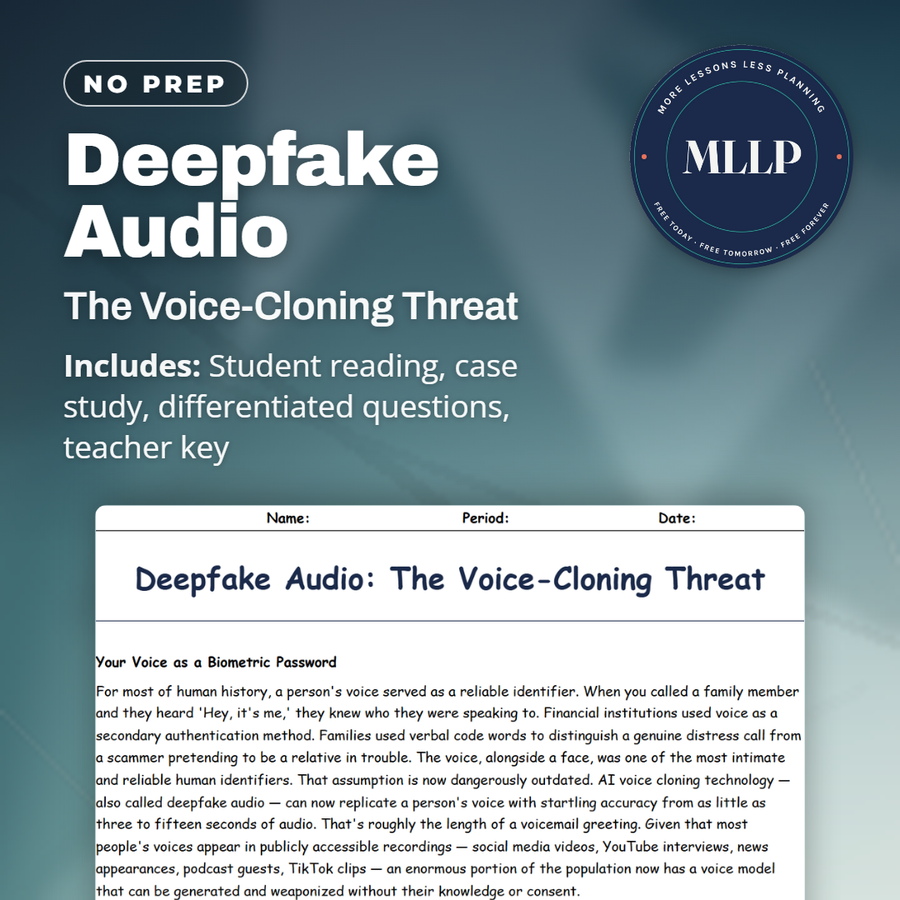
Deepfake Audio: The Voice-Cloning Threat
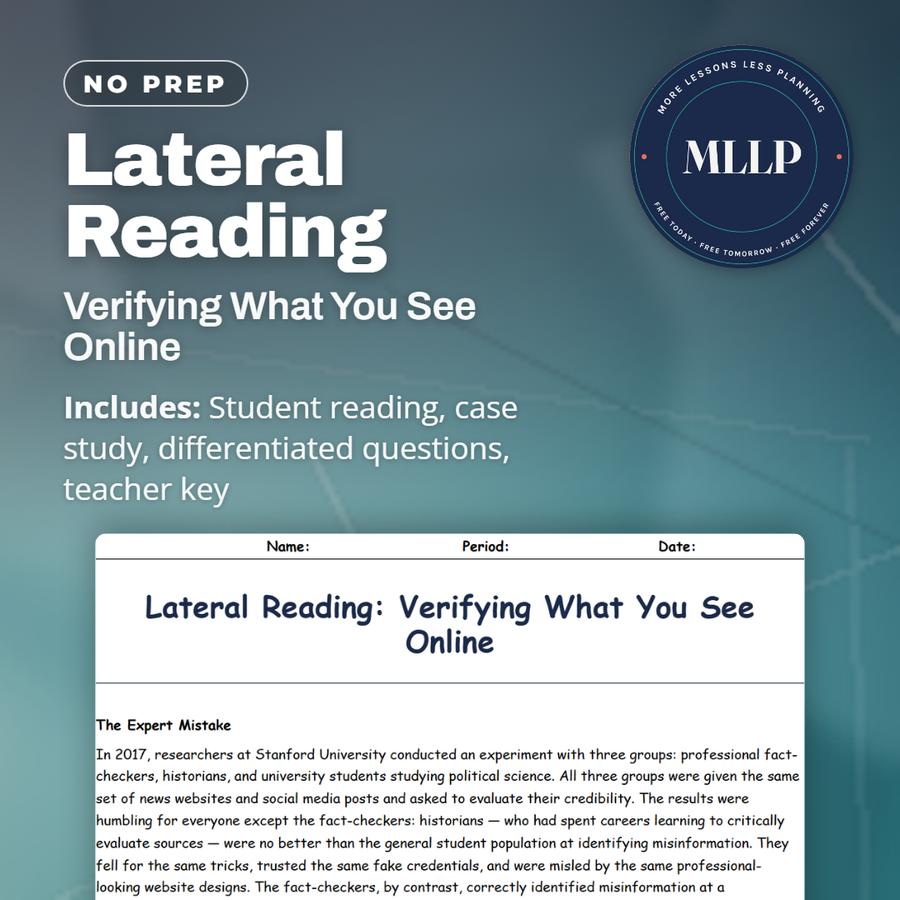
Lateral Reading: Verifying What You See Online
Reverse Image Search and Other Detection Tools
Spotting AI-Generated Images: 7 Telltale Signs
Every lesson on this site is free to download and use. If one of them saved you a prep period, you can chip in a few bucks toward my three kids' daycare fund. That's genuinely where tips go.