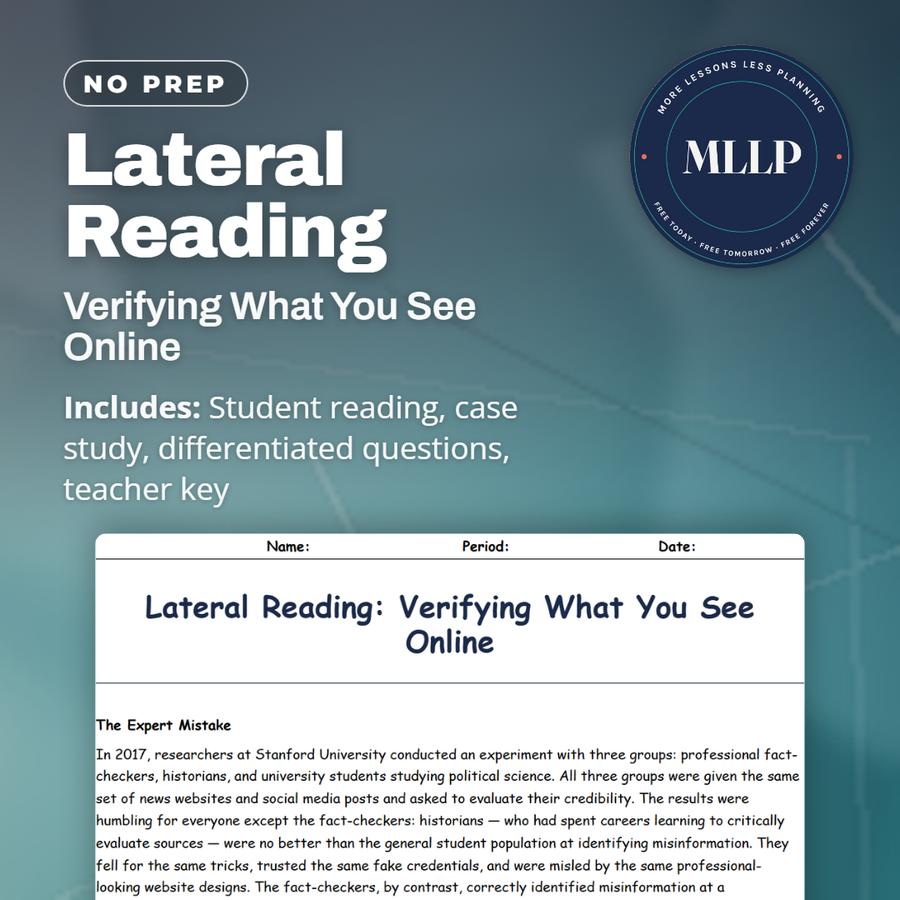
Lateral Reading: Verifying What You See Online
Quality reviewed September 2026
Facts verified September 20, 2026
- Subject
- Career & Life Skills
- Grades
- Grades 9-12
- Length
- 9-page student worksheet
- Time
- About one 50-minute class period
- Great for
- Sub plans and independent work
- Includes
- Reading passage, comprehension questions + full answer key
- Format
- Print-and-go PDF
What students do
- Carlos investigates a supplement site called NutriHealth Institute using three lateral reading checks
- Match internal signals like citations and layout against external signals like watchdog ratings and news coverage
- Explain why the Stanford study found historians no more accurate than students at spotting fake sources
- The evidence hierarchy running from anecdote up to peer-reviewed consensus gets applied to a real claim
What it covers
- The 2017 Stanford study that found professional fact-checkers outperforming historians
- Click restraint and why skeptical clicks still boost a source's engagement signals
- The difference between internal signals like a professional layout and external, harder-to-fake verification
Start reading this worksheet
The Expert Mistake
In 2017, researchers at Stanford University conducted an experiment with three groups: professional fact-checkers, historians, and university students studying political science. All three groups were given the same set of news websites and social media posts and asked to evaluate their credibility. The results were humbling for everyone except the fact-checkers: historians, who had spent careers learning to critically evaluate sources, were no better than the general student population at identifying misinformation. They fell for the same tricks, trusted the same fake credentials, and were misled by the same professional-looking website designs. The fact-checkers, by contrast, correctly identified misinformation at a significantly higher rate and did so much faster. The Stanford researchers studied what the fact-checkers did differently and discovered it was remarkably simple: the fact-checkers did not primarily read the site they were evaluating. They immediately opened new browser tabs and searched for what other sources said about that site or claim. This technique, which the researchers named 'lateral reading', is the single most powerful individual tool for evaluating information online, yet it is almost never taught in traditional education.
What Is Lateral Reading?
Lateral reading is the practice of leaving a source to check what other credible sources say about it, moving horizontally across multiple sources rather than drilling down vertically into the content of a single source. When you encounter a website, article, or claim you're uncertain about, instead of reading it more carefully (vertical reading) or examining its internal design and language for quality signals (also vertical), you open new tabs and ask: what do I know about this source? What do established, credible organizations say about it? Has it been fact-checked? Is anyone reporting on it? This approach is counterintuitive because most educational instruction about evaluating sources focuses on internal signals: Does the website have an 'About' page? Does it cite sources? Is the writing professional? Is there a date and author listed? These criteria are useful for evaluating well-established content types like academic journals, where the conventions are standardized and enforced. But for the modern internet (where anyone can build a professional-looking website in an afternoon and fill it with fabricated credentials), internal signals are easily faked. External verification is much harder to fabricate.
The Mechanics of Lateral Reading in Practice
In practical terms, lateral reading involves several specific habits. When you encounter an unfamiliar source, your first step is a quick search: type the organization name into Google and look at what comes up. Not the organization's own website, but news coverage of the organization, ratings from watchdog groups (like NewsGuard or Media Bias/Fact Check), Wikipedia articles (keeping in mind these can be edited), academic analyses, and any notable controversies or endorsements. This takes roughly 30-60 seconds and is more informative than five minutes of reading the organization's own content. For specific claims, lateral reading means searching for the claim itself and noting what organizations are covering it. If a dramatic claim about health, politics, or current events is being reported only by outlets you've never heard of, that's a significant red flag. If it's covered by multiple major news organizations (The Associated Press, Reuters, BBC), that's a meaningful signal of credibility, though not a guarantee of accuracy. The goal is not to outsource your judgment to credentialed sources, but to use the landscape of coverage as evidence about whether a claim is grounded in verified reporting.
Like what you read? The full reading, the case study, and every question set are in the free download below, along with the answer key.
Why this matters
Every student here already has a favorite influencer, and this reading gives them a three-minute habit, searching a source's name in a new tab, that would have caught the fabricated wellness site in the case study before a single dollar changed hands. It also reframes something they have probably absorbed backward, that a professional-looking website with citations and an advisory board is trustworthy, by showing exactly how cheap those signals are to fake and how much harder it is to fake independent news coverage or a watchdog rating.
From one teacher to another
Historians who had spent careers evaluating sources performed no better than college students at spotting fake ones, and this reading opens with that uncomfortable 2017 Stanford finding before explaining what the professional fact-checkers did differently. Instead of reading a site more carefully, they opened a new tab and searched what other sources said about it, a technique researchers named lateral reading. Students practice the same move through Carlos, who spends three minutes checking a wellness site's advisory board and citations before deciding the whole thing is fabricated. A closing section on evidence quality ranks anecdotes below peer-reviewed studies and asks students to weigh both source and evidence together.
What you get
Download
Where should I send the next one?
Everything here is free and it stays that way. Leave your email and I'll send you the new lessons as they go up. You can unsubscribe from any one of them.
Related resources
AI in News and Misinformation Campaigns
AI-Written Text: How to Tell If a Human Wrote It
Building a Personal Verify Before You Share Habit
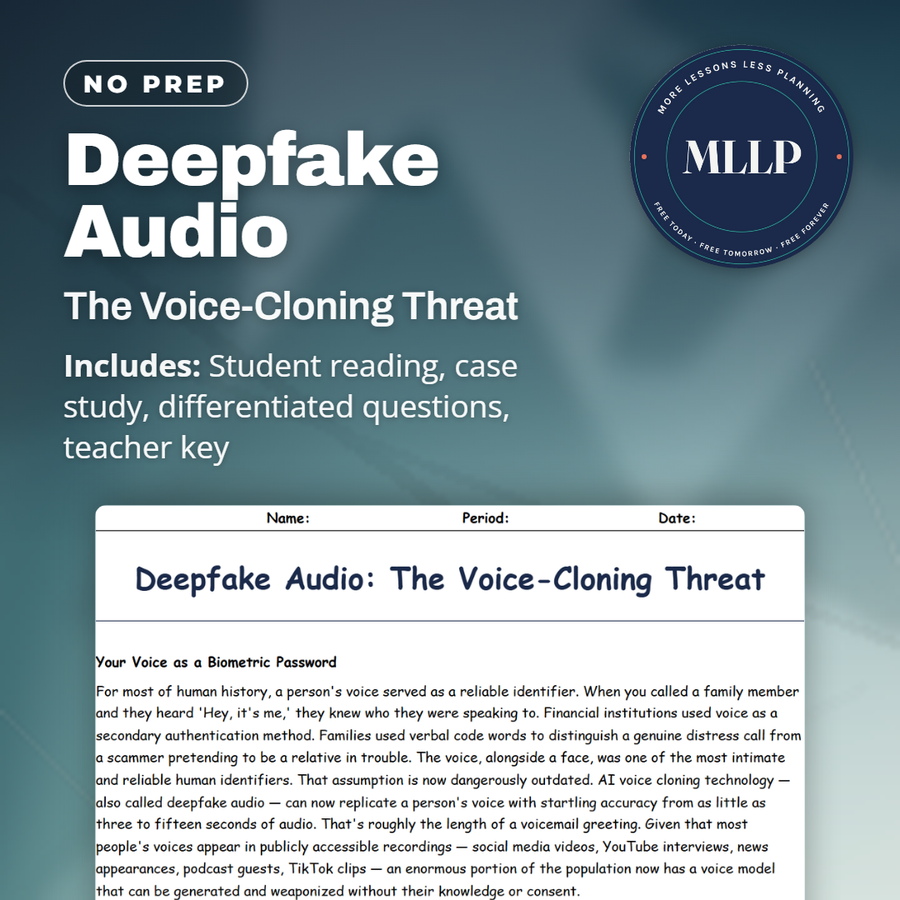
Deepfake Audio: The Voice-Cloning Threat
Reverse Image Search and Other Detection Tools
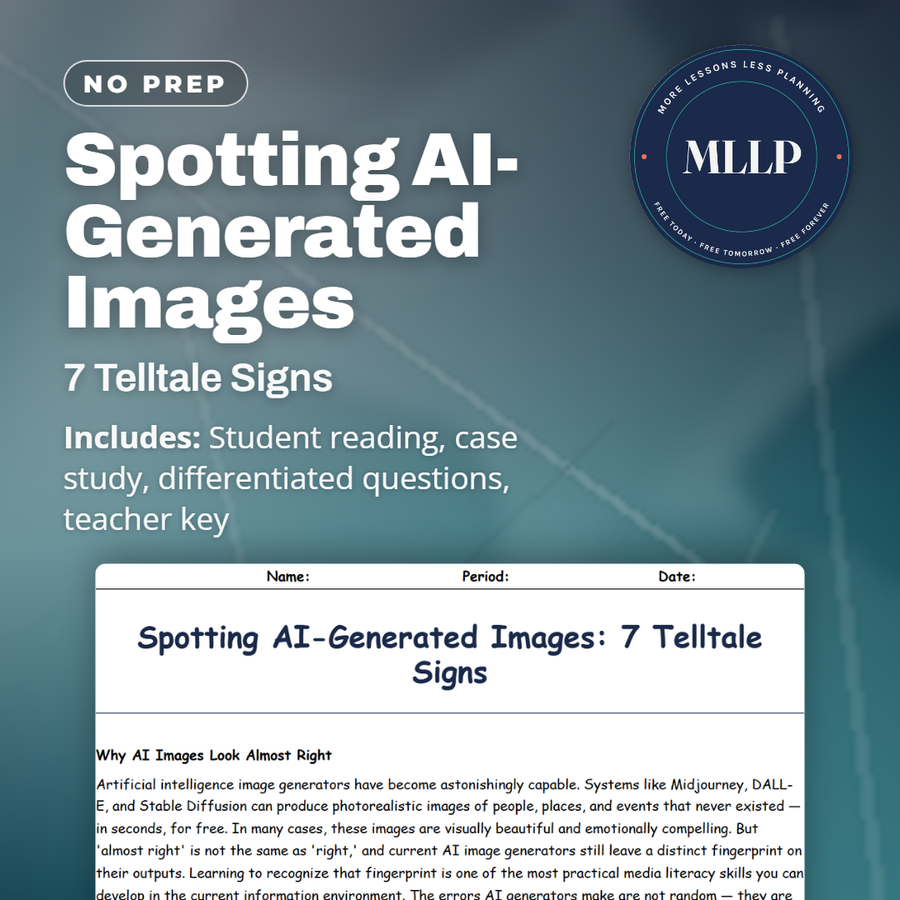
Spotting AI-Generated Images: 7 Telltale Signs
Every lesson on this site is free to download and use. If one of them saved you a prep period, you can chip in a few bucks toward my three kids' daycare fund. That's genuinely where tips go.