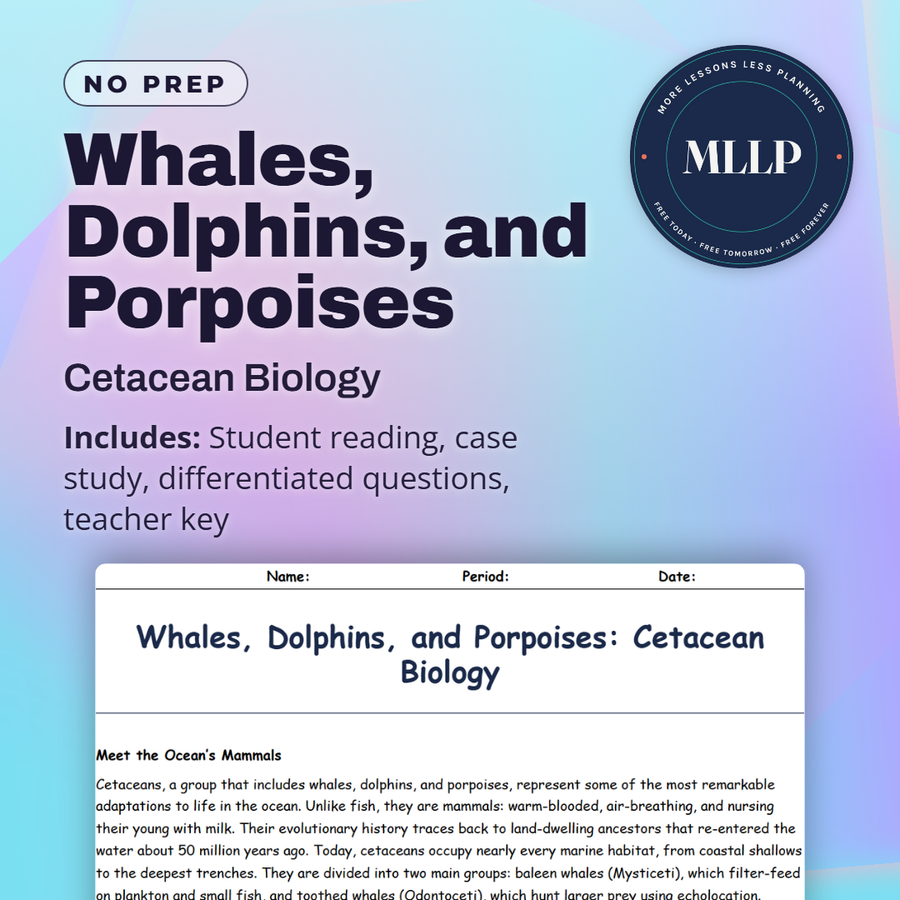
Whales, Dolphins, and Porpoises: Cetacean Biology
Quality reviewed September 2026
Facts verified September 14, 2026
- Subject
- Science
- Grades
- Grades 9-12
- Length
- 7-page student worksheet
- Time
- About one 50-minute class period
- Great for
- Sub plans and independent work
- Includes
- Reading passage, comprehension questions + full answer key
- Format
- Print-and-go PDF
What students do
- Match terms like baleen plates, echolocation, myoglobin, whale songs, and migration to their correct definitions
- Fill in the blank sentences on echolocation, blubber, and the mating display purpose of humpback whale songs
- Answer multiple choice questions on the melon organ used in echolocation, the adaptations that let sperm whales dive deep, and why baleen whales migrate between polar and tropical waters
- Write short answers on the differences between baleen and toothed whale feeding and the evidence for cetacean culture and intelligence, plus case study questions on baleen filter-feeding and the spread of humpback whale songs
What it covers
- How cetaceans evolved from land mammals and the split between filter-feeding baleen whales and echolocating toothed whales
- Toothed whale echolocation, from the melon organ to how orcas and sperm whales hunt in dark or deep water
- A case study on the discovery and spread of humpback whale songs and what they reveal about cetacean culture
Start reading this worksheet
Meet the Ocean’s Mammals
Cetaceans, a group that includes whales, dolphins, and porpoises, represent some of the most remarkable adaptations to life in the ocean. Unlike fish, they are mammals: warm-blooded, air-breathing, and nursing their young with milk. Their evolutionary history traces back to land-dwelling ancestors that re-entered the water about 50 million years ago. Today, cetaceans occupy nearly every marine habitat, from coastal shallows to the deepest trenches. They are divided into two main groups: baleen whales (Mysticeti), which filter-feed on plankton and small fish, and toothed whales (Odontoceti), which hunt larger prey using echolocation. Together, they reveal how mammals can evolve into fully aquatic lifeforms while retaining hallmarks of their ancestry.
Adaptations for Life in Water
Cetaceans have streamlined, fusiform bodies that minimize drag while swimming. Their forelimbs are modified into flippers, providing steering, while their tails end in horizontal flukes powered by strong muscles. Unlike fish, which move side to side, whales and dolphins swim with vertical, up-and-down strokes. Breathing adaptations are equally critical. A blowhole atop the head allows rapid inhalation and exhalation at the surface. Cetaceans can exchange up to 90% of the air in their lungs in one breath, compared to about 15% in humans. Deep-diving species, like sperm whales, store oxygen in muscle-bound myoglobin and can slow their heart rate dramatically, reducing oxygen demand while submerged. These adaptations enable dives lasting over an hour and depths exceeding 2,000 meters. Their insulating blubber maintains body heat, while specialized circulatory systems regulate temperature in frigid waters.
Baleen Whales: The Gentle Giants
Baleen whales lack teeth. Instead, they possess comb-like plates of keratin baleen that filter food from seawater. Species such as blue, humpback, and gray whales use different feeding strategies. Blue whales lunge through dense swarms of krill, engulfing huge volumes of water before pushing it out through baleen plates. Humpbacks employ bubble-net feeding, a coordinated behavior where groups release air bubbles to corral fish into tight clusters. These strategies allow baleen whales to exploit abundant but tiny prey. Their immense size—the blue whale reaches 100 feet and over 180 tons—confers advantages in long-distance migration and energy storage. Seasonal movements between polar feeding grounds and tropical breeding waters showcase how cetaceans synchronize their lives with global ecosystems.
Like what you read? The full reading, the case study, and every question set are in the free download below, along with the answer key.
Why this matters
A humpback whale song that starts in one population can spread to a population that never encountered the original singers. That kind of transmission only makes sense once students know what separates whales from most animals they have studied before: baleen whales filter krill through baleen plates, toothed whales hunt using echolocation and an organ called the melon, and both descended from land mammals that returned to the water.
What changes once students read this is how they talk about intelligence in animals. A song spreading between populations that never met is evidence of culture, not instinct, and that single case study does more to make the point than a lecture on brain size or social structure ever could.
From one teacher to another
Cetacean biology covers how whales, dolphins, and porpoises evolved from land mammals into fully aquatic animals. Students read about the split between baleen whales, which filter krill through baleen plates, and toothed whales, which hunt using echolocation. The passages also cover deep diving adaptations like myoglobin and blubber, along with the social structures dolphins and orcas use to communicate and hunt in groups. The case study on humpback whale songs asks what the spread of a song from one population to another says about cetacean culture. The worksheet includes a teacher answer key.
What you get
Download
Where should I send the next one?
Everything here is free and it stays that way. Leave your email and I'll send you the new lessons as they go up. You can unsubscribe from any one of them.
Related resources
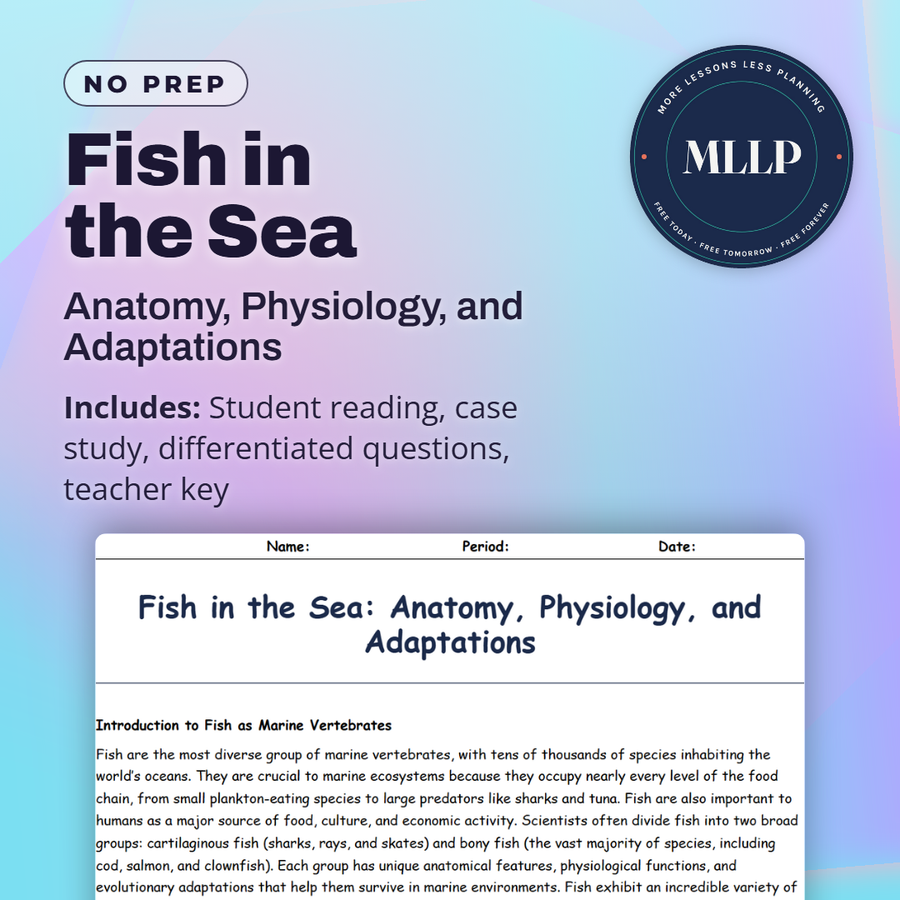
Fish in the Sea: Anatomy, Physiology, and Adaptations
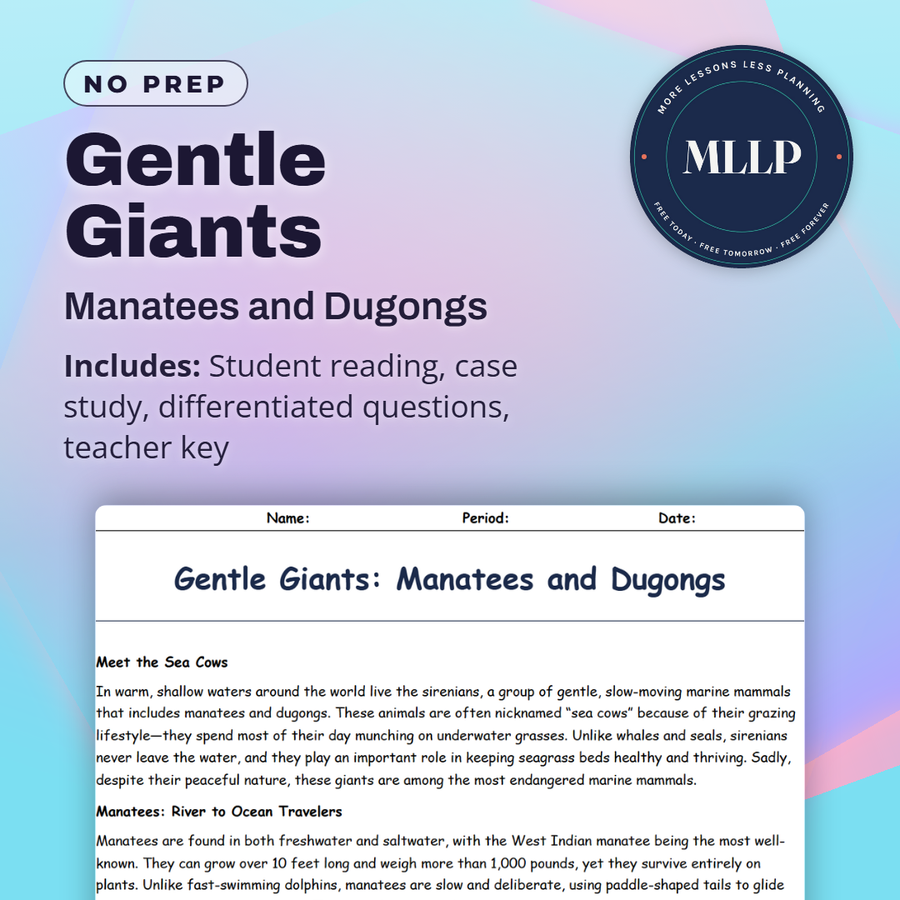
Gentle Giants: Manatees and Dugongs
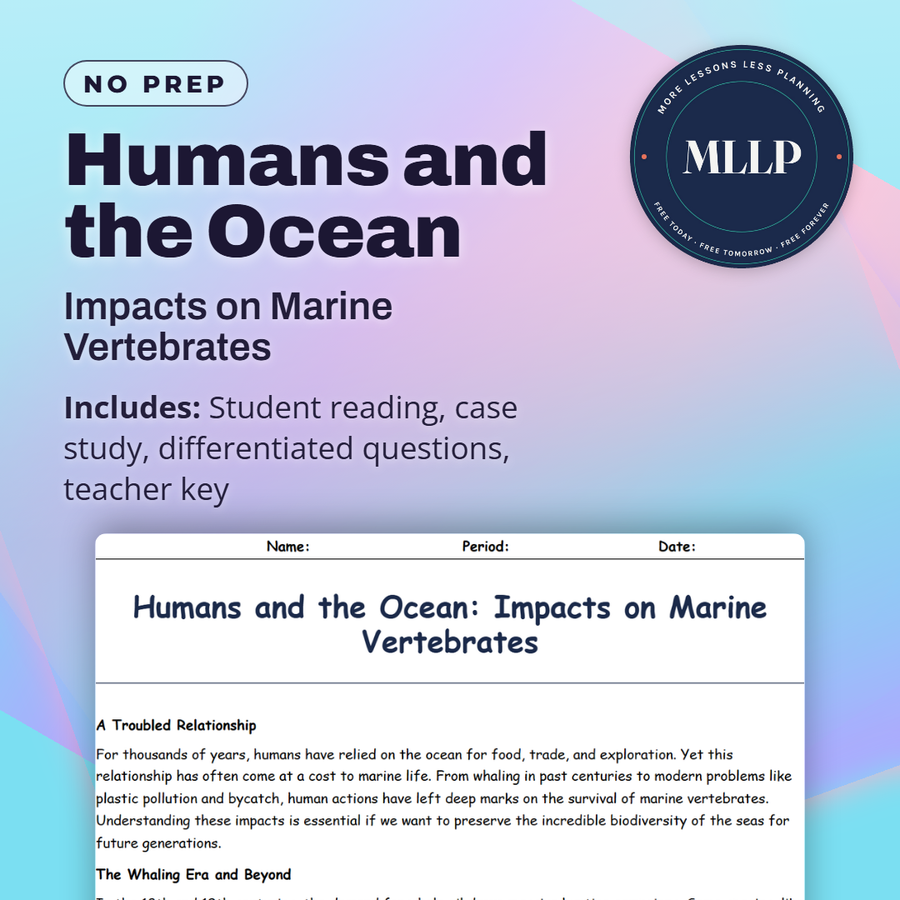
Humans and the Ocean: Impacts on Marine Vertebrates
Love Beneath the Waves: Reproduction in Marine Vertebrates
Marine Birds: Adaptations for Flight and Diving
Marine Reptiles: Sea Turtles, Snakes, and Iguanas
Every lesson on this site is free to download and use. If one of them saved you a prep period, you can chip in a few bucks toward my three kids' daycare fund. That's genuinely where tips go.