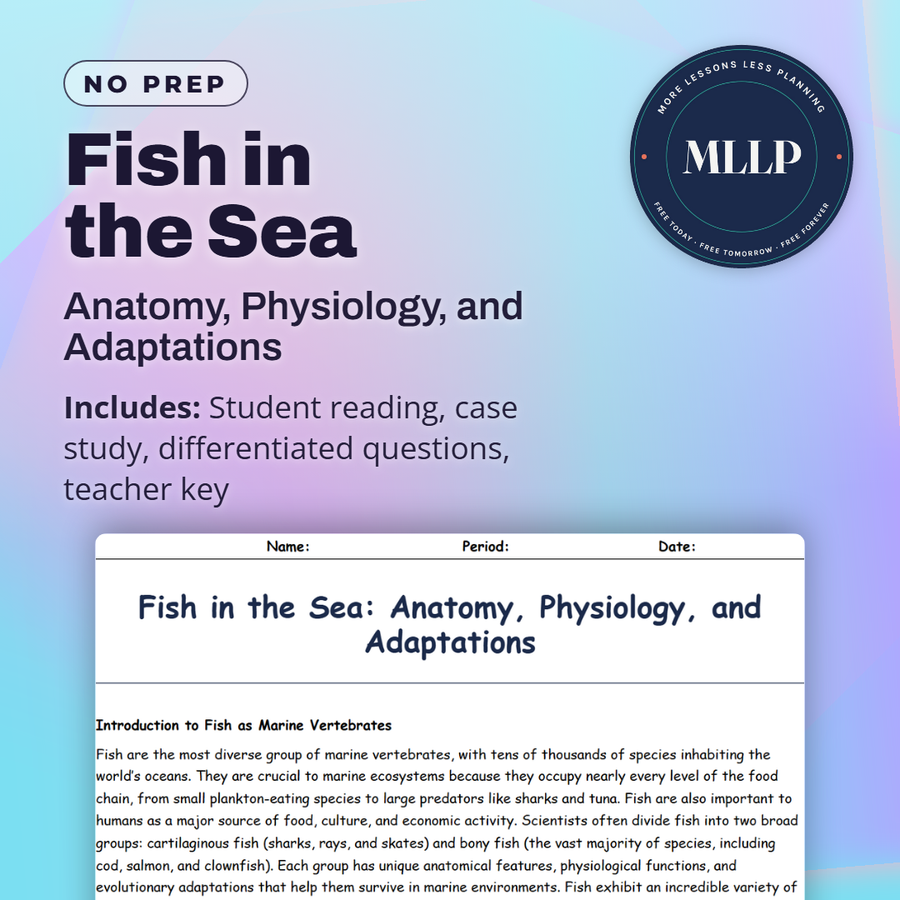
Fish in the Sea: Anatomy, Physiology, and Adaptations
Quality reviewed September 2026
Facts verified September 14, 2026
- Subject
- Science
- Grades
- Grades 9-12
- Length
- 7-page student worksheet
- Time
- About one 50-minute class period
- Great for
- Sub plans and independent work
- Includes
- Reading passage, comprehension questions + full answer key
- Format
- Print-and-go PDF
What students do
- Match clues like a skeleton made of cartilage, having an operculum covering the gills, and how teeth are set in bony fish jaws to the correct term
- Fill in the blank sentences on Chondrichthyes, swim bladders, and the gills sharks force water across
- Answer multiple choice questions on what makes bony fish unique, how sharks maintain buoyancy, and what reduces drag on cartilaginous fish
- Write short answers on the swim bladder's role, tradeoffs between cartilage and bone, and why the case study's shark and tuna are each vulnerable for different reasons
What it covers
- The anatomical and physiological differences between cartilaginous fish like sharks and bony fish like tuna and salmon
- How adaptations such as scales, gills, and swim bladders let fish survive across ocean habitats
- A case study comparing how a great white shark and an Atlantic bluefin tuna each manage buoyancy and body temperature
Start reading this worksheet
Introduction to Fish as Marine Vertebrates
Fish are the most diverse group of marine vertebrates, with tens of thousands of species inhabiting the world’s oceans. They are crucial to marine ecosystems because they occupy nearly every level of the food chain, from small plankton-eating species to large predators like sharks and tuna. Fish are also important to humans as a major source of food, culture, and economic activity. Scientists often divide fish into two broad groups: cartilaginous fish (sharks, rays, and skates) and bony fish (the vast majority of species, including cod, salmon, and clownfish). Each group has unique anatomical features, physiological functions, and evolutionary adaptations that help them survive in marine environments. Fish exhibit an incredible variety of shapes, sizes, and lifestyles. Some species dwell in shallow coastal waters, while others roam the open ocean or lurk in the deep sea. This diversity makes fish one of the most fascinating groups to study when learning about marine science. Understanding their anatomy and physiology provides insight into how life has adapted to thrive in aquatic habitats over millions of years.
Anatomy and Physiology of Cartilaginous vs. Bony Fish
Cartilaginous fish, known scientifically as Chondrichthyes, have skeletons made of cartilage, which is lighter and more flexible than bone. This adaptation makes them agile predators, capable of quick bursts of speed. Sharks, for example, have streamlined bodies, multiple rows of replaceable teeth, and large, powerful fins designed for efficient swimming. Rays and skates, on the other hand, have flattened bodies with wing-like pectoral fins that allow them to “fly” through the water. Bony fish, belonging to the class Osteichthyes, make up about 95% of all fish species. Their skeletons are composed of bone, which provides more structural support than cartilage. They also have swim bladders, internal gas-filled organs that allow them to regulate buoyancy without constant swimming. This gives them an advantage over cartilaginous fish, which must keep moving to avoid sinking. Additionally, bony fish usually have opercula—bony plates that cover and protect the gills—making respiration more efficient.
Adaptations for Marine Survival
Both cartilaginous and bony fish display adaptations that allow them to thrive in their environments. Cartilaginous fish often rely on oil-rich livers for buoyancy and possess highly developed senses, making them effective hunters. Bony fish, with their wide variety of body shapes and fin arrangements, are adapted to diverse ecological niches. Some, like tuna, are built for fast, long-distance swimming, while others, like anglerfish, are adapted for ambush in the deep sea. Another important adaptation is the development of scales. Cartilaginous fish have tiny, tooth-like dermal denticles that reduce drag and turbulence as they swim. Bony fish, on the other hand, typically have overlapping scales that protect the body while still allowing flexibility. Respiration is also key to survival. Fish extract oxygen from water using gills, which contain thin filaments and capillaries that maximize surface area. The efficiency of this system allows fish to live in oxygen-poor environments that would be challenging for terrestrial animals.
Like what you read? The full reading, the case study, and every question set are in the free download below, along with the answer key.
Why this matters
Fish outnumber every other group of marine vertebrates, split between two very different body plans: cartilaginous fish like sharks, built around cartilage, and bony fish like tuna and salmon, built around bone. Scales, gill structure, and swim bladders each solve a different survival problem, and neither branch arrived there by accident.
A shark and a tuna look like the same kind of animal to most students, since both are large and live in open water. Lining up how a great white manages buoyancy against how a bluefin tuna does it is usually the moment that assumption falls apart, once the case study forces a direct comparison.
From one teacher to another
Fish make up the most diverse group of marine vertebrates, and this worksheet walks students through the two major branches, cartilaginous fish like sharks and rays, and bony fish like tuna and salmon. Readings cover skeleton type, swim bladders, gill structure, and scales, along with why each adaptation matters for survival. The case study puts a great white shark side by side with a bluefin tuna to compare buoyancy control and temperature regulation.
What you get
Download
Where should I send the next one?
Everything here is free and it stays that way. Leave your email and I'll send you the new lessons as they go up. You can unsubscribe from any one of them.
Related resources
Gentle Giants: Manatees and Dugongs
Humans and the Ocean: Impacts on Marine Vertebrates
Love Beneath the Waves: Reproduction in Marine Vertebrates
Marine Birds: Adaptations for Flight and Diving
Marine Reptiles: Sea Turtles, Snakes, and Iguanas
Sea Turtle Journeys: Life Cycles and Conservation
Every lesson on this site is free to download and use. If one of them saved you a prep period, you can chip in a few bucks toward my three kids' daycare fund. That's genuinely where tips go.