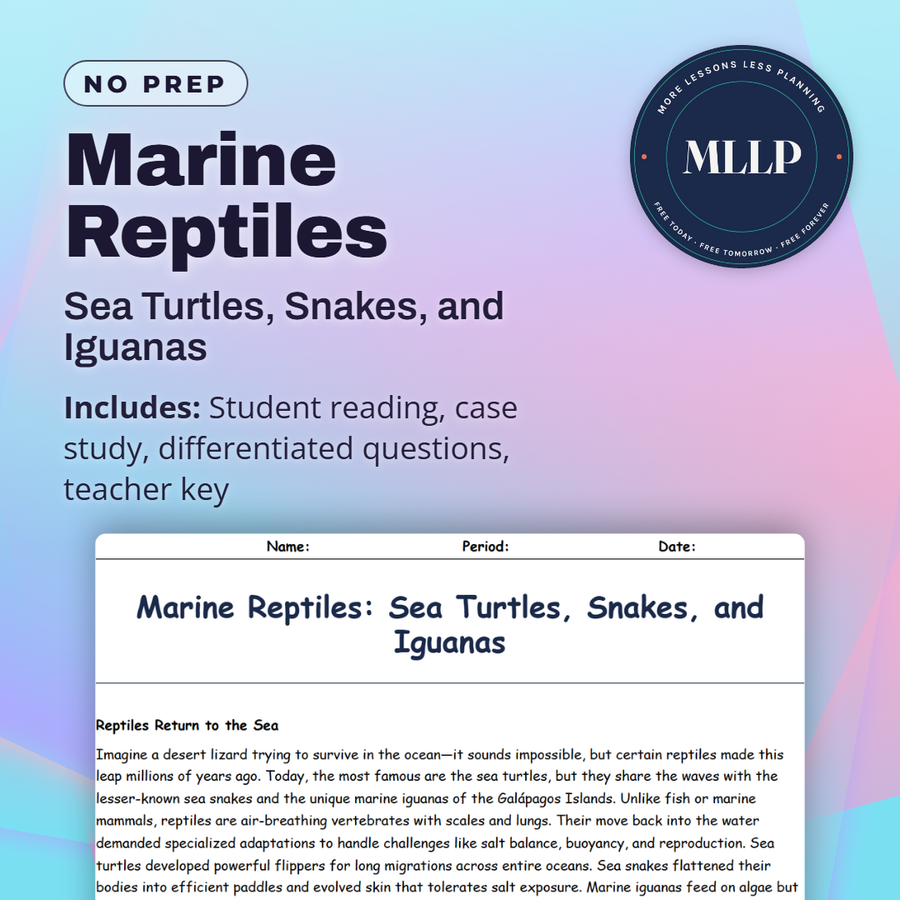
Marine Reptiles: Sea Turtles, Snakes, and Iguanas
Quality reviewed September 2026
Facts verified September 14, 2026
- Subject
- Science
- Grades
- Grades 9-12
- Length
- 7-page student worksheet
- Time
- About one 50-minute class period
- Great for
- Sub plans and independent work
- Includes
- Reading passage, comprehension questions + full answer key
- Format
- Print-and-go PDF
What students do
- Match prompts like sea turtle flippers, sea snake lung, marine iguana basking, and sea snake venom to what each adaptation does
- Fill in the blank sentences on sublingual salt glands, algae grazing, and navigation using Earth's magnetic field
- Answer multiple choice questions on how marine iguanas handle salt, what sea snakes eat, and what helps sea turtles complete long migrations
- Write short answers comparing sea snake and marine iguana temperature regulation, the ecological role of marine reptiles, and threats facing sea snakes and sea turtles
What it covers
- How sea turtles, sea snakes, and marine iguanas each evolved different solutions to salt balance, buoyancy, and reproduction
- The specialized traits of sea snakes, including a flattened body, an elongated lung, and venom for hunting fish and eels
- A case study on sea turtle conservation in Costa Rica, following nesting females and the threats their eggs and hatchlings face
Start reading this worksheet
Reptiles Return to the Sea
Imagine a desert lizard trying to survive in the ocean—it sounds impossible, but certain reptiles made this leap millions of years ago. Today, the most famous are the sea turtles, but they share the waves with the lesser-known sea snakes and the unique marine iguanas of the Galápagos Islands. Unlike fish or marine mammals, reptiles are air-breathing vertebrates with scales and lungs. Their move back into the water demanded specialized adaptations to handle challenges like salt balance, buoyancy, and reproduction. Sea turtles developed powerful flippers for long migrations across entire oceans. Sea snakes flattened their bodies into efficient paddles and evolved skin that tolerates salt exposure. Marine iguanas feed on algae but must haul out to sunbathe and warm up, a reminder that their cold-blooded physiology still anchors them to land. Each group tells a story of evolutionary compromise: they thrive in the sea but retain key reptilian traits, making them fascinating examples of how life finds creative solutions to environmental challenges. To understand them is to see resilience written in scales, shells, and survival strategies.
Sea Turtles: Ancient Mariners
Sea turtles are among the most recognizable marine reptiles, tracing their lineage back more than 100 million years. Unlike land turtles, their shells are streamlined for efficient swimming, and their front flippers are elongated like wings, propelling them gracefully across the sea. They surface to breathe, but their ability to slow heart rates allows dives lasting over an hour. One of their most striking features is their migratory behavior. Green turtles, for example, may cross thousands of miles between feeding grounds and nesting beaches, guided by an internal compass sensitive to Earth’s magnetic field. Their diet shifts with species: hawksbills consume sponges, greens graze on seagrass, and leatherbacks specialize in jellyfish. Yet turtles remain tied to land for reproduction. Females return to sandy beaches to dig nests, laying dozens of eggs at a time. Hatchlings must scramble from nest to sea, running a gauntlet of predators. Survival rates are low, but those that succeed may live for decades, growing into vital parts of marine ecosystems as grazers and predators.
Sea Snakes: The Silent Slitherers
Sea snakes represent one of the most complete returns to aquatic life among reptiles. Found mostly in the Indo-Pacific, they include over 60 species, many highly venomous. Their bodies are laterally flattened, with paddle-like tails that make them agile swimmers. Unlike fish, they breathe air, but a single elongated lung runs almost the length of their body, functioning both for respiration and buoyancy control. Some can even absorb oxygen through their skin, an unusual trait for reptiles. Their diet centers on fish and eels, which they subdue with fast-acting venom. Most sea snakes are not aggressive toward humans, though bites can be dangerous. To survive in salty environments, they possess sublingual salt glands that excrete excess salt. Despite their aquatic mastery, sea snakes face threats from habitat loss, bycatch in fishing gear, and declining coral reefs. Their specialized physiology makes them vulnerable to rapid environmental change, underlining how delicate balance is for animals at the edge of two worlds.
Like what you read? The full reading, the case study, and every question set are in the free download below, along with the answer key.
Why this matters
Marine iguanas bask on rocks to warm back up after diving for algae in cold water, since a cold-blooded reptile loses heat fast underwater. This reading compares that solution to a sea turtle's navigation by Earth's magnetic field and a sea snake's flattened body and venom built for hunting fish.
What students find hardest to accept is that reptiles, animals built to breathe air on land, ever made it into the ocean at all. The Costa Rica case study on nesting leatherback turtles gives that struggle a face: volunteers protecting eggs and hatchlings against odds that have not gotten easier.
From one teacher to another
Reptiles are air-breathing, scaled animals that seem like an odd fit for ocean life, but sea turtles, sea snakes, and marine iguanas each found a way to make it work. This worksheet compares their adaptations for salt balance, buoyancy, and feeding, from a sea turtle's flippers to a marine iguana's salt-excreting nasal glands. The case study follows conservation volunteers protecting nesting leatherback turtles in Costa Rica.
What you get
Download
Where should I send the next one?
Everything here is free and it stays that way. Leave your email and I'll send you the new lessons as they go up. You can unsubscribe from any one of them.
Related resources
Fish in the Sea: Anatomy, Physiology, and Adaptations
Gentle Giants: Manatees and Dugongs
Humans and the Ocean: Impacts on Marine Vertebrates
Love Beneath the Waves: Reproduction in Marine Vertebrates
Marine Birds: Adaptations for Flight and Diving
Sea Turtle Journeys: Life Cycles and Conservation
Every lesson on this site is free to download and use. If one of them saved you a prep period, you can chip in a few bucks toward my three kids' daycare fund. That's genuinely where tips go.