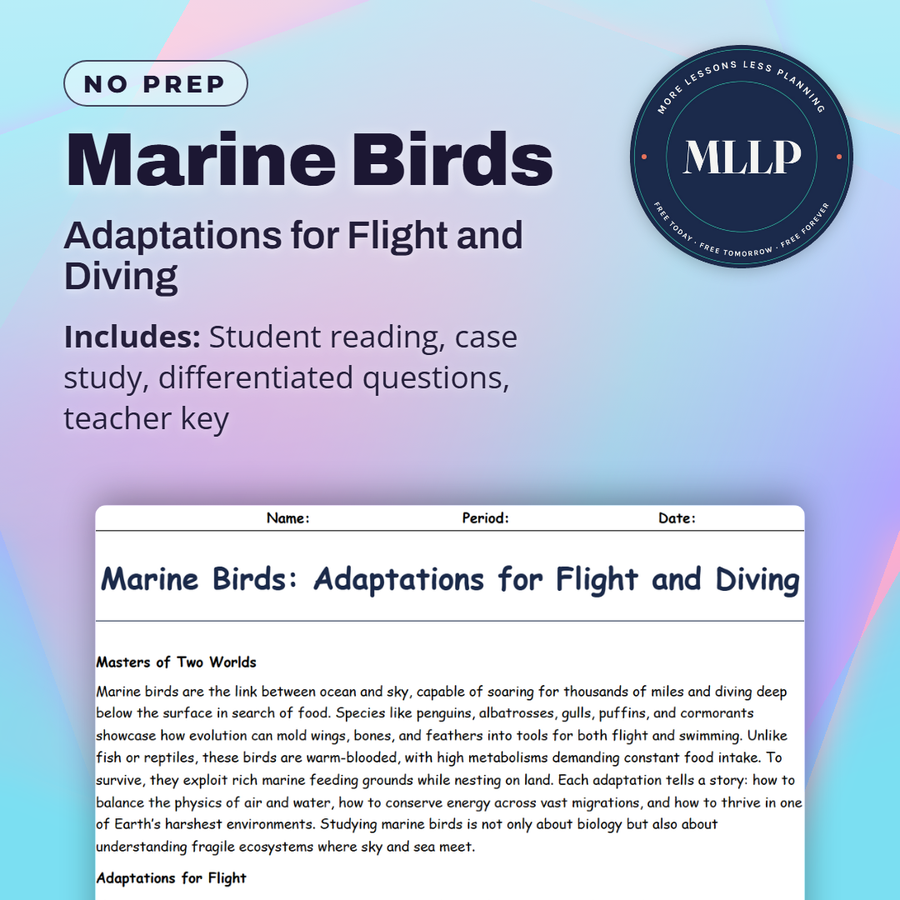
Marine Birds: Adaptations for Flight and Diving
Quality reviewed September 2026
Facts verified September 14, 2026
- Subject
- Science
- Grades
- Grades 9-12
- Length
- 7-page student worksheet
- Time
- About one 50-minute class period
- Great for
- Sub plans and independent work
- Includes
- Reading passage, comprehension questions + full answer key
- Format
- Print-and-go PDF
What students do
- Match prompts like albatross wingspan, penguin flippers, cormorant feathers, and salt glands to what each adaptation does
- Fill in the blank sentences on celestial and magnetic navigation, dense bones for diving, and the salt glands that let birds drink seawater
- Answer multiple choice questions on what lets penguins dive despite not flying, what powers albatross migrations, and what salt glands do
- Write short answers on migration and navigation, penguin versus cormorant diving adaptations, and the tradeoffs of nesting in large colonies
What it covers
- How albatrosses use dynamic soaring and long wingspans to cross oceans with minimal effort
- How diving birds like penguins and cormorants trade flight for underwater adaptations like flippers and dense bones
- A case study on a satellite-tracked albatross, showing how dynamic soaring lets it circle Antarctica without landing
Start reading this worksheet
Masters of Two Worlds
Marine birds are the link between ocean and sky, capable of soaring for thousands of miles and diving deep below the surface in search of food. Species like penguins, albatrosses, gulls, puffins, and cormorants showcase how evolution can mold wings, bones, and feathers into tools for both flight and swimming. Unlike fish or reptiles, these birds are warm-blooded, with high metabolisms demanding constant food intake. To survive, they exploit rich marine feeding grounds while nesting on land. Each adaptation tells a story: how to balance the physics of air and water, how to conserve energy across vast migrations, and how to thrive in one of Earth’s harshest environments. Studying marine birds is not only about biology but also about understanding fragile ecosystems where sky and sea meet.
Adaptations for Flight
Not all marine birds dive, but most are specialists in flight. Albatrosses are famous for their massive wingspans, often exceeding 11 feet, allowing them to glide for hours without flapping. Their dynamic soaring technique harnesses wind currents above waves, reducing energy use. Gulls and terns balance maneuverability and stamina, foraging close to coasts but also capable of long journeys. Hollow bones and lightweight feathers reduce body mass, while efficient respiratory systems with air sacs deliver oxygen during strenuous flight. Migration is another remarkable adaptation. Arctic terns, for instance, travel from the Arctic to Antarctica each year—a round trip of over 40,000 miles. This is the longest migration of any known animal. These epic journeys highlight how marine birds are tuned not just to survive but to push biological limits. Their navigation relies on celestial cues, Earth’s magnetic field, and memory of landmarks, showing a level of orientation comparable to sea turtles and whales.
Adaptations for Diving
Some marine birds, like penguins, puffins, and cormorants, specialize in plunging into water. Penguins are flightless, having traded wings for flippers that propel them underwater like torpedoes. Streamlined bodies and dense bones help them dive hundreds of feet below the surface. Puffins and auks still retain flight but flap their wings underwater to chase small fish. Cormorants use partially wettable feathers, which reduce buoyancy and allow deeper dives, though it means they must spread their wings afterward to dry. Diving birds have strong muscles, high oxygen storage in blood and muscle tissue, and the ability to slow heart rate while submerged. These physiological tricks mirror those of marine mammals, demonstrating convergent evolution. Foraging strategies vary: penguins often hunt in coordinated groups, while cormorants rely on speed and pursuit. These adaptations highlight how birds straddle two worlds, excelling both in the air and beneath the waves.
Like what you read? The full reading, the case study, and every question set are in the free download below, along with the answer key.
Why this matters
A satellite-tagged albatross in this reading circles Antarctica without ever landing, covering that distance on wings built for gliding, not flapping. This reading also asks why a penguin, built with dense bones and flippers for diving, can dive deep but cannot fly at all.
Most students walk in assuming birds share one basic body plan with small tweaks between species, so putting an albatross and a penguin side by side breaks that fast. Once they see that both species gave up something, flight in one case, easy takeoff in the other, to win at ocean life, the tradeoff becomes the whole lesson.
From one teacher to another
Marine birds live at the boundary between sky and sea, and this worksheet covers the adaptations that let them succeed in both. Students read about the wingspans and dynamic soaring that carry albatrosses across oceans, plus the flippers, dense bones, and wettable feathers that help penguins and cormorants dive deep. The case study tracks a satellite-tagged albatross circling Antarctica without ever landing.
What you get
Download
Where should I send the next one?
Everything here is free and it stays that way. Leave your email and I'll send you the new lessons as they go up. You can unsubscribe from any one of them.
Related resources
Fish in the Sea: Anatomy, Physiology, and Adaptations
Gentle Giants: Manatees and Dugongs
Humans and the Ocean: Impacts on Marine Vertebrates
Love Beneath the Waves: Reproduction in Marine Vertebrates
Marine Reptiles: Sea Turtles, Snakes, and Iguanas
Sea Turtle Journeys: Life Cycles and Conservation
Every lesson on this site is free to download and use. If one of them saved you a prep period, you can chip in a few bucks toward my three kids' daycare fund. That's genuinely where tips go.