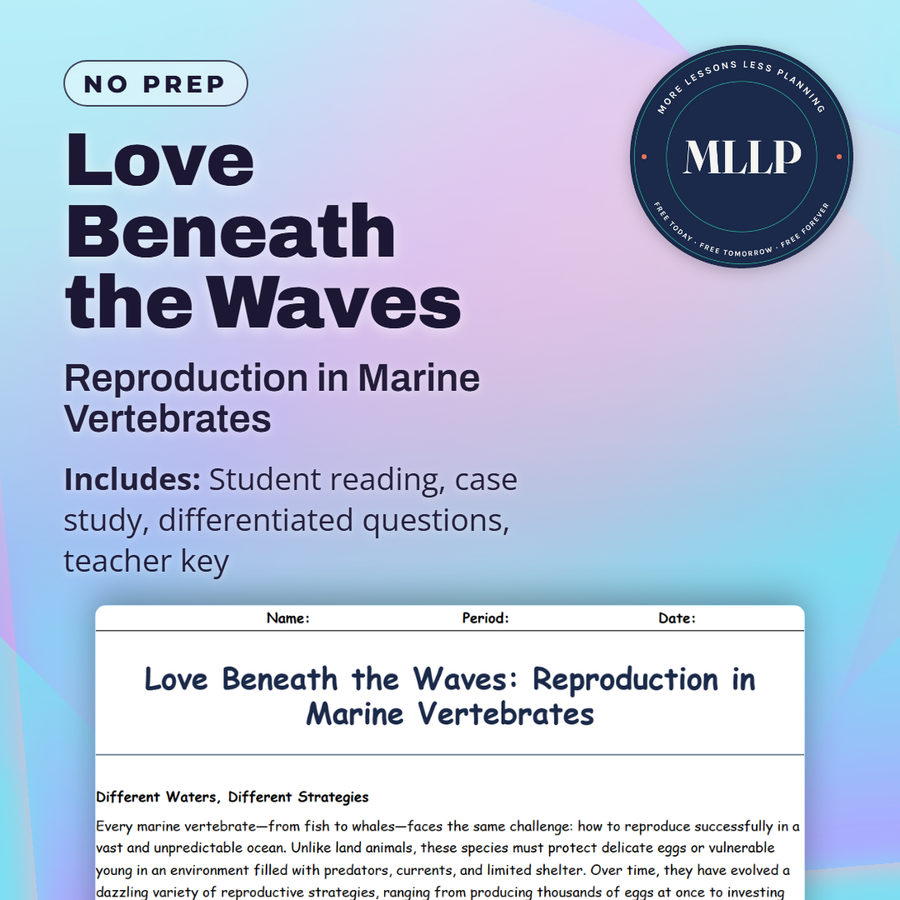
Love Beneath the Waves: Reproduction in Marine Vertebrates
Quality reviewed September 2026
Facts verified September 14, 2026
- Subject
- Science
- Grades
- Grades 9-12
- Length
- 6-page student worksheet
- Time
- About one 50-minute class period
- Great for
- Sub plans and independent work
- Includes
- Reading passage, comprehension questions + full answer key
- Format
- Print-and-go PDF
What students do
- Match prompts like shark reproduction, whale calf care, tuna reproduction, and penguin parenting to the correct strategy
- Fill in the blank sentences on live-born shark pups, pinniped rookeries, and the dangers hatchlings face reaching the ocean
- Answer multiple choice questions on what broadcast spawning is, which marine vertebrates lay eggs on beaches, and how whales reproduce
- Write short answers comparing reptile and bird parenting, why fish release so many eggs, and why parental investment matters for marine mammals
What it covers
- How bony fish rely on broadcast spawning while sharks and rays produce fewer, larger offspring
- How sea turtles, penguins, and albatrosses balance egg-laying with different levels of parental care
- A case study on the emperor penguin, where two parents share the work of keeping a single egg alive in Antarctica
Start reading this worksheet
Different Waters, Different Strategies
Every marine vertebrate (from fish to whales) faces the same challenge: how to reproduce successfully in a vast and unpredictable ocean. Unlike land animals, these species must protect delicate eggs or vulnerable young in an environment filled with predators, currents, and limited shelter. Over time, they have evolved a dazzling variety of reproductive strategies, ranging from producing thousands of eggs at once to investing years in raising a single calf.
Fish: Quantity Over Quality
Most bony fish release huge numbers of eggs and sperm into the water in a process called broadcast spawning. This strategy ensures that at least some offspring survive, even though most eggs are eaten by predators. Some fish, like clownfish, guard their eggs after fertilization, increasing survival rates. Cartilaginous fish such as sharks and rays take a different path. Instead of producing thousands of eggs, they invest in fewer, larger offspring. Many sharks give birth to live young after long pregnancies, and some species develop inside protective egg cases nicknamed “mermaid’s purses.”
Reptiles and Birds: Nesting and Nurture
Marine reptiles like sea turtles return to sandy beaches to lay eggs, digging nests where dozens or even hundreds of eggs incubate. Sadly, few hatchlings make it back to the ocean. Marine birds, from penguins to albatrosses, usually lay only one or two eggs per season but provide dedicated parental care. Penguins, for instance, take turns keeping eggs warm on their feet, while albatross pairs may care for a single chick for nearly a year. This high-investment strategy ensures that fewer but stronger offspring survive.
Like what you read? The full reading, the case study, and every question set are in the free download below, along with the answer key.
Why this matters
A sea turtle lays her eggs on a beach and leaves the hatchlings to face the dangers of reaching the ocean alone, while an emperor penguin pair takes turns balancing a single egg through brutal Antarctic conditions. This reading lines up those two strategies next to broadcast spawning in bony fish and live birth in sharks and rays.
It is tempting to rank these strategies by which parent works hardest, but the real test is simpler: whether enough offspring survive. A fish releasing so many eggs into open water looks careless next to penguin parenting, yet both have kept their species alive by playing different odds.
From one teacher to another
Every marine vertebrate has to solve the same problem, how to raise young in an ocean full of predators and currents. This worksheet compares broadcast spawning in bony fish, live birth in sharks and rays, beach nesting in sea turtles, and the high parental investment of birds and mammals. The case study follows an emperor penguin pair balancing a single egg through brutal Antarctic conditions.
What you get
Download
Where should I send the next one?
Everything here is free and it stays that way. Leave your email and I'll send you the new lessons as they go up. You can unsubscribe from any one of them.
Related resources
Fish in the Sea: Anatomy, Physiology, and Adaptations
Gentle Giants: Manatees and Dugongs
Humans and the Ocean: Impacts on Marine Vertebrates
Marine Birds: Adaptations for Flight and Diving
Marine Reptiles: Sea Turtles, Snakes, and Iguanas
Sea Turtle Journeys: Life Cycles and Conservation
Every lesson on this site is free to download and use. If one of them saved you a prep period, you can chip in a few bucks toward my three kids' daycare fund. That's genuinely where tips go.