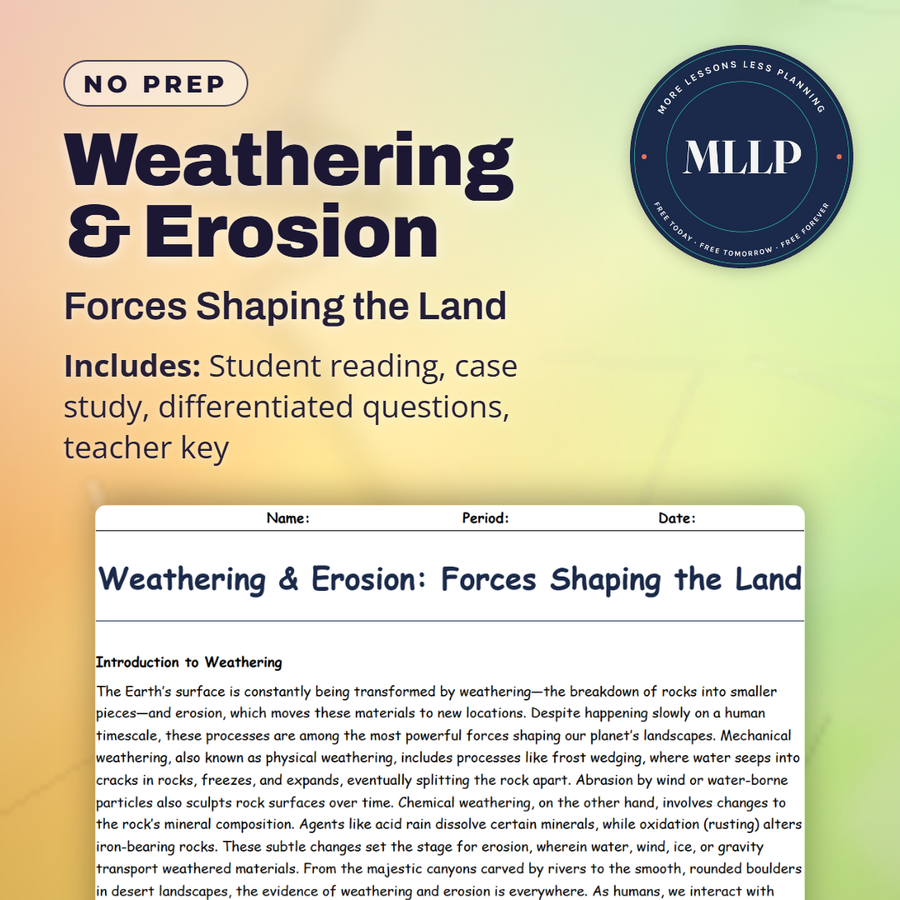
Weathering & Erosion: Forces Shaping the Land
Quality reviewed September 2026
Facts verified September 14, 2026
- Subject
- Social Studies
- Grades
- Grades 9-12
- Length
- 7-page student worksheet
- Time
- About one 50-minute class period
- Great for
- Sub plans and independent work
- Includes
- Reading passage, comprehension questions + full answer key
- Format
- Print-and-go PDF
What students do
- Match terms like Oxidation, Sand Dune, Mass Wasting, and Till to their correct descriptions
- Fill in the blank sentences on chemical weathering, erosion, and glacial till
- Answer multiple choice questions on mechanical weathering, why floodplains are fertile, and how glaciers erode rock
- Write short answers on sustainable agriculture, how human activity speeds up erosion, and how dams affect coastlines downstream
What it covers
- Mechanical and chemical weathering, plus how water, wind, ice, and gravity drive erosion
- Deposition and how it builds landforms like deltas, sand dunes, and floodplains
- A case study on how the Colorado River carved the Grand Canyon over millions of years
Start reading this worksheet
Introduction to Weathering
The Earth’s surface is constantly being transformed by weathering—the breakdown of rocks into smaller pieces—and erosion, which moves these materials to new locations. Despite happening slowly on a human timescale, these processes are among the most powerful forces shaping our planet’s landscapes. Mechanical weathering, also known as physical weathering, includes processes like frost wedging, where water seeps into cracks in rocks, freezes, and expands, eventually splitting the rock apart. Abrasion by wind or water-borne particles also sculpts rock surfaces over time. Chemical weathering, on the other hand, involves changes to the rock’s mineral composition. Agents like acid rain dissolve certain minerals, while oxidation (rusting) alters iron-bearing rocks. These subtle changes set the stage for erosion, wherein water, wind, ice, or gravity transport weathered materials. From the majestic canyons carved by rivers to the smooth, rounded boulders in desert landscapes, the evidence of weathering and erosion is everywhere. As humans, we interact with these processes daily, whether we realize it or not. Structures must be built to withstand local weathering conditions, and agricultural practices must account for soil erosion. Understanding these phenomena helps us appreciate Earth’s evolving surface and guides our efforts to preserve fertile soils and stable terrains.
Erosion Agents: Water, Wind, Ice, Gravity
Water is perhaps the most effective erosional force. Rivers, streams, and rainfall all contribute to the gradual removal of rock and soil. Over millennia, a river can cut deeply into bedrock, creating features like the Grand Canyon. When rivers reach flatter areas, they slow down and deposit sediment, forming floodplains and deltas. Wind can act as a powerful erosional agent in dry, sparsely vegetated regions. It lifts and transports fine particles, resulting in phenomena like dust storms and the creation of sand dunes where sediment is eventually dropped. Ice, in the form of glaciers, can reshape entire landscapes. As glaciers advance and retreat, they grind away rock surfaces, carrying debris over long distances. The resulting valleys, lakes, and moraines serve as geological footprints of past glacial periods. Gravity also plays a direct role in erosion through landslides, rockfalls, and the downslope movement of soil. Although sudden mass movements can be destructive, they are a natural mechanism of landscape evolution, redistributing materials from higher elevations to lower areas.
Like what you read? The full reading, the case study, and every question set are in the free download below, along with the answer key.
Why this matters
The Grand Canyon did not happen in a season, the Colorado River carved it over millions of years, one grain of sediment at a time. This reading separates that slow process into its parts, mechanical and chemical weathering breaking rock down, then water, wind, ice, and gravity carrying the pieces away as erosion.
Students often lump weathering and erosion together, so I have them trace how deposition finishes the story: sediment settling out to build landforms like deltas, dunes, and floodplains. The Colorado River section makes it concrete, since a dam on that river changed its natural sediment flow, and they start asking what downstream landforms are quietly losing.
From one teacher to another
This one separates weathering, erosion, and deposition clearly instead of treating them as one blurry process, which helps when students are trying to explain how a landform actually formed. The mechanical versus chemical weathering distinction sets up the erosion agents section nicely, water, wind, ice, and gravity each get their own explanation. The Grand Canyon case study ties it all together and shows how dams changed the Colorado River's natural sediment flow. Solid fit for a landforms unit.
What you get
Download
Where should I send the next one?
Everything here is free and it stays that way. Leave your email and I'll send you the new lessons as they go up. You can unsubscribe from any one of them.
Related resources
Biomes & Ecosystems: Life Across Earth’s Habitats
Climate vs. Weather: Understanding the Difference
Convergent Boundaries: Where Plates Collide
Deserts: Survival in the Harshest Climates

Divergent Boundaries: Where Plates Pull Apart
Earth’s Layers: From Crust to Core
Every lesson on this site is free to download and use. If one of them saved you a prep period, you can chip in a few bucks toward my three kids' daycare fund. That's genuinely where tips go.