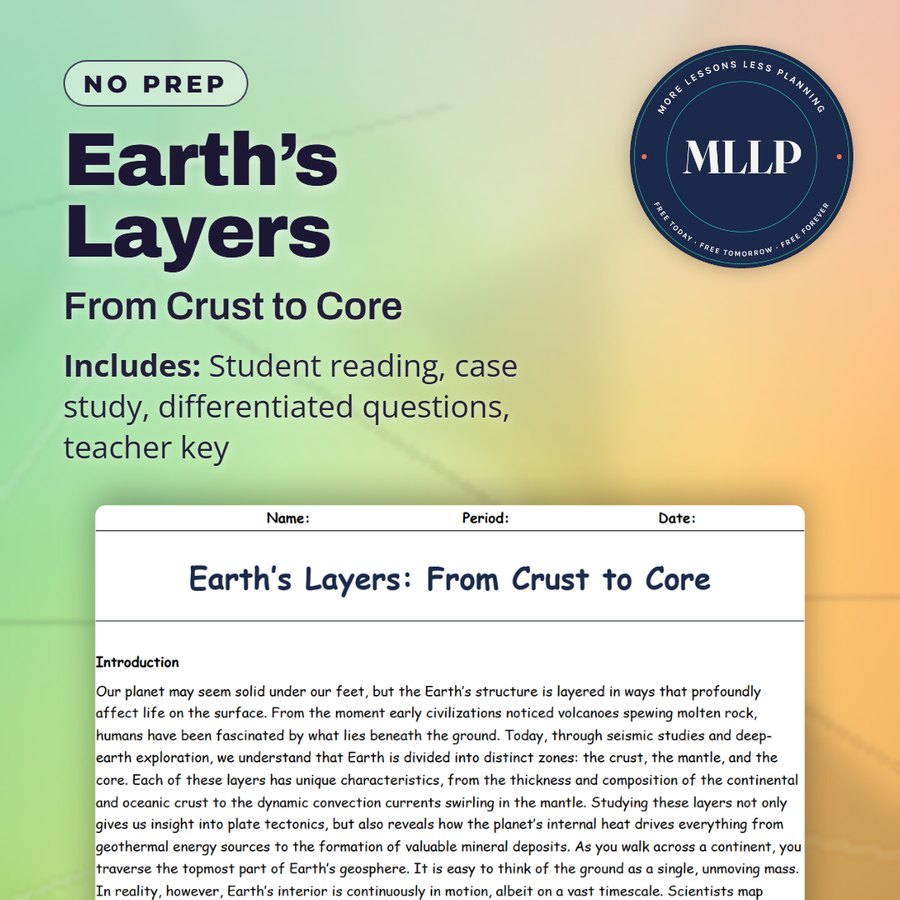
Earth’s Layers: From Crust to Core
Quality reviewed September 2026
Facts verified September 14, 2026
- Subject
- Social Studies
- Grades
- Grades 9-12
- Length
- 9-page student worksheet
- Time
- About one 50-minute class period
- Great for
- Sub plans and independent work
- Includes
- Reading passage, comprehension questions + full answer key
- Format
- Print-and-go PDF
What students do
- Match terms like Mantle Plume, Subduction Zone, Transform Boundary, Outer Core, and Crustal Uplift to their correct definitions
- Fill in the blank sentences on the inner core, oceanic crust, and geothermal energy
- Answer multiple choice questions on which layer generates Earth's magnetic field, how continental crust differs from oceanic crust, and what drives plate tectonics
- Write short answers on how understanding Earth's layers helps mitigate natural disasters, why the mantle matters for plate tectonics, and why studying the core matters for technology and navigation
What it covers
- The crust and mantle, including the difference between continental and oceanic crust and how mantle convection powers plate tectonics
- The outer and inner core, how the liquid outer core generates Earth's magnetic field, and what seismic waves reveal about the solid inner core
- A case study on geothermal energy drilling in Iceland and how the country taps heat from its crust and mantle for electricity and heating
Start reading this worksheet
Introduction
Our planet may seem solid under our feet, but the Earth’s structure is layered in ways that profoundly affect life on the surface. From the moment early civilizations noticed volcanoes spewing molten rock, humans have been fascinated by what lies beneath the ground. Today, through seismic studies and deep-earth exploration, we understand that Earth is divided into distinct zones: the crust, the mantle, and the core. Each of these layers has unique characteristics, from the thickness and composition of the continental and oceanic crust to the dynamic convection currents swirling in the mantle. Studying these layers not only gives us insight into plate tectonics, but also reveals how the planet’s internal heat drives everything from geothermal energy sources to the formation of valuable mineral deposits. As you walk across a continent, you traverse the topmost part of Earth’s geosphere. It is easy to think of the ground as a single, unmoving mass. In reality, however, Earth’s interior is continuously in motion, albeit on a vast timescale. Scientists map seismic waves and volcanic activity to gain information about areas we can’t directly observe. By piecing together these data, they’ve built models showing how the crust varies in thickness, sometimes as thin as five kilometers beneath the oceans and up to seventy kilometers under mountain ranges. Beneath this crust lies the massive mantle, accounting for most of Earth’s bulk. Go deeper still, and you hit the core, a superheated region that influences the planet’s magnetic field. Each layer plays a critical role in shaping the planet’s surface, from earthquakes to volcanic eruptions.
The Crust: Earth’s Outermost Layer
The crust is the thin, relatively cool outer shell of our planet. Although it is the most familiar layer (after all, we live on it), its features vary substantially between the continental crust and the oceanic crust. Continental crust, which forms the landmasses we inhabit, is generally thicker and composed mostly of lighter, granitic rocks. Oceanic crust, on the other hand, is thinner but denser, made largely of basaltic rocks formed at mid-ocean ridges where tectonic plates separate. This contrast explains why continents ride higher on the mantle, a phenomenon referred to as isostasy. While the oceanic crust may seem remote to our daily lives, it plays a key role in understanding plate tectonics. These slabs of rock are constantly being created and destroyed. At divergent plate boundaries, new oceanic crust forms as magma wells up from below, cools, and solidifies. Over millions of years, the newly formed crust migrates away from the ridge, only to be recycled back into the mantle at subduction zones. Continental crust can be deformed, fractured, and pushed upward to form mountains or rifted apart during tectonic movement. By measuring how crustal plates move a few centimeters per year (about the rate at which your fingernails grow), scientists can predict potential zones of earthquakes and volcanic activity.
The Mantle: Convection and Movement
Beneath the crust is the mantle, a vast region of semi-solid rock that makes up the bulk of Earth’s volume. It extends roughly 2,900 kilometers below the surface and can be subdivided into the upper mantle and the lower mantle. The upper portion, partially molten in places, flows very slowly. This motion is driven by convection currents: heat from the deeper mantle and core causes hotter, less dense material to rise, while cooler, denser material sinks. Over geological timescales, these circulating currents carry enormous slabs of crust, effectively powering plate tectonics. The mantle is primarily composed of silicate minerals rich in magnesium and iron. Though solid under normal conditions, it behaves plastically over millions of years. This capacity for slow, creeping flow is exactly what allows tectonic plates to shift above it. When mantle plumes (columns of hotter, upwelling rock) rise close to Earth’s surface, they can cause widespread volcanism. Notable hotspots like Hawaii owe their existence to these ascending mantle plumes, which release lava through repeated volcanic eruptions, eventually forming entire island chains. Crucially, the mantle’s role in driving plate motions has significant implications for natural hazards. Fault lines form where plates interact, leading to earthquakes when stress accumulates and is abruptly released. Where rising magma finds a pathway through weaknesses in the crust, volcanic eruptions can reshape landscapes, add new crustal material, or even influence global climate if the eruption is powerful enough. For geologists, understanding the mantle’s inner workings is key to explaining, and possibly forecasting, such events.
Like what you read? The full reading, the case study, and every question set are in the free download below, along with the answer key.
Why this matters
Iceland heats homes and generates electricity by drilling into heat starting at the crust and mantle, the practical payoff this reading builds toward. First it takes students from the ground down to the center of the planet: continental versus oceanic crust, mantle convection, and how the liquid outer core generates Earth's magnetic field.
I place this at the start of a plate tectonics unit so students have the layers to reference once boundaries and earthquakes come up. The reference table lets them check their matching answers before short answer questions ask why the core matters for something as unrelated-sounding as navigation.
From one teacher to another
This reading takes students from the ground down to the center of the planet, layer by layer, tying each one to something practical: the crust to earthquakes and mountain building, the mantle to plate tectonics, and the core to Earth's magnetic field. The Iceland case study is a favorite of mine because it shows geothermal energy as a direct, practical payoff of understanding these layers. The quick reference table is handy for students to check their matching answers before moving into the short answer section. This fits well at the start of a plate tectonics unit.
What you get
Download
Where should I send the next one?
Everything here is free and it stays that way. Leave your email and I'll send you the new lessons as they go up. You can unsubscribe from any one of them.
Related resources
Biomes & Ecosystems: Life Across Earth’s Habitats
Climate vs. Weather: Understanding the Difference
Convergent Boundaries: Where Plates Collide
Deserts: Survival in the Harshest Climates
Divergent Boundaries: Where Plates Pull Apart
Grasslands: Where Grasses Rule the Landscape
Every lesson on this site is free to download and use. If one of them saved you a prep period, you can chip in a few bucks toward my three kids' daycare fund. That's genuinely where tips go.