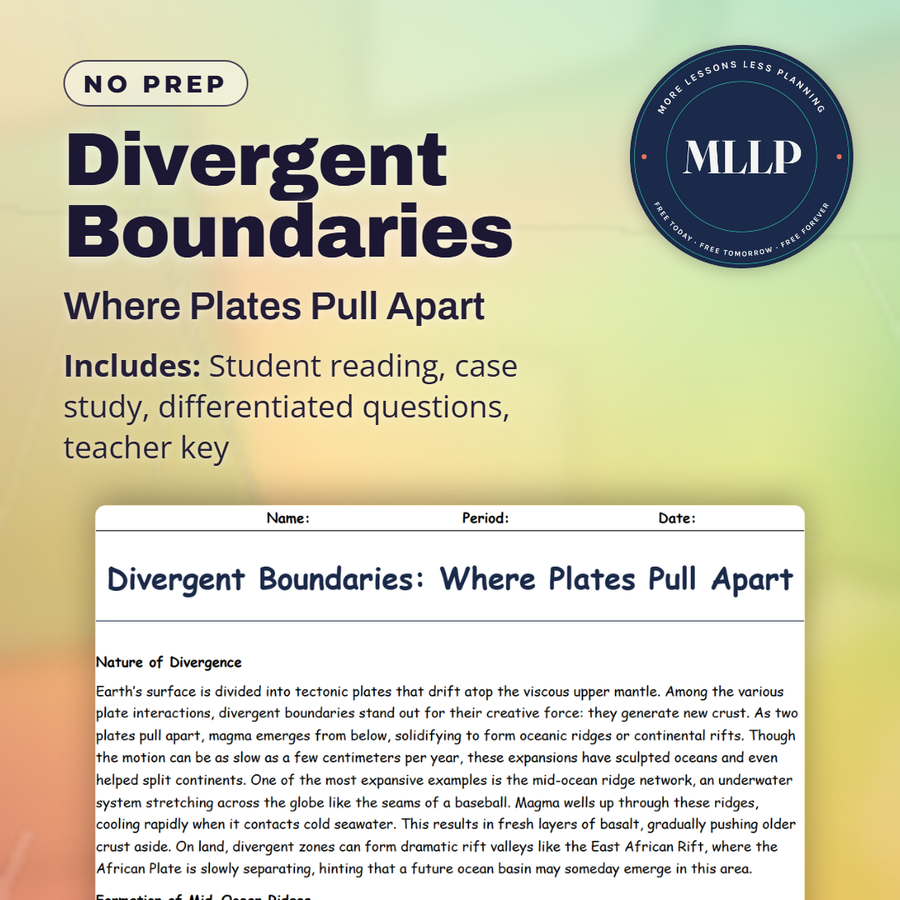
Divergent Boundaries: Where Plates Pull Apart
Quality reviewed September 2026
Facts verified September 14, 2026
- Subject
- Social Studies
- Grades
- Grades 9-12
- Length
- 6-page student worksheet
- Time
- About one 50-minute class period
- Great for
- Sub plans and independent work
- Includes
- Reading passage, comprehension questions + full answer key
- Format
- Print-and-go PDF
What students do
- Match terms like Rift Valley, Seafloor Spreading, Mid-Ocean Ridge, Hydrothermal Vent, and Iceland to their correct definitions
- Fill in the blank sentences on divergent boundaries, seafloor spreading, and rift valleys
- Answer multiple choice questions on what drives seafloor spreading, what a continental rift indicates, and the role of hydrothermal vents
- Write short answers on how seafloor spreading reveals plate movement, how continental rifts differ from mid-ocean ridges, and why rift zone communities turn to geothermal energy
What it covers
- How divergent boundaries form new crust, from mid-ocean ridges and seafloor spreading to hydrothermal vent ecosystems
- Continental rifts like the East African Rift, including the volcanic activity and geothermal energy potential found there
- A case study on Iceland's location on the Mid-Atlantic Ridge and the 2010 Eyjafjallajökull eruption that disrupted European air travel
Start reading this worksheet
Nature of Divergence
Earth’s surface is divided into tectonic plates that drift atop the viscous upper mantle. Among the various plate interactions, divergent boundaries stand out for their creative force: they generate new crust. As two plates pull apart, magma emerges from below, solidifying to form oceanic ridges or continental rifts. Though the motion can be as slow as a few centimeters per year, these expansions have sculpted oceans and even helped split continents. One of the most expansive examples is the mid-ocean ridge network, an underwater system stretching across the globe like the seams of a baseball. Magma wells up through these ridges, cooling rapidly when it contacts cold seawater. This results in fresh layers of basalt, gradually pushing older crust aside. On land, divergent zones can form dramatic rift valleys like the East African Rift, where the African Plate is slowly separating, hinting that a future ocean basin may someday emerge in this area.
Formation of Mid-Ocean Ridges
In the mid-20th century, scientists gathering seafloor data noticed that rocks near the ridges were surprisingly young, while those farther away were older. This led to the theory of seafloor spreading. Along these submarine mountain chains, magma seeps from the mantle and crystallizes. The ridges aren’t just static bumps; they often feature a central rift valley where the seafloor splits. Hydrothermal vents, or “black smokers,” dot some areas, spewing superheated, mineral-laden water that supports exotic chemosynthetic life forms. These hydrothermal ecosystems surprised biologists, as they rely on chemical energy rather than sunlight. Tube worms, giant clams, and specialized bacteria flourish around these vents, offering insight into how life might exist in extreme environments beyond Earth. Geophysicists and marine geologists deploy submersibles and robotic vehicles to study these depths, tracing how the entire ocean floor renews itself over tens of millions of years.
Continental Rifts
While most divergent boundaries lie beneath oceans, some occur on land. When a continent begins to break apart, the crust thins and stretches, forming a rift valley. The East African Rift provides a compelling case, showcasing volcanic mountains such as Mount Kilimanjaro, hot springs, and repeated earthquakes. Over millions of years, water may invade these rifts, transforming them into narrow seas and, potentially, new oceans. Local communities in rift zones face both opportunities and challenges. Geothermal energy is abundant, offering a cleaner power source compared to fossil fuels. On the flip side, faulting can damage infrastructure and farmland, while volcanic hazards threaten towns. Understanding rift dynamics helps governments implement building codes, disaster preparedness, and sustainable energy projects.
Like what you read? The full reading, the case study, and every question set are in the free download below, along with the answer key.
Why this matters
A single eruption in Iceland in 2010 disrupted air travel across Europe. This reading explains why a country that small sits on that kind of power: it straddles the Mid-Atlantic Ridge, where two plates pull apart. The same process, further south, opened the East African Rift.
Reading this next to the convergent boundaries worksheet lets students see the two forces as one system, not separate topics. Most have heard of a volcano canceling flights, so the Eyjafjallajökull eruption gives seafloor spreading a real headline, and the rift's geothermal potential gives the idea a practical payoff too.
From one teacher to another
This reading pairs well with the convergent boundaries worksheet since it covers the opposite process: plates spreading apart instead of colliding. Students see how mid-ocean ridges and continental rifts like the one in East Africa both trace back to the same divergent force, just in different settings. The Iceland case study ties it together nicely, since most students have at least heard of a volcano disrupting flights. I like that the reading also touches on hydrothermal vent ecosystems, which adds an unexpected layer beyond just the geology.
What you get
Download
Where should I send the next one?
Everything here is free and it stays that way. Leave your email and I'll send you the new lessons as they go up. You can unsubscribe from any one of them.
Related resources
Biomes & Ecosystems: Life Across Earth’s Habitats
Climate vs. Weather: Understanding the Difference
Convergent Boundaries: Where Plates Collide
Deserts: Survival in the Harshest Climates
Earth’s Layers: From Crust to Core
Grasslands: Where Grasses Rule the Landscape
Every lesson on this site is free to download and use. If one of them saved you a prep period, you can chip in a few bucks toward my three kids' daycare fund. That's genuinely where tips go.