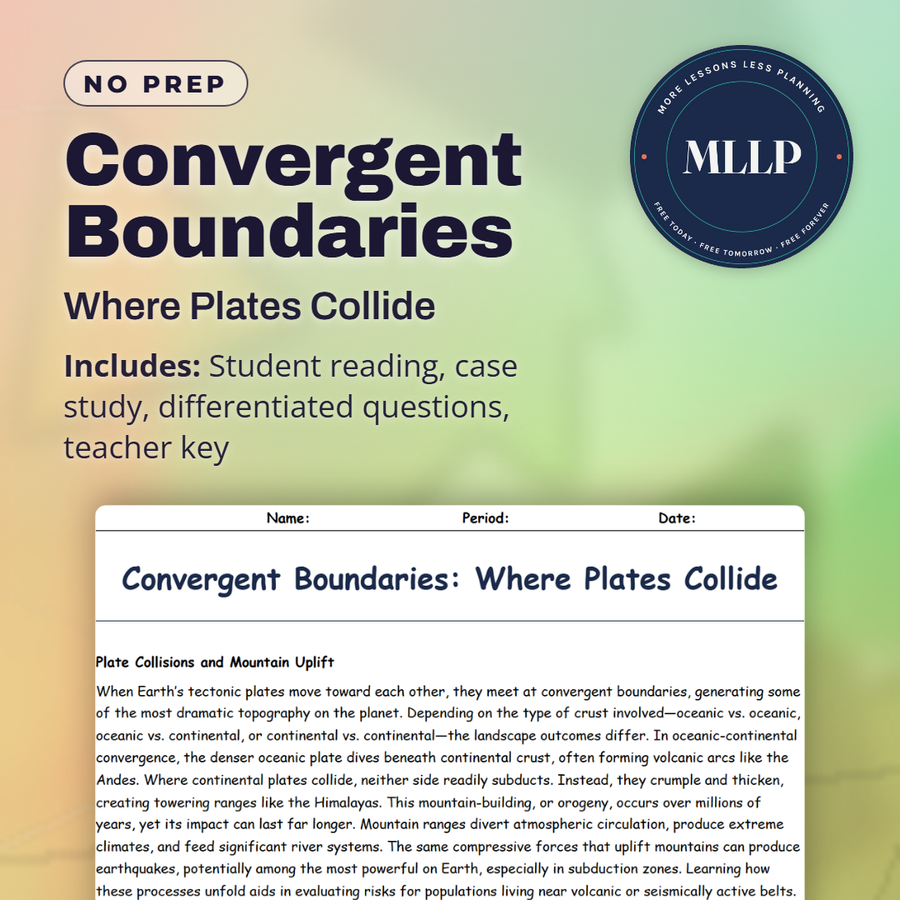
Convergent Boundaries: Where Plates Collide
Quality reviewed September 2026
Facts verified September 14, 2026
- Subject
- Social Studies
- Grades
- Grades 9-12
- Length
- 7-page student worksheet
- Time
- About one 50-minute class period
- Great for
- Sub plans and independent work
- Includes
- Reading passage, comprehension questions + full answer key
- Format
- Print-and-go PDF
What students do
- Match terms like Subduction Zone, Megathrust Quake, Himalayas, Island Arc, and Ring of Fire to their correct definitions
- Fill in the blank sentences on convergent boundaries, continental-continental collisions, and tsunamis
- Answer multiple choice questions on how subduction works, why volcanic arcs form, and what continental-continental collisions produce
- Write short answers on why subduction zones produce powerful earthquakes, how mountain-building affects local ecosystems, and what strategies reduce subduction zone risks
What it covers
- The three types of convergent boundaries, from oceanic-oceanic to continental-continental, and how each produces different landforms like volcanic arcs or mountain ranges
- Subduction zones, the Ring of Fire, and the earthquake and tsunami risks tied to plates sinking beneath one another
- A case study on the Cascadia Subduction Zone, the 1700 megathrust earthquake, and how Pacific Northwest cities prepare for the next one
Start reading this worksheet
Plate Collisions and Mountain Uplift
When Earth’s tectonic plates move toward each other, they meet at convergent boundaries, generating some of the most dramatic topography on the planet. Depending on the type of crust involved (oceanic vs. oceanic, oceanic vs. continental, or continental vs. continental), the landscape outcomes differ. In oceanic-continental convergence, the denser oceanic plate dives beneath continental crust, often forming volcanic arcs like the Andes. Where continental plates collide, neither side readily subducts. Instead, they crumple and thicken, creating towering ranges like the Himalayas. This mountain-building, or orogeny, occurs over millions of years, yet its impact can last far longer. Mountain ranges divert atmospheric circulation, produce extreme climates, and feed significant river systems. The same compressive forces that uplift mountains can produce earthquakes, potentially among the most powerful on Earth, especially in subduction zones. Learning how these processes unfold aids in evaluating risks for populations living near volcanic or seismically active belts.
Subduction Zones
Where an oceanic plate plunges under another plate, we find a subduction zone. This region is marked by a deep ocean trench, such as the Mariana Trench in the Pacific. As the subducting slab sinks, it carries water and sediment into the mantle, lowering the melting point of the overlying rock. This partial melting generates magma that can fuel volcanoes. Along the Ring of Fire, which encircles the Pacific Ocean, volcanic activity stems largely from these subduction-related processes. Subduction zones also create powerful earthquakes, sometimes leading to tsunamis if the seafloor shifts abruptly. The 2004 Indian Ocean tsunami is a sobering reminder of the potential impact; an undersea quake triggered massive waves that devastated coastal communities across multiple countries. Because subduction zones accumulate stress over centuries, seismic events can be infrequent but catastrophic. Recognizing early-warning signs and implementing preparedness strategies saves lives.
Continental Collisions
When continental plates converge, subduction is minimal because both plates are relatively buoyant. Instead, the crust buckles, thickens, and lifts into monumental ranges. The Himalayas formed when the Indian Plate rammed into Eurasia, a collision that persists today. As mountains grow higher, weathering and erosion act to sculpt them, forming precipitous peaks and deep valleys. Meanwhile, the increased elevation influences local climates, often creating rain shadows and specialized mountain ecosystems. Despite fewer volcanoes in purely continental collisions, earthquake hazards remain severe. Large quakes can alter entire landscapes, damming rivers and triggering landslides. Populations living in high-altitude basins can face floods if glacial lakes overrun their natural barriers. Understanding these geologic forces informs infrastructure planning: roads, dams, and buildings all need robust engineering to withstand shifting ground.
Like what you read? The full reading, the case study, and every question set are in the free download below, along with the answer key.
Why this matters
Seattle and Portland sit near a fault line most residents have never heard of. The Cascadia Subduction Zone last ruptured in 1700, and this reading explains why that coast is overdue for another one: oceanic crust sliding beneath continental crust until the strain releases as a megathrust quake.
Other collisions build mountains like the Himalayas or volcanic arcs like the Andes. Once students can sort a boundary into oceanic-oceanic, oceanic-continental, or continental-continental with the reference table, tectonics stops being one vague fact about shaking ground.
From one teacher to another
This reading covers convergent boundaries from the ground up: how oceanic and continental crust interact differently, why some collisions build mountains like the Himalayas while others create volcanic arcs like the Andes, and where the earthquake risk comes from. The Cascadia case study is a strong hook because it ties the geology directly to cities students may have heard of, like Seattle and Portland. The quick reference table keeps the three boundary types straight before students hit the matching section. This pairs well with a broader plate tectonics unit alongside divergent and transform boundaries.
What you get
Download
Where should I send the next one?
Everything here is free and it stays that way. Leave your email and I'll send you the new lessons as they go up. You can unsubscribe from any one of them.
Related resources
Biomes & Ecosystems: Life Across Earth’s Habitats
Climate vs. Weather: Understanding the Difference
Deserts: Survival in the Harshest Climates
Divergent Boundaries: Where Plates Pull Apart
Earth’s Layers: From Crust to Core
Grasslands: Where Grasses Rule the Landscape
Every lesson on this site is free to download and use. If one of them saved you a prep period, you can chip in a few bucks toward my three kids' daycare fund. That's genuinely where tips go.