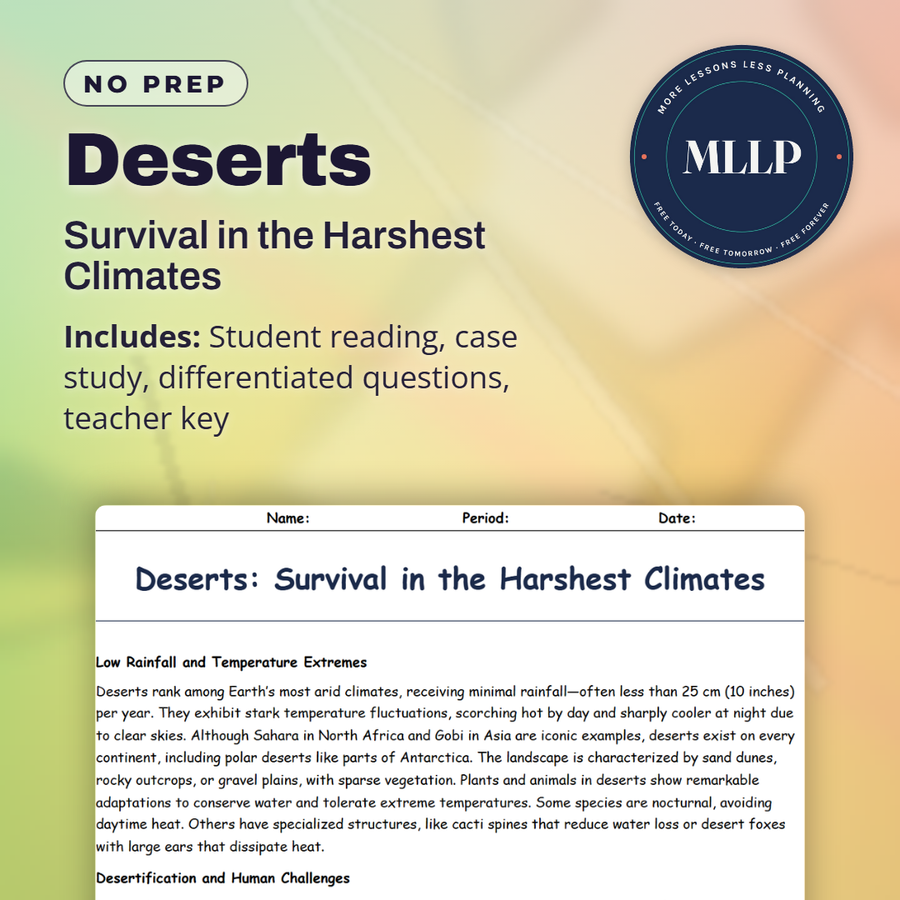
Deserts: Survival in the Harshest Climates
Quality reviewed September 2026
Facts verified September 14, 2026
- Subject
- Social Studies
- Grades
- Grades 9-12
- Length
- 6-page student worksheet
- Time
- About one 50-minute class period
- Great for
- Sub plans and independent work
- Includes
- Reading passage, comprehension questions + full answer key
- Format
- Print-and-go PDF
What students do
- Match terms like Oasis, Drip Irrigation, Desert Bloom, Permafrost, and Shelterbelt to their correct definitions
- Fill in the blank sentences on desertification, succulent plants, and oases
- Answer multiple choice questions on typical desert rainfall totals, what causes desertification, and why desert animals are often nocturnal
- Write short answers on why deserts get so cold at night, how deforestation can contribute to desertification, and how reforestation projects combat desert encroachment
What it covers
- Desert climate features, from extreme temperature swings to low annual rainfall, and the plant and animal adaptations that make survival possible
- Desertification and its human causes, including overgrazing and land mismanagement in regions like the Sahel
- A case study on drip irrigation and shelterbelt planting used to fight sand encroachment along the edge of the Sahara
Start reading this worksheet
Low Rainfall and Temperature Extremes
Deserts rank among Earth’s most arid climates, receiving minimal rainfall: often less than 25 cm (10 inches) per year. They exhibit stark temperature fluctuations, scorching hot by day and sharply cooler at night due to clear skies. Although Sahara in North Africa and Gobi in Asia are iconic examples, deserts exist on every continent, including polar deserts like parts of Antarctica. The landscape is characterized by sand dunes, rocky outcrops, or gravel plains, with sparse vegetation. Plants and animals in deserts show remarkable adaptations to conserve water and tolerate extreme temperatures. Some species are nocturnal, avoiding daytime heat. Others have specialized structures, like cacti spines that reduce water loss or desert foxes with large ears that dissipate heat.
Desertification and Human Challenges
Desertification occurs when land degrades, losing vegetation and productive capacity, often due to overgrazing, deforestation, or unsustainable water use. Climate change can exacerbate this trend by intensifying droughts and raising temperatures. Regions bordering deserts, like the Sahel in Africa, face a heightened risk of expanding desert conditions, endangering agriculture and local livelihoods. Humans who inhabit deserts often rely on resourcefulness: herding animals adapted to sparse grass or trading in oasis towns. Modern technology (like solar power or drip irrigation) can assist in making deserts more habitable. However, water scarcity remains a central problem. Groundwater, if not carefully managed, can be depleted rapidly. Moreover, desert storms can carry dust across continents, impacting air quality far beyond desert borders.
Like what you read? The full reading, the case study, and every question set are in the free download below, along with the answer key.
Why this matters
A desert can drop from scorching heat to near freezing within a single day, which breaks the assumption that deserts are simply hot. From there the reading moves into desertification, tracing how overgrazing and land mismanagement in places like the Sahel turn productive land to sand.
Students expect a desertification reading to end on a warning, so the case study on drip irrigation and shelterbelt planting along the Sahara's edge matters: it gives them an actual response to point to. That shift, from describing damage to describing a fix, is what makes the last section worth assigning.
From one teacher to another
This one explains why deserts can be freezing at night after a scorching day. The reading covers the climate basics, then moves into desertification and the human factors that make it worse, before ending on a case study about drip irrigation and tree planting along the Sahara's edge. I like that the case study gives students a concrete example of a solution rather than just a list of problems. This pairs well with a broader climate zones unit or a look at land use and resource management.
What you get
Download
Where should I send the next one?
Everything here is free and it stays that way. Leave your email and I'll send you the new lessons as they go up. You can unsubscribe from any one of them.
Related resources
Biomes & Ecosystems: Life Across Earth’s Habitats
Climate vs. Weather: Understanding the Difference
Convergent Boundaries: Where Plates Collide

Divergent Boundaries: Where Plates Pull Apart
Earth’s Layers: From Crust to Core
Grasslands: Where Grasses Rule the Landscape
Every lesson on this site is free to download and use. If one of them saved you a prep period, you can chip in a few bucks toward my three kids' daycare fund. That's genuinely where tips go.