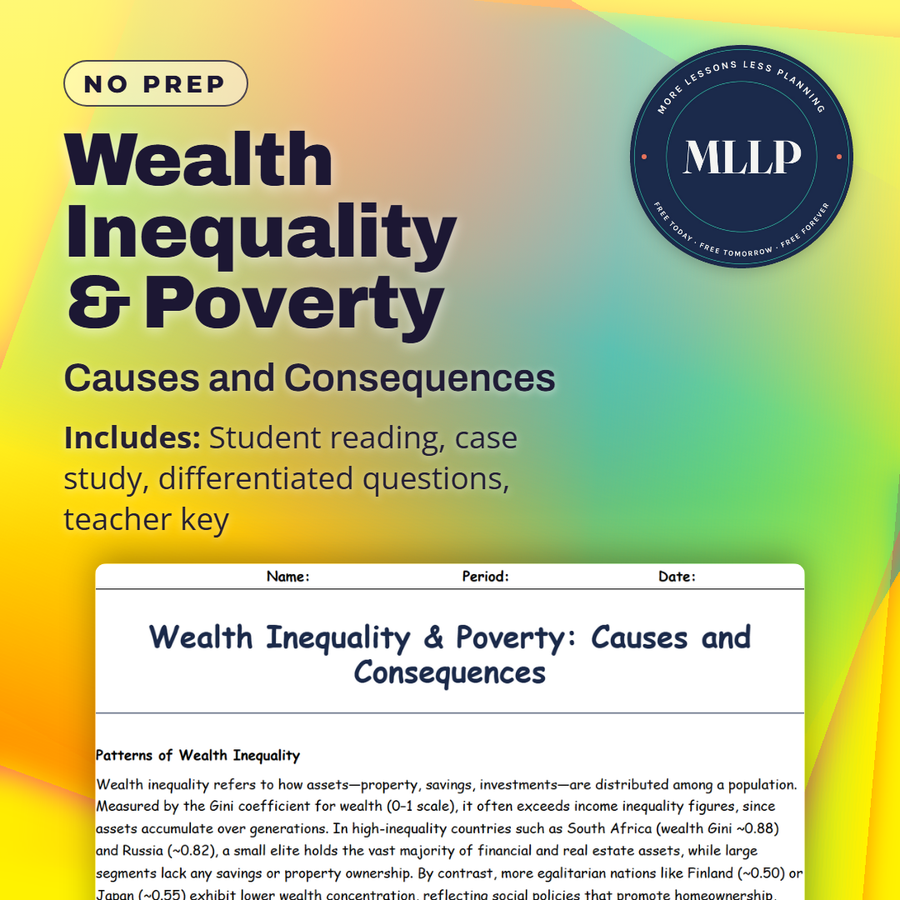
Wealth Inequality & Poverty: Causes and Consequences
Quality reviewed September 2026
Facts verified September 14, 2026
- Subject
- Social Studies
- Grades
- Grades 9-12
- Length
- 7-page student worksheet
- Time
- About one 50-minute class period
- Great for
- Sub plans and independent work
- Includes
- Reading passage, comprehension questions + full answer key
- Format
- Print-and-go PDF
What students do
- Match terms like progressive taxation, Bolsa Família, microcredit, and the Sustainable Development Goals to their correct goals
- Fill in the blank sentences on the Gini coefficient, conditional cash transfer requirements, and the UN's extreme poverty targets
- Answer multiple choice questions on what a high wealth Gini coefficient means, what conditional cash transfers require, and structural causes of poverty
- Write short answers on the strengths and limits of microfinance, how progressive taxation addresses wealth concentration, and why public education reduces long-term poverty
What it covers
- How wealth inequality is measured with the Gini coefficient and why it often exceeds income inequality
- Structural causes of poverty, including education gaps, geographic isolation, and discrimination
- A case study on the Grameen Bank's microcredit program in Bangladesh and its effect on borrowers, mostly women
Start reading this worksheet
Patterns of Wealth Inequality
Wealth inequality refers to how assets (property, savings, investments) are distributed among a population. Measured by the Gini coefficient for wealth (0–1 scale), it often exceeds income inequality figures, since assets accumulate over generations. In high-inequality countries such as South Africa (wealth Gini ~0.88) and Russia (~0.82), a small elite holds the vast majority of financial and real estate assets, while large segments lack any savings or property ownership. By contrast, more egalitarian nations like Finland (~0.50) or Japan (~0.55) exhibit lower wealth concentration, reflecting social policies that promote homeownership, retirement savings, and inheritance taxes. Understanding these patterns helps students see why two families earning the same income can have vastly different levels of economic security and upward mobility. Wealth provides a cushion against shocks: unemployment, medical emergencies. It also funds investments in education or business ventures. Without assets, low-income households face higher borrowing costs or become reliant on informal credit networks, perpetuating cycles of poverty.
Structural Causes of Poverty
Poverty arises from complex, interrelated factors. Education gaps limit access to skilled employment, while health disparities (malnutrition, disease) reduce productivity and increase healthcare expenses. Geographic isolation, such as rural communities with poor infrastructure, restricts market access, trapping residents in subsistence activities. Moreover, labor market shifts (automation, globalization) erode traditional blue-collar job opportunities, disproportionately affecting workers without specialized skills. Institutional factors also play a role: weak governance, corruption, and lack of social safety nets leave vulnerable groups unprotected. Discrimination, based on race, gender, or caste, can systematically exclude people from land ownership, credit, or formal employment. By exploring these root causes, students learn that poverty is not solely an individual failing but often the outcome of broader economic and social structures. Table 1: Wealth Inequality and Poverty Rates in Selected Countries
Consequences for Society and Growth
High inequality and poverty undermine social cohesion and economic stability. When a majority feels left behind, political polarization and social unrest often follow. Extreme wealth gaps can skew policy: affluent groups fund lobbying and campaign contributions, shaping regulations to their advantage. On the economic front, low aggregate demand in underprivileged communities limits market growth, while underinvestment in human capital curbs long-term innovation and productivity. Moreover, poverty exacts immense social costs: higher crime rates, deteriorating public health, and lower educational attainment. Children growing up in impoverished households face developmental challenges that can persist into adulthood. Addressing inequality and poverty is thus not only a moral imperative but an economic necessity. By analyzing these effects, students appreciate why governments implement redistributive policies and targeted poverty alleviation programs.
Like what you read? The full reading, the case study, and every question set are in the free download below, along with the answer key.
Why this matters
A woman with no collateral and no credit history is not who a bank usually lends to, which is what makes the Grameen Bank's microcredit program in Bangladesh worth reading closely. Small loans to borrowers who had never qualified before sit at the center of this reading on wealth inequality.
Students tend to assume poverty comes down to one bad policy, so I use the Gini coefficient and tools like progressive taxation and conditional cash transfers to show how many levers are in play at once. Coming after the earlier reading on Brazil's Bolsa Família, this one lets students compare a cash program against a lending program side by side.
From one teacher to another
I like this one for grounding wealth inequality in something students can picture, like the Grameen Bank's small loans to women in Bangladesh who had no collateral or credit history. It also gives a clear rundown of policy tools like progressive taxation and conditional cash transfers, which builds nicely on the earlier reading about Brazil's Bolsa Família. This works well toward the end of a development unit.
What you get
Download
Where should I send the next one?
Everything here is free and it stays that way. Leave your email and I'll send you the new lessons as they go up. You can unsubscribe from any one of them.
Related resources

Agriculture & Food Production: Feeding the Future
Economic Development Indicators: GDP, HDI & Beyond
Economic Sectors Explained: Primary, Secondary, Tertiary & Quaternary
Economic Systems Compared: Capitalism, Socialism & Mixed Models
Globalization & Outsourcing: Connecting World Economies
Industrial Resources & Sustainability: Balancing Growth
Every lesson on this site is free to download and use. If one of them saved you a prep period, you can chip in a few bucks toward my three kids' daycare fund. That's genuinely where tips go.