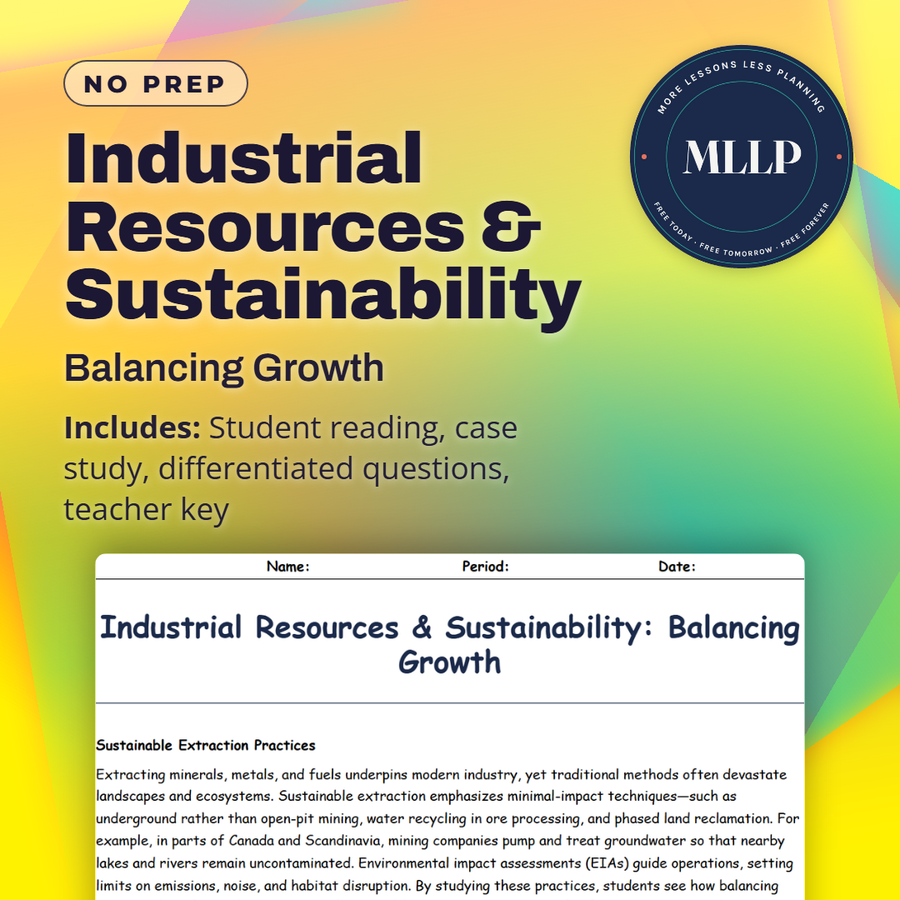
Industrial Resources & Sustainability: Balancing Growth
Quality reviewed September 2026
Facts verified September 14, 2026
- Subject
- Social Studies
- Grades
- Grades 9-12
- Length
- 8-page student worksheet
- Time
- About one 50-minute class period
- Great for
- Sub plans and independent work
- Includes
- Reading passage, comprehension questions + full answer key
- Format
- Print-and-go PDF
What students do
- Match terms like biomining, electric-arc furnaces, digital twins, and carbon pricing to their correct definitions
- Fill in the blank sentences on the circular economy, biomining, and public procurement demand for sustainable products
- Answer multiple choice questions on what urban mining reduces, what extended producer responsibility requires, and what carbon capture and utilization produces
- Write short answers on electric-arc furnaces, how deposit-refund schemes boost recycling, and why carbon pricing drives investment in cleaner technology
What it covers
- Sustainable extraction practices like underground mining, water recycling, and environmental impact assessments
- The circular economy, including urban mining, extended producer responsibility, and product-as-service models
- A case study on the Netherlands' Circular Steel Initiative and how recycled steel cut carbon emissions
Start reading this worksheet
Sustainable Extraction Practices
Extracting minerals, metals, and fuels underpins modern industry, yet traditional methods often devastate landscapes and ecosystems. Sustainable extraction emphasizes minimal-impact techniques, such as underground rather than open-pit mining, water recycling in ore processing, and phased land reclamation. For example, in parts of Canada and Scandinavia, mining companies pump and treat groundwater so that nearby lakes and rivers remain uncontaminated. Environmental impact assessments (EIAs) guide operations, setting limits on emissions, noise, and habitat disruption. By studying these practices, students see how balancing economic benefits with environmental stewardship preserves resources for future generations. Governments enforce regulations (limits on allowable pollutant discharge, mandatory reclamation bonds, and biodiversity offsets) to hold firms accountable. Public consultations engage local communities, ensuring that indigenous rights and social concerns shape project design. As a result, modern mines can operate alongside wildlife corridors and traditional land uses, demonstrating that resource extraction need not entail long-term environmental sacrifice.
The Circular Economy: Waste as a Resource
A circular economy shifts away from “take–make–dispose” toward a system where waste becomes input. Materials are reused, remanufactured, or recycled in closed loops. In metal industries, urban mining, which recovers copper from discarded electronics or steel from demolished buildings, reduces reliance on virgin ores and cuts energy consumption by up to 90 percent. Chemical recycling of plastics breaks long chains into monomers for new production, while glass and paper enjoy nearly 100 percent recyclability in many countries. Circular models demand redesigning products for durability, repairability, and material traceability. Companies adopt extended producer responsibility (EPR), where manufacturers manage end-of-life collection and recycling. Students can debate how shifting business models (from selling products to leasing services) encourages firms to maintain and upgrade equipment, aligning profit motives with sustainability goals. Table 1: Key Circular Economy Strategies
Innovation and Regulatory Frameworks
Innovation drives sustainability: biomining uses microbes to extract metals from low-grade ores with fewer chemicals, while carbon capture and utilization (CCU) transforms CO₂ into building materials or fuels. Digital twins, virtual replicas of facilities, optimize energy and resource flows in real time, pinpointing inefficiencies before they occur. High-school students can explore how sensors, drones, and AI analytics monitor mine sites, predict equipment failures, and enforce environmental compliance. At the policy level, carbon pricing, resource taxes, and green procurement standards push both public and private sectors to adopt cleaner technologies. International agreements, like the Minamata Convention on mercury, limit toxic releases from mining and industry. By comparing policy mixes across countries, learners grasp how regulation and innovation interact: stringent rules spur technological breakthroughs, while clear incentives ensure market uptake of sustainable solutions.
Like what you read? The full reading, the case study, and every question set are in the free download below, along with the answer key.
Why this matters
Recycled steel cutting carbon emissions in the Netherlands' Circular Steel Initiative is the case study that makes the circular economy feel like policy rather than a slogan. Urban mining and extended producer responsibility stop being terms to memorize once students see a country built a program around them.
I want students to see sustainability as more than mining less: electric-arc furnaces, deposit-refund schemes, and carbon pricing all push the same direction, and explaining how each piece drives the others matters more than listing them separately.
From one teacher to another
I like this one for moving past the usual pollution talking points into specific circular economy strategies like urban mining and extended producer responsibility. The Netherlands steel case study shows students what those strategies look like when a country commits to them at scale. It pairs naturally with the natural resources reading, since both deal with balancing extraction against long-term sustainability.
What you get
Download
Where should I send the next one?
Everything here is free and it stays that way. Leave your email and I'll send you the new lessons as they go up. You can unsubscribe from any one of them.
Related resources
Agriculture & Food Production: Feeding the Future
Economic Development Indicators: GDP, HDI & Beyond
Economic Sectors Explained: Primary, Secondary, Tertiary & Quaternary
Economic Systems Compared: Capitalism, Socialism & Mixed Models
Globalization & Outsourcing: Connecting World Economies
Industrialization & Global Trade: From Factories to Free Markets
Every lesson on this site is free to download and use. If one of them saved you a prep period, you can chip in a few bucks toward my three kids' daycare fund. That's genuinely where tips go.