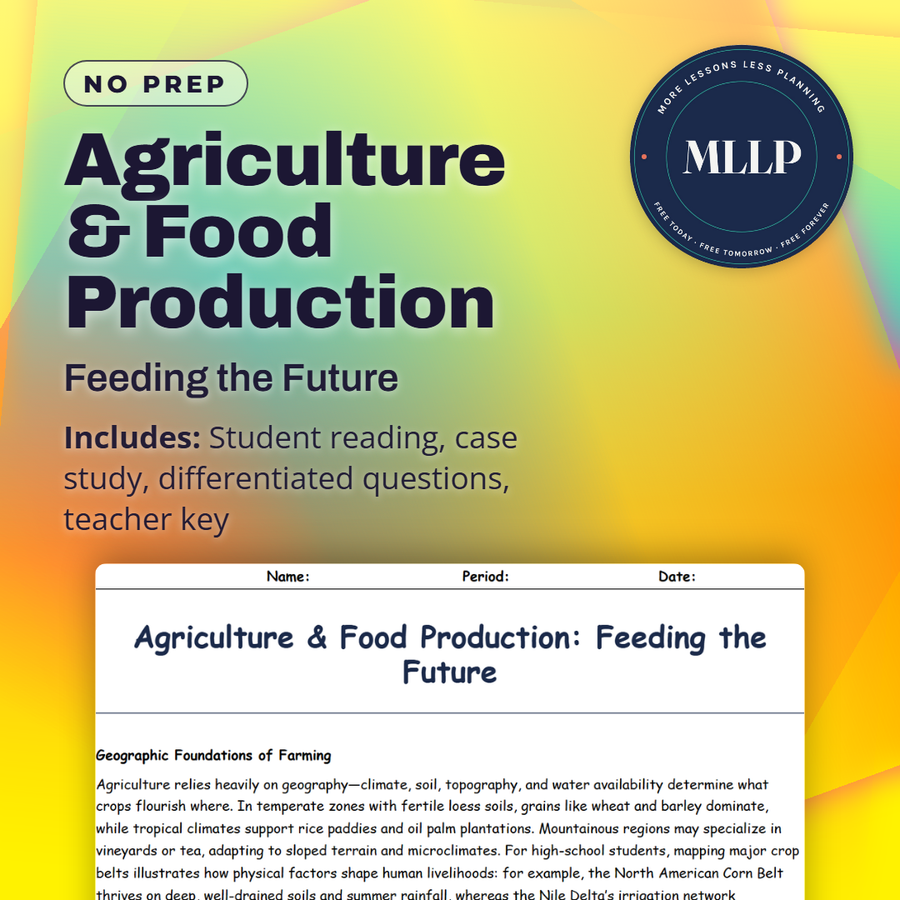
Agriculture & Food Production: Feeding the Future
Quality reviewed September 2026
Facts verified September 14, 2026
- Subject
- Social Studies
- Grades
- Grades 9-12
- Length
- 7-page student worksheet
- Time
- About one 50-minute class period
- Great for
- Sub plans and independent work
- Includes
- Reading passage, comprehension questions + full answer key
- Format
- Print-and-go PDF
What students do
- Match agricultural innovations like drone crop monitoring, LED-lit vertical farms, and alternate wetting and drying to their correct descriptions
- Fill in the blank sentences on Green Revolution seed varieties, precision farming's reduction of input waste, and extensive agriculture's input use
- Answer multiple choice questions on extensive cattle ranching, the original Green Revolution, and the goal of precision agriculture
- Write short answers on the benefits and drawbacks of rice intensification, how precision agriculture helps smallholder farmers, and how vertical farming addresses land limits
What it covers
- How geography, including climate, soil, and topography, shapes crop belts like the North American Corn Belt and the Nile Delta
- The difference between intensive agriculture, with high inputs on small land, and extensive agriculture, with low inputs on large land
- A case study on the System of Rice Intensification in Madagascar and its effects on yields and water use
Start reading this worksheet
Geographic Foundations of Farming
Agriculture relies heavily on geography: climate, soil, topography, and water availability determine what crops flourish where. In temperate zones with fertile loess soils, grains like wheat and barley dominate, while tropical climates support rice paddies and oil palm plantations. Mountainous regions may specialize in vineyards or tea, adapting to sloped terrain and microclimates. For high-school students, mapping major crop belts illustrates how physical factors shape human livelihoods: for example, the North American Corn Belt thrives on deep, well-drained soils and summer rainfall, whereas the Nile Delta’s irrigation network undergirds centuries of Egyptian agriculture. Farming geography doesn’t stop at crop choice. Land tenure, transport networks, and market access influence whether farmers grow for subsistence or commercial sale. Smallholders in sub-Saharan Africa may struggle to get produce to urban centers without paved roads, limiting income and food security. Conversely, export-oriented plantations near ports benefit from global supply chains. Recognizing these geographic interconnections helps students appreciate why local conditions matter for feeding billions.
Intensive vs. Extensive Agricultural Systems
Agricultural methods fall on a spectrum from intensive to extensive. Intensive agriculture maximizes output per hectare using high-yield seeds, fertilizers, and irrigation, as seen in Dutch greenhouse horticulture or California’s Central Valley orchards. Such systems demand significant inputs and labor but produce large harvests on limited land. Extensive agriculture spreads low inputs (minimal irrigation or chemicals) over large areas, common in Australia’s sheep grazing or Brazil’s cattle ranches. Although less productive per hectare, extensive farms capitalize on vast land availability and lower labor costs. Each approach carries trade-offs. Intensive farms can deplete soils, pollute waterways with agrochemicals, and require energy-intensive infrastructure. Extensive farms may lead to deforestation, habitat loss, and greenhouse-gas emissions from methane-producing livestock. Students can compare yields, input costs, and environmental footprints to evaluate which method suits specific regions and policy goals. Table 1: Comparison of Agricultural Systems
Like what you read? The full reading, the case study, and every question set are in the free download below, along with the answer key.
Why this matters
Rice intensification in Madagascar doubled yields without heavy chemical inputs, proof that big gains do not always need more machinery. That case sits next to the Green Revolution and today's precision farming tools, three eras solving the same problem of feeding more people from the same land.
What surprises students is the split between intensive farming on small plots and extensive farming, like cattle ranching, across huge stretches. Once they place the Corn Belt and the Nile Delta on that spectrum, precision agriculture and input waste stop sounding abstract.
From one teacher to another
I like how this one lays out the difference between intensive and extensive farming before getting into the Green Revolution and today's precision agriculture tools. The case study on rice intensification in Madagascar gives students a concrete example of a low-cost practice that doubled yields without heavy chemical use. This pairs well with a unit on world food systems, and it works fine as a standalone reading too.
What you get
Download
Where should I send the next one?
Everything here is free and it stays that way. Leave your email and I'll send you the new lessons as they go up. You can unsubscribe from any one of them.
Related resources
Economic Development Indicators: GDP, HDI & Beyond
Economic Sectors Explained: Primary, Secondary, Tertiary & Quaternary
Economic Systems Compared: Capitalism, Socialism & Mixed Models
Globalization & Outsourcing: Connecting World Economies
Industrial Resources & Sustainability: Balancing Growth
Industrialization & Global Trade: From Factories to Free Markets
Every lesson on this site is free to download and use. If one of them saved you a prep period, you can chip in a few bucks toward my three kids' daycare fund. That's genuinely where tips go.