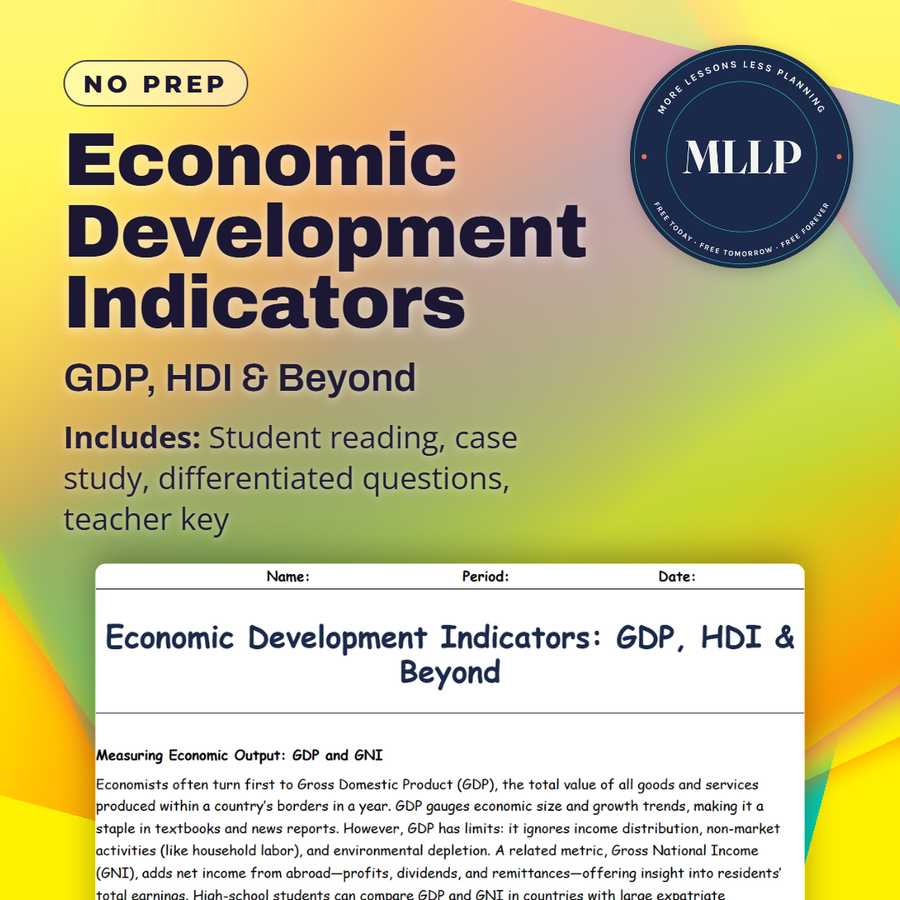
Economic Development Indicators: GDP, HDI & Beyond
Quality reviewed September 2026
Facts verified September 14, 2026
- Subject
- Social Studies
- Grades
- Grades 9-12
- Length
- 6-page student worksheet
- Time
- About one 50-minute class period
- Great for
- Sub plans and independent work
- Includes
- Reading passage, comprehension questions + full answer key
- Format
- Print-and-go PDF
What students do
- Match terms like GDP, HDI, the Gini coefficient, and the MPI to their correct definitions
- Fill in the blank sentences on HDI's education component, high Gini coefficients, and the requirements of Bolsa Família
- Answer multiple choice questions on GNI per capita, what a high Gini coefficient means, and how the MPI differs from GDP
- Write short answers on GDP's strengths and drawbacks, how conditional cash transfers affect health and education, and why composite indices matter for policy
What it covers
- GDP and GNI as measures of economic output, including how remittances raise GNI above GDP in countries like the Philippines
- The Human Development Index and how it combines health, education, and income into one score
- A case study on Brazil's Bolsa Família program and its effect on poverty and the Multidimensional Poverty Index
Start reading this worksheet
Measuring Economic Output: GDP and GNI
Economists often turn first to Gross Domestic Product (GDP), the total value of all goods and services produced within a country’s borders in a year. GDP gauges economic size and growth trends, making it a staple in textbooks and news reports. However, GDP has limits: it ignores income distribution, non-market activities (like household labor), and environmental depletion. A related metric, Gross National Income (GNI), adds net income from abroad (profits, dividends, and remittances), offering insight into residents’ total earnings. High-school students can compare GDP and GNI in countries with large expatriate communities. For example, the Philippines’ GNI exceeds its GDP by including overseas remittances, revealing the crucial role of migrant workers. Discussing these measures illuminates why a booming GDP doesn’t always translate into broader prosperity and sparks debates about what “economic success” truly means.
Beyond Output: The Human Development Index
To address GDP’s shortcomings, the Human Development Index (HDI) combines three dimensions: health (life expectancy), education (mean and expected years of schooling), and standard of living (GNI per capita). Developed by the United Nations, HDI ranks countries on a 0–1 scale, highlighting that wealthy nations tend to offer longer lives and better schooling. HDI reveals surprising trends: despite moderate GDP, Costa Rica outperforms many oil-rich states in HDI by investing heavily in universal healthcare and literacy programs. Encouraging students to dissect HDI components fosters critical thinking about policy priorities and compels them to consider holistic development, where social investments matter as much as economic output. Table 1: Key Development Indicators
Like what you read? The full reading, the case study, and every question set are in the free download below, along with the answer key.
Why this matters
A country's GNI can climb above its GDP without producing a single extra good, simply because workers send money home, the way remittances raise the Philippines' numbers. That gap is exactly why GDP alone can hide as much as it reveals, which is the opening this reading uses before introducing the Human Development Index.
The Brazil case study on Bolsa Família is where the numbers stop being abstract, tying the Gini coefficient and the Multidimensional Poverty Index to an actual cash transfer program. By the end students are questioning what a country should even be measured by to count as successful.
From one teacher to another
This reading walks students through GDP, GNI, and the Human Development Index before showing why national averages can hide real inequality. The Brazil case study on Bolsa Família ties the Gini coefficient and the MPI to an actual policy, which makes the numbers feel less abstract. It fits a broader development unit, since it gets students questioning what counts as economic success.
What you get
Download
Where should I send the next one?
Everything here is free and it stays that way. Leave your email and I'll send you the new lessons as they go up. You can unsubscribe from any one of them.
Related resources
Agriculture & Food Production: Feeding the Future
Economic Sectors Explained: Primary, Secondary, Tertiary & Quaternary
Economic Systems Compared: Capitalism, Socialism & Mixed Models
Globalization & Outsourcing: Connecting World Economies
Industrial Resources & Sustainability: Balancing Growth
Industrialization & Global Trade: From Factories to Free Markets
Every lesson on this site is free to download and use. If one of them saved you a prep period, you can chip in a few bucks toward my three kids' daycare fund. That's genuinely where tips go.