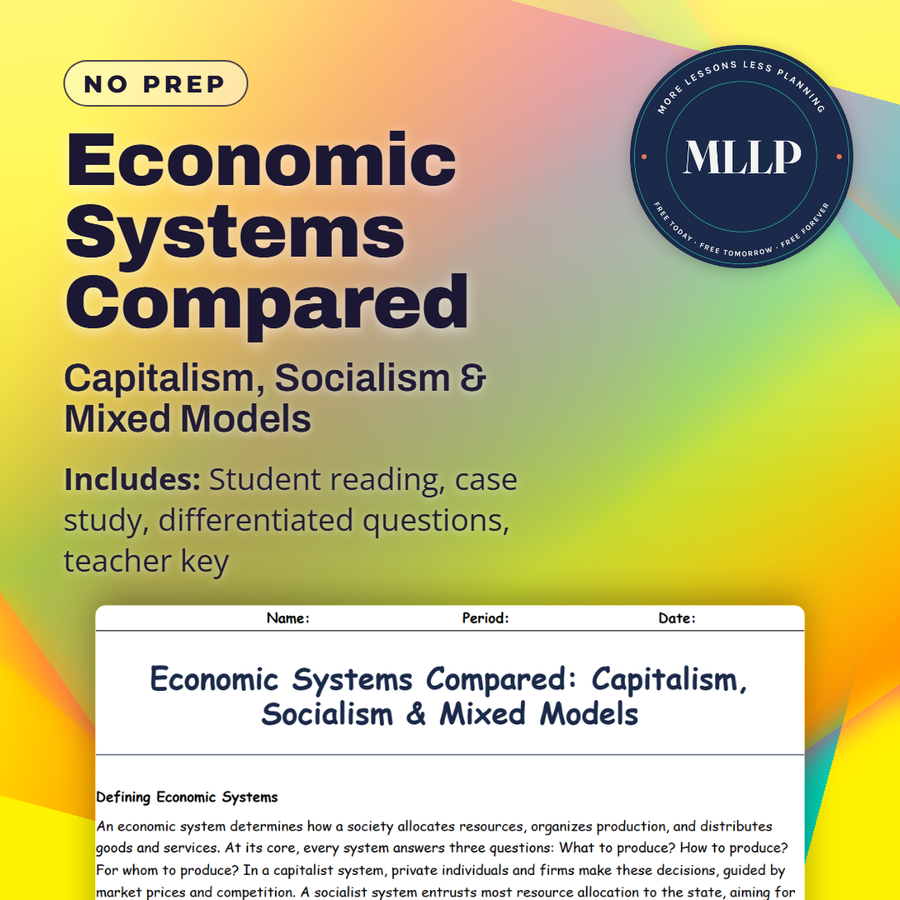
Economic Systems Compared: Capitalism, Socialism & Mixed Models
Quality reviewed September 2026
Facts verified September 14, 2026
- Subject
- Social Studies
- Grades
- Grades 9-12
- Length
- 8-page student worksheet
- Time
- About one 50-minute class period
- Great for
- Sub plans and independent work
- Includes
- Reading passage, comprehension questions + full answer key
- Format
- Print-and-go PDF
What students do
- Match features like universal free education, a dynamic startup ecosystem, and a sovereign wealth fund to the economic system that fits
- Fill in the blank sentences on the profit motive in capitalism, inefficiencies in central planning, and taxation in mixed economies
- Answer multiple choice questions on traits of a pure socialist economy, how mixed economies differ from capitalism, and causes of inequality in capitalist systems
- Write short answers on why socialist planning can limit innovation, how government intervention stabilizes markets, and the challenge of setting tax rates
What it covers
- Capitalism, socialism, and mixed economies, and how each one answers what, how, and for whom to produce
- The tradeoffs between market freedom and government control, including innovation, equity, and efficiency
- A case study on Norway's mixed economy, funded by its oil wealth fund, and how it balances markets with social welfare
Start reading this worksheet
Defining Economic Systems
An economic system determines how a society allocates resources, organizes production, and distributes goods and services. At its core, every system answers three questions: What to produce? How to produce? For whom to produce? In a capitalist system, private individuals and firms make these decisions, guided by market prices and competition. A socialist system entrusts most resource allocation to the state, aiming for equitable distribution and social welfare. Mixed economies blend elements of both, allowing markets to operate alongside government regulation and public ownership in key sectors. Understanding these frameworks helps students analyze why different countries prioritize growth, equity, or stability, and how those choices shape daily life. Economic systems influence incentives, efficiency, and social outcomes. Market-driven capitalism can foster innovation but risk inequality; socialism can prioritize social safety nets but may dampen entrepreneurial spirit. Mixed models seek a middle path, using regulations, public services, and safety nets to correct market failures while preserving incentives for private enterprise. By examining system characteristics, teens grasp why Scandinavia’s welfare states differ from the laissez-faire approach of the United States or the command-heavy model once practiced in the Soviet Union.
Capitalism: Market Freedom & Innovation
Capitalism centers on private property, profit motive, and free markets. Firms compete to produce goods and services efficiently, driving innovation and customer choice. Entrepreneurs invest capital where returns are highest, and consumers “vote” with their purchases, signaling demand. Prices emerge from the interaction of supply and demand: high prices attract new producers, while low prices signal oversupply. Advantages include rapid technological progress, diverse product offerings, and dynamic small-business growth. Think of Silicon Valley startups or the smartphone revolution: private investors fund risky ventures in pursuit of high returns. Capitalism also encourages specialization and global trade, as countries export goods they produce most efficiently. However, unfettered markets can yield monopolies, negative externalities (pollution), and income inequality. Without regulation, businesses may exploit workers, degrade the environment, or engage in unethical practices.
Socialism: Collective Control & Equity
In socialist systems, the state often owns major industries (energy, transportation, healthcare) and directs investment through central planning. The goal is to ensure basic needs for all citizens and reduce wealth disparities. Governments set production targets, control prices, and provide universal services funded by taxes. Education and healthcare become rights rather than market transactions. This model shines in promoting social welfare, low unemployment, and access to essential services. Residents of socialist-leaning countries benefit from free education and healthcare, helping to narrow social gaps. On the flip side, central planning can struggle with information overload, where bureaucrats lack real-time data to match supply with demand efficiently. Shortages, surpluses, and slow innovation can result when incentives for productivity are weak. Students can compare healthcare outcomes in Sweden’s mixed-socialist model versus purely market-based systems to gauge trade-offs between efficiency and equity.
Like what you read? The full reading, the case study, and every question set are in the free download below, along with the answer key.
Why this matters
Ask a student to pick between capitalism and socialism and most treat it like choosing a side, missing that a real economy like Norway's runs a blend of the two. Norway makes that blend visible: an oil wealth fund pays for social programs while private companies still compete in open markets.
Defaulting to one side is the instinct here, and working through the tradeoffs pulls students out of it: why central planning can limit innovation, how intervention stabilizes markets, and why setting a tax rate is harder than it sounds with real budgets.
From one teacher to another
This one gives students a clear framework for comparing capitalism, socialism, and mixed economies before applying it to a real example. Norway's oil fund case study shows how a country can run competitive private markets while still funding extensive social programs. The short answer questions then ask students to explain those tradeoffs themselves, from why central planning can limit innovation to the challenge of setting tax rates.
What you get
Download
Where should I send the next one?
Everything here is free and it stays that way. Leave your email and I'll send you the new lessons as they go up. You can unsubscribe from any one of them.
Related resources
Agriculture & Food Production: Feeding the Future
Economic Development Indicators: GDP, HDI & Beyond
Economic Sectors Explained: Primary, Secondary, Tertiary & Quaternary
Globalization & Outsourcing: Connecting World Economies
Industrial Resources & Sustainability: Balancing Growth
Industrialization & Global Trade: From Factories to Free Markets
Every lesson on this site is free to download and use. If one of them saved you a prep period, you can chip in a few bucks toward my three kids' daycare fund. That's genuinely where tips go.