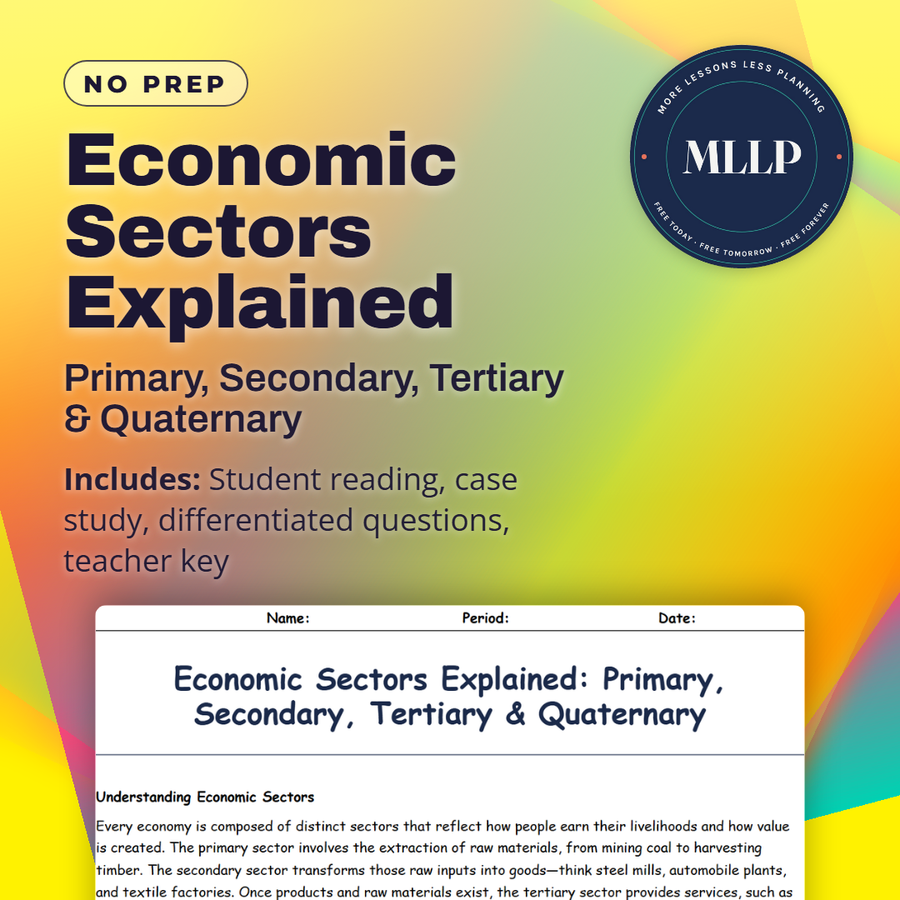
Economic Sectors Explained: Primary, Secondary, Tertiary & Quaternary
Quality reviewed September 2026
Facts verified September 14, 2026
- Subject
- Social Studies
- Grades
- Grades 9-12
- Length
- 7-page student worksheet
- Time
- About one 50-minute class period
- Great for
- Sub plans and independent work
- Includes
- Reading passage, comprehension questions + full answer key
- Format
- Print-and-go PDF
What students do
- Match examples like diamond mining, a car assembly plant, hotel management, and a genetic engineering lab to their correct economic sector
- Fill in the blank sentences on the primary, secondary, and quaternary sectors and what each one produces
- Answer multiple choice questions on which activity belongs to the tertiary sector, what a quaternary company does, and why high income countries employ more service workers
- Write short answers on the risks of overreliance on one sector, an environmental challenge tied to the primary sector, and how education supports the quaternary sector
What it covers
- The four economic sectors, from raw material extraction to manufacturing, services, and knowledge based work
- How a country's sector balance shifts as it develops, moving from agriculture and extraction toward services and innovation
- A case study on Iceland's shift from a fishing based economy to fish processing, tourism, and geothermal research
Start reading this worksheet
Understanding Economic Sectors
Every economy is composed of distinct sectors that reflect how people earn their livelihoods and how value is created. The primary sector involves the extraction of raw materials, from mining coal to harvesting timber. The secondary sector transforms those raw inputs into goods (think steel mills, automobile plants, and textile factories). Once products and raw materials exist, the tertiary sector provides services, such as retail shops, healthcare, and education, facilitating both production and consumption. Finally, the quaternary sector focuses on knowledge and innovation. IT firms, research labs, and data analytics companies drive this knowledge-based economy. As a nation develops, its sectoral balance shifts: many low-income countries rely heavily on agriculture and extraction, while high-income nations see larger service and knowledge sectors. Recognizing these divisions helps students grasp why a handful of steelworkers in Pittsburgh and software engineers in Bangalore both matter, and how each contributes differently to GDP, employment, and living standards.
The Primary Sector: Foundations of Production
The primary sector forms the bedrock of any economy by supplying natural resources. Activities here include agriculture, fishing, forestry, and mining. In developing regions, up to half of all workers may toil in fields or mines, producing basic commodities like wheat, cotton, iron ore, or crude oil. These raw materials have intrinsic economic value but often require processing before they enter global markets. Environmental factors (soil quality, climate, and resource location) dictate which primary activities dominate a region. For example, the Canadian boreal forest fuels a massive timber industry, while the oil-rich Middle East specializes in petroleum extraction. Understanding the primary sector also highlights sustainability challenges: overfishing, deforestation, and strip mining can degrade ecosystems, prompting governments and companies to adopt regenerative practices or stricter regulations.
The Secondary & Tertiary Sectors: Manufacturing to Services
Once raw materials reach factories, the secondary sector adds value by manufacturing and construction. It encompasses everything from assembly lines building smartphones to craft breweries fermenting local hops. Industrial hubs (such as Detroit’s historic auto plants or Shenzhen’s electronics factories) emerged where transportation networks, skilled labor, and capital converged. As productivity rose and incomes climbed, economies transitioned to the tertiary sector, delivering services like banking, tourism, and healthcare. The expansion of retail chains and financial centers illustrates how consumers and businesses increasingly depend on services. In many post-industrial nations, services account for over 70 percent of employment. Service jobs often require different skills (communication, problem-solving, and customer relations), underscoring the need for versatile education and training systems.
Like what you read? The full reading, the case study, and every question set are in the free download below, along with the answer key.
Why this matters
Iceland's economy did not start with geothermal research labs, it started with fishing boats. This reading traces that shift through all four sectors: raw material extraction, the fish processing plants that followed, tourism, and finally the geothermal research that puts the country in the quaternary sector today.
Watching one country climb through every sector gives students cause and effect instead of four definitions to memorize. I assign this early in an economic geography unit, before development indicators come up, so students already have a model of how a sector balance shifts as a country grows.
From one teacher to another
I like this one for showing students that the same country can move through all four economic sectors over time. The Iceland case study traces that shift directly, from raw fishing to fish processing plants to geothermal research, so students can see cause and effect instead of just memorizing definitions. It works well early in an economic geography unit, before getting into development indicators.
What you get
Download
Where should I send the next one?
Everything here is free and it stays that way. Leave your email and I'll send you the new lessons as they go up. You can unsubscribe from any one of them.
Related resources
Agriculture & Food Production: Feeding the Future
Economic Development Indicators: GDP, HDI & Beyond
Economic Systems Compared: Capitalism, Socialism & Mixed Models
Globalization & Outsourcing: Connecting World Economies
Industrial Resources & Sustainability: Balancing Growth
Industrialization & Global Trade: From Factories to Free Markets
Every lesson on this site is free to download and use. If one of them saved you a prep period, you can chip in a few bucks toward my three kids' daycare fund. That's genuinely where tips go.