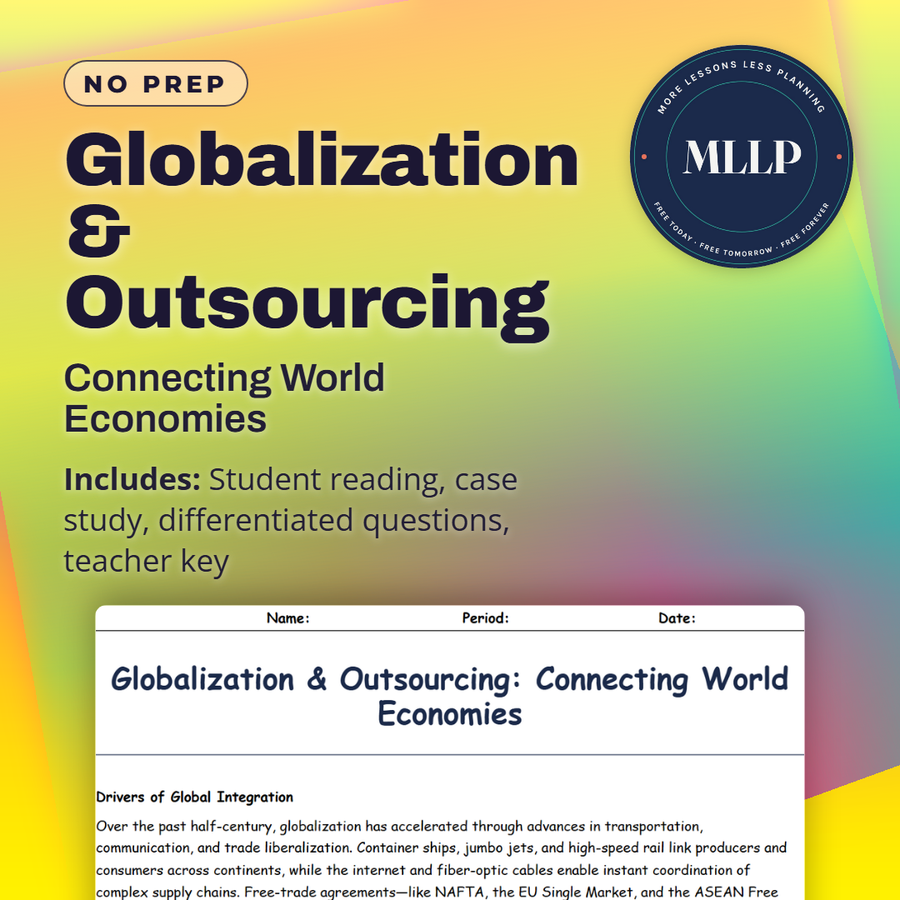
Globalization & Outsourcing: Connecting World Economies
Quality reviewed September 2026
Facts verified September 14, 2026
- Subject
- Social Studies
- Grades
- Grades 9-12
- Length
- 7-page student worksheet
- Time
- About one 50-minute class period
- Great for
- Sub plans and independent work
- Includes
- Reading passage, comprehension questions + full answer key
- Format
- Print-and-go PDF
What students do
- Match terms like just in time production, reshoring, comparative advantage, and global value chain to their correct definitions
- Fill in the blank sentences on containerization, trade barriers, and how global value chains segment production across countries
- Answer multiple choice questions on what reduced coordination costs in global value chains, what near-shoring means, and why firms outsource non-core tasks
- Write short answers on the benefits and social costs of business process outsourcing, why firms mix outsourcing with in-house production, and how governments can capture more value from global value chains
What it covers
- What drives globalization, including trade agreements, broadband internet, and containerized shipping
- How outsourcing and global value chains spread production across countries to take advantage of cost and skill differences
- A case study on call center outsourcing in the Philippines and its economic and social effects on workers
Start reading this worksheet
Drivers of Global Integration
Over the past half-century, globalization has accelerated through advances in transportation, communication, and trade liberalization. Container ships, jumbo jets, and high-speed rail link producers and consumers across continents, while the internet and fiber-optic cables enable instant coordination of complex supply chains. Free-trade agreements (like NAFTA, the EU Single Market, and the ASEAN Free Trade Area) have reduced tariffs and harmonized regulations, making cross-border commerce smoother. For students, understanding these drivers reveals how a smartphone assembled in Vietnam can contain components designed in Germany, programmed in India, and marketed in Brazil, illustrating the truly global nature of modern products. Technology firms leverage cloud computing, video conferencing, and collaborative software to manage decentral-ized teams, while logistics companies use real-time tracking to optimize shipping routes. As a result, businesses can outsource non-core functions (customer service, accounting, or manufacturing) to locations offering cost or skill advantages. These trends have reshaped labor markets, urban development, and cultural exchange, underscoring geography’s continued relevance in a digitally connected world. Even as physical distance matters less, factors like time zones, legal frameworks, and language still shape patterns of global collaboration.
The Mechanics of Outsourcing
Outsourcing occurs when firms contract third-party providers, often in different countries, to perform tasks previously done in-house. Business process outsourcing (BPO) covers call centers, payroll processing, and HR services, commonly located in India, the Philippines, and Eastern Europe. Manufacturing outsourcing shifted assembly lines to China, Vietnam, and Mexico, where lower labor costs and favorable trade regimes improved profit margins. Companies weigh cost savings, quality control, and intellectual property considerations when selecting partners, navigating complex legal and logistical challenges. Outsourcing can bring economic benefits: host countries gain employment, technology transfer, and foreign investment, while home countries see lower consumer prices and firms can reallocate resources to research, marketing, or product development. Yet critics highlight potential downsides: job losses in high-wage regions, wage suppression, and weakened labor standards. Students exploring outsourcing should analyze case studies to assess how firms balance efficiency with ethical responsibilities, and how governments negotiate policies (like minimum wage laws or data-privacy regulations) to manage outsourcing’s impacts. Table 1: Major Drivers of Globalization
Like what you read? The full reading, the case study, and every question set are in the free download below, along with the answer key.
Why this matters
A smartphone is never made in one place. Its parts move through several countries before assembly, which shows students what a global value chain actually looks like instead of a term on a vocabulary list.
The Philippines call center case study is where the social costs and benefits stop being abstract. Students are quick to list what outsourcing offers a local economy, but weighing the social costs against those benefits is a harder, and more honest, exercise.
From one teacher to another
This reading connects the abstract idea of a global value chain to something concrete, like a smartphone assembled from parts made in several countries. The Philippines call center case study gives students a real example of how outsourcing reshaped a local economy, for better and worse. I like pairing this with the economic sectors reading, since outsourcing often means shifting tertiary sector jobs across borders.
What you get
Download
Where should I send the next one?
Everything here is free and it stays that way. Leave your email and I'll send you the new lessons as they go up. You can unsubscribe from any one of them.
Related resources

Agriculture & Food Production: Feeding the Future
Economic Development Indicators: GDP, HDI & Beyond
Economic Sectors Explained: Primary, Secondary, Tertiary & Quaternary
Economic Systems Compared: Capitalism, Socialism & Mixed Models
Industrial Resources & Sustainability: Balancing Growth
Industrialization & Global Trade: From Factories to Free Markets
Every lesson on this site is free to download and use. If one of them saved you a prep period, you can chip in a few bucks toward my three kids' daycare fund. That's genuinely where tips go.