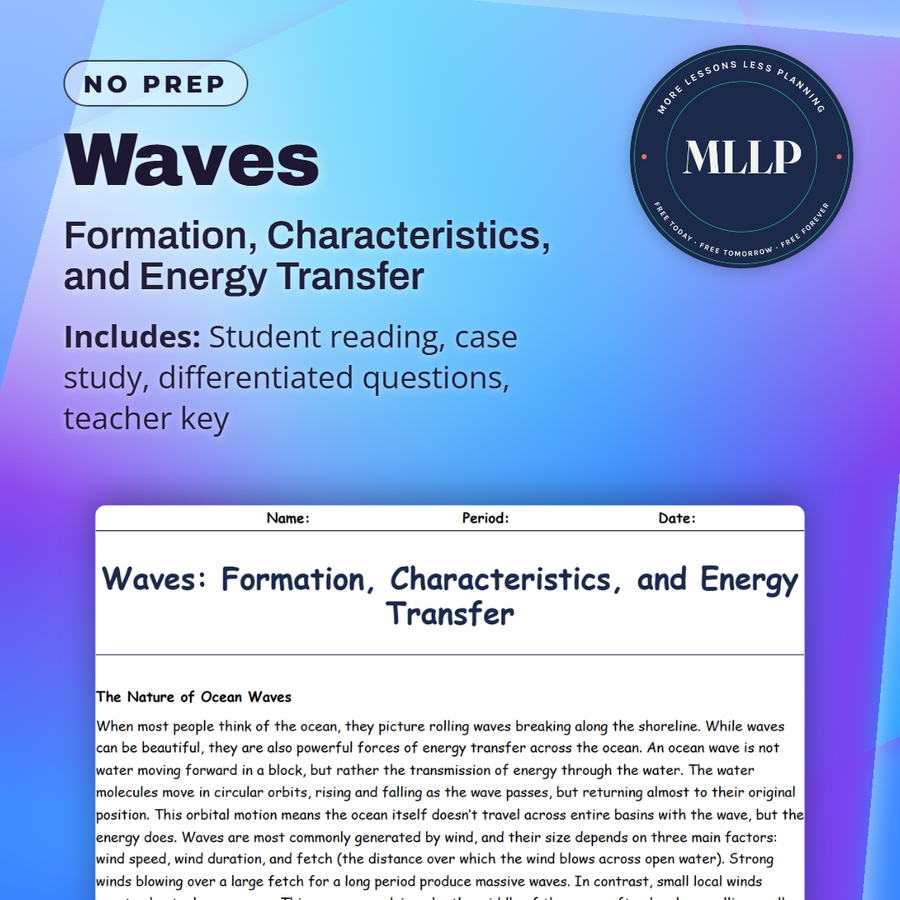
Waves: Formation, Characteristics, and Energy Transfer
Quality reviewed September 2026
Facts verified September 14, 2026
- Subject
- Science
- Grades
- Grades 9-12
- Length
- 6-page student worksheet
- Time
- About one 50-minute class period
- Great for
- Sub plans and independent work
- Includes
- Reading passage, comprehension questions + full answer key
- Format
- Print-and-go PDF
What students do
- Match terms like swell, tsunami, seiche, shallow-water wave, and wind wave to their correct definitions
- Fill in the blank sentences on wavelength, shallow water, and the three factors controlling wind waves
- Answer multiple choice questions on what does not affect wind-generated wave size, what happens to a deep-water wave in shallow water, and what makes a tsunami different from ordinary waves
- Write short answers on why long-wavelength swells matter to surfers and sailors, how tsunamis show the difference between energy and water movement, and why understanding waves matters for coastal engineering
What it covers
- How wind speed, duration, and fetch combine to form waves, and how wavelength and height determine their energy
- The difference between deep-water waves, shallow-water waves, and rare wave types like tsunamis and seiches
- A case study on the 2004 Indian Ocean tsunami and the earthquake that triggered it
Start reading this worksheet
The Nature of Ocean Waves
When most people think of the ocean, they picture rolling waves breaking along the shoreline. While waves can be beautiful, they are also powerful forces of energy transfer across the ocean. An ocean wave is not water moving forward in a block, but rather the transmission of energy through the water. The water molecules move in circular orbits, rising and falling as the wave passes, but returning almost to their original position. This orbital motion means the ocean itself doesn’t travel across entire basins with the wave, but the energy does. Waves are most commonly generated by wind, and their size depends on three main factors: wind speed, wind duration, and fetch (the distance over which the wind blows across open water). Strong winds blowing over a large fetch for a long period produce massive waves. In contrast, small local winds create short, choppy waves. This process explains why the middle of the ocean often has long, rolling swells, while local storms near the coast generate rougher seas. The characteristics of a wave are defined by its wavelength (distance between crests), wave height (distance from trough to crest), and period (time between wave crests). Together, these determine the wave’s energy. Longer wavelengths and higher wave heights carry more energy, which can influence coastal erosion and navigation safety.
Wave Behavior and Types
Ocean waves behave differently depending on water depth and the conditions they encounter. Deep-water waves occur when the depth is greater than half the wavelength, meaning the wave’s orbital motion does not interact with the seafloor. These waves travel quickly and efficiently across vast distances, forming the swells that surfers and sailors rely on. As waves move into shallower water, they become shallow-water waves. Here, the orbital motion touches the seafloor, causing the wave to slow down, increase in height, and eventually break. This is why waves build as they approach shorelines and why coastal erosion is often intensified during storms. Not all waves are generated by local winds. Tsunamis, for example, are caused by undersea earthquakes, volcanic eruptions, or landslides. Unlike typical wind waves, tsunamis have extremely long wavelengths—sometimes hundreds of kilometers—and can cross entire oceans with devastating impacts when they reach shallow coasts. Another type, seiches, occur in enclosed or partially enclosed basins such as lakes, harbors, or bays, caused by sudden changes in atmospheric pressure or wind shifts.
Like what you read? The full reading, the case study, and every question set are in the free download below, along with the answer key.
Why this matters
A wave crossing the ocean does not carry water toward shore so much as it carries energy, with the water itself moving in circles and mostly staying put until the wave reaches shallow water and breaks. Wind speed, duration, and fetch decide how big an ordinary wave gets, but a tsunami runs on an entirely different source of energy: the ocean floor itself moving.
Students tend to lump tsunamis in with big waves, so I use the 2004 Indian Ocean tsunami to pull the two ideas apart. An earthquake off Sumatra sent that energy racing across an entire ocean basin, and the disaster is the reason a tsunami warning system exists today.
From one teacher to another
An ocean wave doesn't carry water across the sea so much as it carries energy, with water molecules moving in circular orbits as the wave passes through. This reading covers how wind speed, duration, and fetch determine a wave's size, how waves slow down and grow taller as they move into shallow water, and how rare events like tsunamis and seiches differ from ordinary wind waves. The case study on the 2004 Indian Ocean tsunami traces how an undersea earthquake off Sumatra sent waves racing across an entire ocean basin, and how the disaster led to a new tsunami warning system.
What you get
Download
Where should I send the next one?
Everything here is free and it stays that way. Leave your email and I'll send you the new lessons as they go up. You can unsubscribe from any one of them.
Related resources
Coastal Processes: Erosion, Deposition, Barrier Islands, and Estuaries
El Niño and La Niña: Ocean-Atmosphere Climate Connections
Ocean Tides: Gravitational Forces of the Moon and Sun
Properties of Seawater: Salinity, Temperature, and Density
Surface Currents and Wind Patterns: The Coriolis Effect and Gyres
The Role of Oceans in Weather and Climate Systems
Every lesson on this site is free to download and use. If one of them saved you a prep period, you can chip in a few bucks toward my three kids' daycare fund. That's genuinely where tips go.