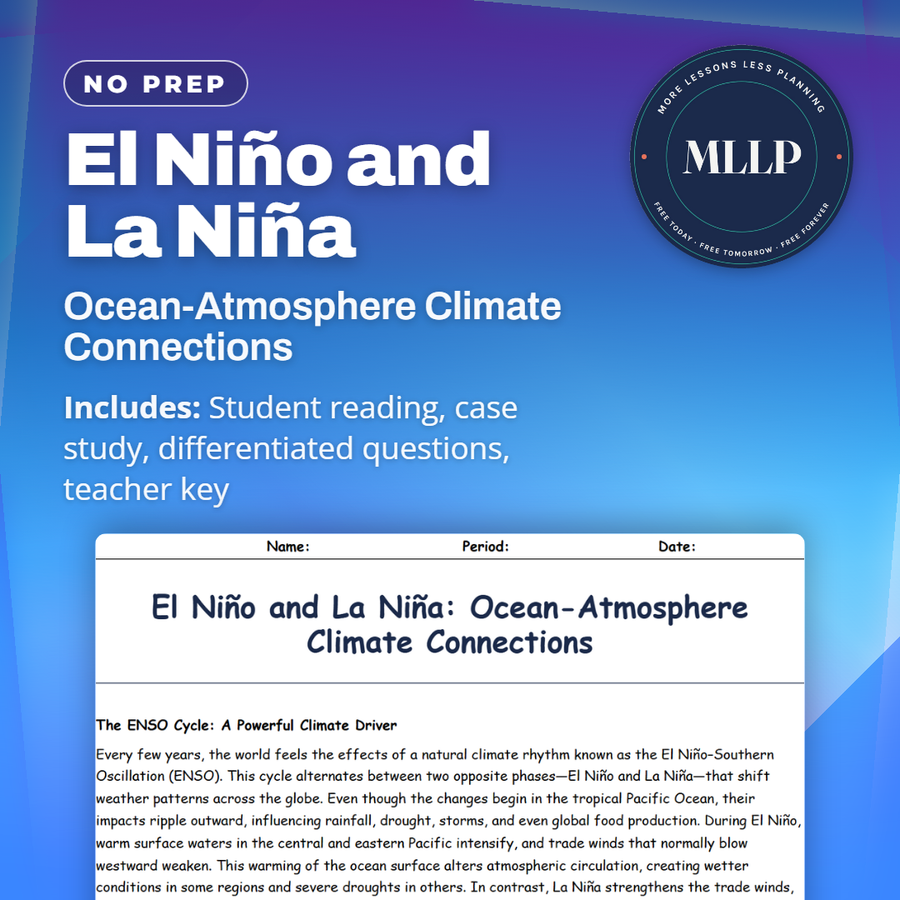
El Niño and La Niña: Ocean-Atmosphere Climate Connections
Quality reviewed September 2026
Facts verified September 14, 2026
- Subject
- Science
- Grades
- Grades 9-12
- Length
- 6-page student worksheet
- Time
- About one 50-minute class period
- Great for
- Sub plans and independent work
- Includes
- Reading passage, comprehension questions + full answer key
- Format
- Print-and-go PDF
What students do
- Match terms like El Niño, La Niña, the ENSO cycle, Atlantic hurricanes, and the Indian monsoon to their correct definitions
- Fill in the blank sentences on the ENSO cycle's timing, trade winds, and La Niña's link to hurricane activity
- Answer multiple choice questions on what happens during El Niño, how La Niña affects Atlantic hurricanes, and why ENSO monitoring matters
- Write short answers comparing El Niño and La Niña's global impacts, how ENSO affects food security, and why international cooperation matters for forecasting
What it covers
- How the El Niño-Southern Oscillation cycle shifts trade winds and ocean temperatures in the Pacific
- The global ripple effects of El Niño and La Niña on rainfall, drought, and hurricane activity
- A case study on the 1997-1998 El Niño and the widespread flooding, drought, and wildfires it caused
Start reading this worksheet
The ENSO Cycle: A Powerful Climate Driver
Every few years, the world feels the effects of a natural climate rhythm known as the El Niño–Southern Oscillation (ENSO). This cycle alternates between two opposite phases (El Niño and La Niña) that shift weather patterns across the globe. Even though the changes begin in the tropical Pacific Ocean, their impacts ripple outward, influencing rainfall, drought, storms, and even global food production. During El Niño, warm surface waters in the central and eastern Pacific intensify, and trade winds that normally blow westward weaken. This warming of the ocean surface alters atmospheric circulation, creating wetter conditions in some regions and severe droughts in others. In contrast, La Niña strengthens the trade winds, pushing warm water farther west and allowing cold, nutrient-rich waters to rise along South America’s coast. This often brings floods to some areas and powerful hurricanes in others. The ENSO cycle is unpredictable in its timing, typically occurring every two to seven years. Yet, its influence is so strong that monitoring ENSO is now a cornerstone of modern climate science. By studying patterns of sea surface temperatures, winds, and pressure changes, scientists can issue forecasts months in advance: forecasts that help governments, farmers, and communities prepare for what’s ahead.
Like what you read? The full reading, the case study, and every question set are in the free download below, along with the answer key.
Why this matters
A shift in Pacific trade winds thousands of miles from land can flood Peru, dry Southeast Asia into wildfire conditions, and change how many hurricanes reach the Atlantic in a season. That is the reach of El Niño and La Niña, opposite phases of one ocean-atmosphere cycle running from warm water and weakened trade winds to cold upwelling and strengthened winds.
What convinces students this matters beyond a vocabulary quiz is watching one shared cause, the 1997 to 1998 El Niño, produce flooding in Peru, wildfires in Southeast Asia, and a shift in Atlantic hurricane activity. Satellite monitoring let scientists track it as one connected event, not scattered disasters.
From one teacher to another
El Niño and La Niña are opposite phases of a single climate cycle that begins in the tropical Pacific but reaches farther than any other ocean pattern. The reading covers how warm water and weakened trade winds define El Niño, how strengthened trade winds and cold upwelling define La Niña, and how each phase shifts rainfall, drought, and hurricane activity around the globe. The case study on the 1997-1998 El Niño traces catastrophic flooding in Peru, drought-driven wildfires in Southeast Asia, and the satellite monitoring that let scientists track it in real time.
What you get
Download
Where should I send the next one?
Everything here is free and it stays that way. Leave your email and I'll send you the new lessons as they go up. You can unsubscribe from any one of them.
Related resources
Coastal Processes: Erosion, Deposition, Barrier Islands, and Estuaries
Ocean Tides: Gravitational Forces of the Moon and Sun
Properties of Seawater: Salinity, Temperature, and Density
Surface Currents and Wind Patterns: The Coriolis Effect and Gyres
The Role of Oceans in Weather and Climate Systems
Thermohaline Circulation and the Global Conveyor Belt
Every lesson on this site is free to download and use. If one of them saved you a prep period, you can chip in a few bucks toward my three kids' daycare fund. That's genuinely where tips go.