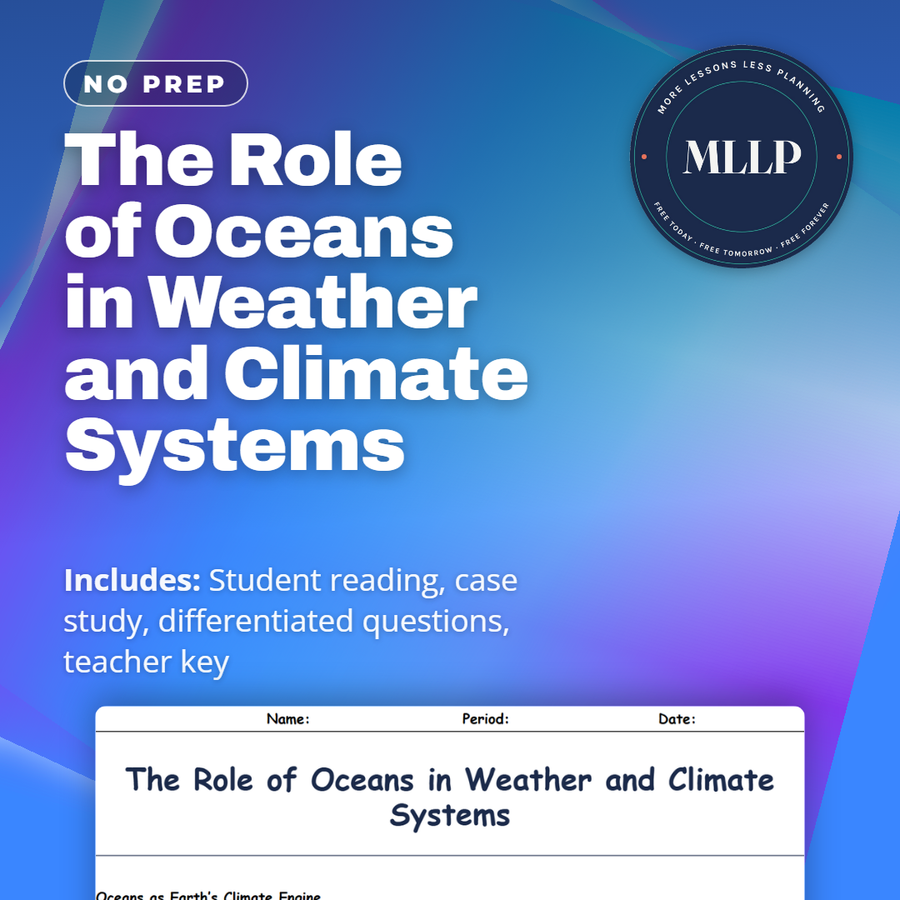
The Role of Oceans in Weather and Climate Systems
Quality reviewed September 2026
Facts verified September 14, 2026
- Subject
- Science
- Grades
- Grades 9-12
- Length
- 6-page student worksheet
- Time
- About one 50-minute class period
- Great for
- Sub plans and independent work
- Includes
- Reading passage, comprehension questions + full answer key
- Format
- Print-and-go PDF
What students do
- Match terms like hurricane, monsoon, storm surge, the climate engine, and Hurricane Katrina to their correct definitions
- Fill in the blank sentences on the sea-surface temperature hurricanes need, monsoons, and the storm surge that flooded New Orleans
- Answer multiple choice questions on what fuels a hurricane, what causes summer monsoon rains, and what ocean-atmosphere interaction does and doesn't influence
- Write short answers on why oceans are called Earth's climate engine, how climate change affects hurricane strength, and why predicting monsoons matters for agriculture
What it covers
- How oceans store and redistribute heat, acting as a climate engine that shapes global weather
- How warm ocean water fuels hurricanes and drives seasonal monsoon rains
- A case study on Hurricane Katrina and how Gulf of Mexico heat fed its rapid intensification
Start reading this worksheet
Oceans as Earth’s Climate Engine
The oceans are the largest storage system for heat on the planet. Covering more than 70% of Earth’s surface, they absorb energy from the Sun and redistribute it through currents and evaporation. This makes the ocean a powerful driver of weather and climate systems. Without oceans, Earth’s temperatures would swing wildly between day and night, and global climate patterns would look entirely different. Oceans influence the formation of storms, the arrival of monsoons, and the long-term stability of climate systems. They act as a “heat engine,” transferring warmth from the equator toward the poles. This circulation not only balances Earth’s energy but also controls rainfall, wind patterns, and seasonal cycles.
Hurricanes and Ocean Heat
One of the clearest examples of ocean influence on weather is the hurricane. These powerful storms, also called tropical cyclones or typhoons depending on location, form over warm tropical waters. Hurricanes draw energy from the evaporation of warm seawater, which fuels their swirling winds and heavy rains. When sea-surface temperatures rise above 26°C (79°F), conditions are favorable for storm development. As warm, moist air rises, it creates a low-pressure system that strengthens as more moisture condenses, releasing heat. This process can lead to a fully developed hurricane capable of immense destruction. The stronger the heat content of the ocean, the stronger the storm can become. Climate change is already influencing hurricanes. Warmer oceans are producing storms with greater intensity, heavier rainfall, and slower movement, increasing flood risks for coastal communities. Understanding the link between oceans and hurricanes helps forecasters save lives and governments prepare for emergencies.
Monsoons and Ocean Circulation
Monsoons are another vital example of ocean-atmosphere interaction. These seasonal wind and rain patterns occur mainly in South Asia, Africa, and parts of Australia. Monsoons are fueled by differences in heating between land and ocean. In summer, land heats faster than the ocean, drawing moist air inland that produces heavy rainfall. In winter, the cycle reverses, and dry air flows out to sea. The strength and timing of monsoons depend on ocean circulation, particularly the Indian Ocean and Pacific systems. Millions of farmers rely on monsoon rains for agriculture, making them one of the most important climate features in the world. However, both El Niño and climate change can alter monsoon patterns, leading to droughts or excessive flooding. This makes studying ocean conditions essential for food security and water management in heavily populated regions.
Like what you read? The full reading, the case study, and every question set are in the free download below, along with the answer key.
Why this matters
Most people treat a hurricane as a storm that happens to cross the ocean, but the ocean is what builds it. Once sea-surface temperatures climb high enough, warm water becomes fuel, and that same uneven heating between land and sea drives monsoon rains on a much larger, seasonal scale.
I use Hurricane Katrina to make that fuel supply concrete instead of abstract. Students can trace the moment unusually warm Gulf of Mexico water helped push Katrina to Category 5, and once the storm surge hits New Orleans on the page, they stop treating warm water as background scenery and start reading a sea-surface temperature map the way a forecaster would.
From one teacher to another
Oceans cover most of the planet and store more heat than the atmosphere ever could, which makes them the engine behind much of Earth's weather. The reading explains how warm seawater fuels hurricanes once sea-surface temperatures climb high enough, how monsoons form from the uneven heating of land and ocean, and how both systems can be thrown off by rising temperatures. The case study on Hurricane Katrina traces how unusually warm Gulf of Mexico water helped the storm intensify to Category 5 before its storm surge flooded New Orleans.
What you get
Download
Where should I send the next one?
Everything here is free and it stays that way. Leave your email and I'll send you the new lessons as they go up. You can unsubscribe from any one of them.
Related resources
Coastal Processes: Erosion, Deposition, Barrier Islands, and Estuaries
El Niño and La Niña: Ocean-Atmosphere Climate Connections
Ocean Tides: Gravitational Forces of the Moon and Sun
Properties of Seawater: Salinity, Temperature, and Density
Surface Currents and Wind Patterns: The Coriolis Effect and Gyres
Thermohaline Circulation and the Global Conveyor Belt
Every lesson on this site is free to download and use. If one of them saved you a prep period, you can chip in a few bucks toward my three kids' daycare fund. That's genuinely where tips go.