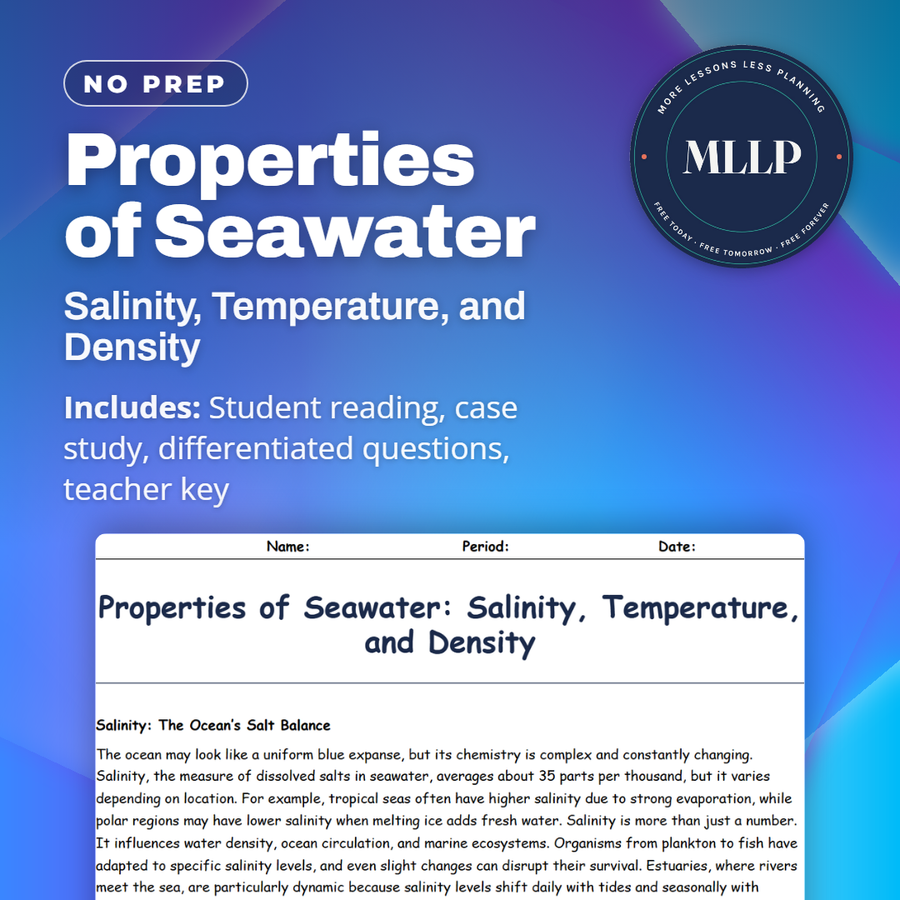
Properties of Seawater: Salinity, Temperature, and Density
Quality reviewed September 2026
Facts verified September 14, 2026
- Subject
- Science
- Grades
- Grades 9-12
- Length
- 6-page student worksheet
- Time
- About one 50-minute class period
- Great for
- Sub plans and independent work
- Includes
- Reading passage, comprehension questions + full answer key
- Format
- Print-and-go PDF
What students do
- Match terms like salinity, thermocline, density, dead zone, and stratification to their correct definitions
- Fill in the blank sentences on salinity, the thermocline, and why cold, salty water sinks
- Answer multiple choice questions on average ocean salinity, the layer where temperature drops fastest, and why cold, salty water sinks in polar regions
- Write short answers on how salinity and temperature together set density, why ocean temperature regulates coastal climate, and how the Gulf of Mexico dead zone connects to seawater properties
What it covers
- How salinity, temperature, and density interact to shape ocean water and circulation
- Why thermal stratification and the thermocline layer surface waters from the deep ocean
- A case study on the Gulf of Mexico dead zone and how nutrient runoff and stratification combine to cut off oxygen
Start reading this worksheet
Salinity: The Ocean’s Salt Balance
The ocean may look like a uniform blue expanse, but its chemistry is complex and constantly changing. Salinity, the measure of dissolved salts in seawater, averages about 35 parts per thousand, but it varies depending on location. For example, tropical seas often have higher salinity due to strong evaporation, while polar regions may have lower salinity when melting ice adds fresh water. Salinity is more than just a number. It influences water density, ocean circulation, and marine ecosystems. Organisms from plankton to fish have adapted to specific salinity levels, and even slight changes can disrupt their survival. Estuaries, where rivers meet the sea, are particularly dynamic because salinity levels shift daily with tides and seasonally with rainfall. Understanding salinity is essential for predicting biological patterns, managing fisheries, and studying how human activities like dam building or irrigation affect coastal waters.
Temperature: The Ocean’s Heat Reservoir
Water has a high heat capacity, meaning it absorbs and stores large amounts of energy without changing temperature quickly. This property makes the ocean a global climate regulator. Coastal regions, for instance, experience milder winters and cooler summers because the nearby sea moderates air temperature. Ocean temperature is not uniform. Surface waters warm quickly in sunlight, while deeper waters remain cold and stable. This layering, called thermal stratification, creates boundaries such as the thermocline, where temperature drops rapidly with depth. Temperature affects not only climate but also biological productivity. Many species thrive only within narrow temperature ranges, and warming seas are already stressing coral reefs and polar ecosystems.
Like what you read? The full reading, the case study, and every question set are in the free download below, along with the answer key.
Why this matters
Slide off a dock in the Gulf of Mexico in July and the surface can feel like a warm bath while your feet hit a totally different temperature just below. That jump is the thermocline: salinity and temperature together set how dense seawater is, and cold, salty water sinks to drive the global conveyor belt.
The Gulf of Mexico dead zone usually lands as a pollution story only, right up until this reading forces density into the conversation. Nutrient runoff matters, but it's the layering of warm water over cold, salty water that traps the runoff near the bottom and cuts off oxygen. Density is the hidden variable behind the case study.
From one teacher to another
Salinity, temperature, and density might sound like three separate topics, but this worksheet shows how tightly they're linked in seawater. Students read about how salinity varies by region and season, how the ocean's high heat capacity moderates coastal climate, and how cold, salty water sinks to drive circulation like the thermohaline conveyor belt. The case study on the Gulf of Mexico dead zone connects all three properties to a real problem, tracing how nutrient runoff, warm surface water, and stratification combine to starve bottom waters of oxygen.
What you get
Download
Where should I send the next one?
Everything here is free and it stays that way. Leave your email and I'll send you the new lessons as they go up. You can unsubscribe from any one of them.
Related resources
Coastal Processes: Erosion, Deposition, Barrier Islands, and Estuaries
El Niño and La Niña: Ocean-Atmosphere Climate Connections
Ocean Tides: Gravitational Forces of the Moon and Sun
Surface Currents and Wind Patterns: The Coriolis Effect and Gyres
The Role of Oceans in Weather and Climate Systems
Thermohaline Circulation and the Global Conveyor Belt
Every lesson on this site is free to download and use. If one of them saved you a prep period, you can chip in a few bucks toward my three kids' daycare fund. That's genuinely where tips go.