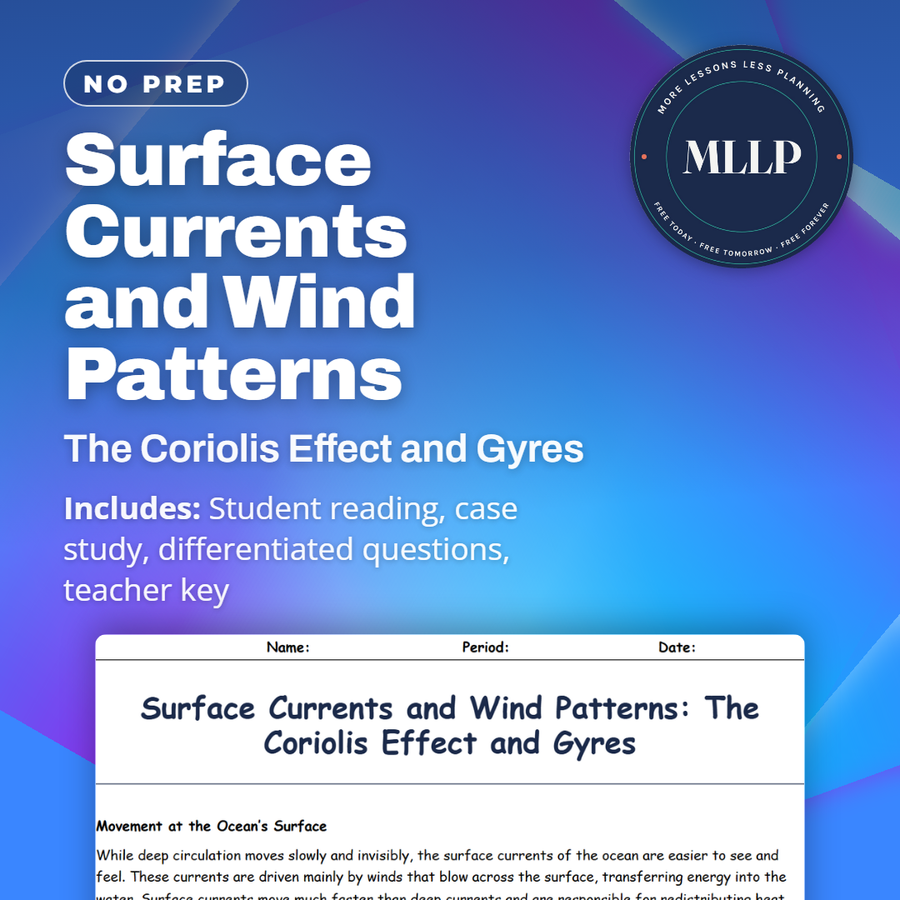
Surface Currents and Wind Patterns: The Coriolis Effect and Gyres
Quality reviewed September 2026
Facts verified September 14, 2026
- Subject
- Science
- Grades
- Grades 9-12
- Length
- 6-page student worksheet
- Time
- About one 50-minute class period
- Great for
- Sub plans and independent work
- Includes
- Reading passage, comprehension questions + full answer key
- Format
- Print-and-go PDF
What students do
- Match terms like the Coriolis effect, the Gulf Stream, gyres, the California Current, and the Great Pacific Garbage Patch to their correct definitions
- Fill in the blank sentences on the Coriolis effect, gyres, and the California Current
- Answer multiple choice questions on what drives surface currents, which way the Coriolis effect deflects currents in the Northern Hemisphere, and why the Great Pacific Garbage Patch forms
- Write short answers on how surface currents redistribute heat, why western boundary currents move faster than eastern ones, and how to reduce plastic buildup in gyres
What it covers
- How wind and the Coriolis effect combine to drive surface currents and form large rotating gyres
- The difference between fast, warm western boundary currents like the Gulf Stream and cooler eastern boundary currents like the California Current
- A case study on the Great Pacific Garbage Patch and how gyre circulation traps floating plastic
Start reading this worksheet
Movement at the Ocean’s Surface
While deep circulation moves slowly and invisibly, the surface currents of the ocean are easier to see and feel. These currents are driven mainly by winds that blow across the surface, transferring energy into the water. Surface currents move much faster than deep currents and are responsible for redistributing heat around the globe in a matter of weeks or months, rather than centuries. The most powerful surface currents form large, rotating systems called gyres. Each of the world’s major ocean basins contains a gyre: the North and South Pacific, the North and South Atlantic, and the Indian Ocean. Within these gyres, warm water flows toward the poles on the western sides of basins, while cooler water flows back toward the equator on the eastern sides. This balance creates both climate stability and distinct regional weather patterns.
The Coriolis Effect
A key player in shaping currents is the Coriolis effect, which results from Earth’s rotation. As winds push water, the Coriolis effect deflects movement to the right in the Northern Hemisphere and to the left in the Southern Hemisphere. This deflection explains why currents do not simply move in straight lines but instead curve and help form circular gyres. For example, the North Atlantic Gyre includes the Gulf Stream, which carries warm water northward along the U.S. East Coast, before turning east toward Europe. This current contributes to Europe’s relatively mild winters. In contrast, the Canary Current on the eastern side of the gyre brings cool water southward toward Africa. These differences shape regional climates and support unique ecosystems.
Like what you read? The full reading, the case study, and every question set are in the free download below, along with the answer key.
Why this matters
A plastic bottle dropped into the Pacific can circle for years inside the same slow-spinning gyre, never quite escaping. Wind sets surface currents moving, and Earth's rotation bends them, the Coriolis effect, deflecting currents right in the Northern Hemisphere and left in the Southern until the water loops into a closed rotation.
The surprise for most students is that this same physics produces two different currents on opposite sides of a basin: a fast, warm Gulf Stream and a cooler, slower California Current. That single explanation is also what turns the Great Pacific Garbage Patch from a mystery into something predictable: plastic dropped anywhere in the gyre eventually follows the same physics as the currents around it.
From one teacher to another
Wind sets ocean surface water in motion, but Earth's rotation is what bends that motion into the giant rotating gyres found in every ocean basin. This worksheet covers how the Coriolis effect deflects currents right in the Northern Hemisphere and left in the Southern Hemisphere, and how that deflection produces fast western boundary currents like the Gulf Stream alongside cooler eastern boundary currents like the California Current. The case study on the Great Pacific Garbage Patch shows what happens when this same circulation traps millions of tons of plastic debris in the center of the North Pacific Gyre.
What you get
Download
Where should I send the next one?
Everything here is free and it stays that way. Leave your email and I'll send you the new lessons as they go up. You can unsubscribe from any one of them.
Related resources
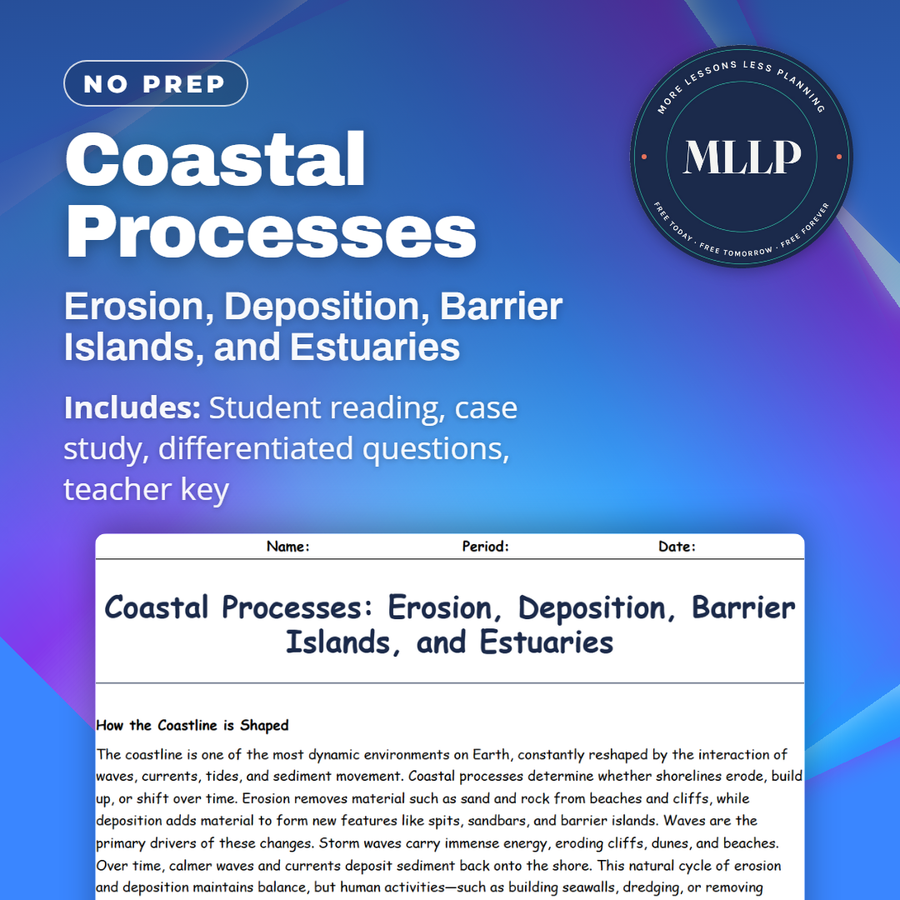
Coastal Processes: Erosion, Deposition, Barrier Islands, and Estuaries
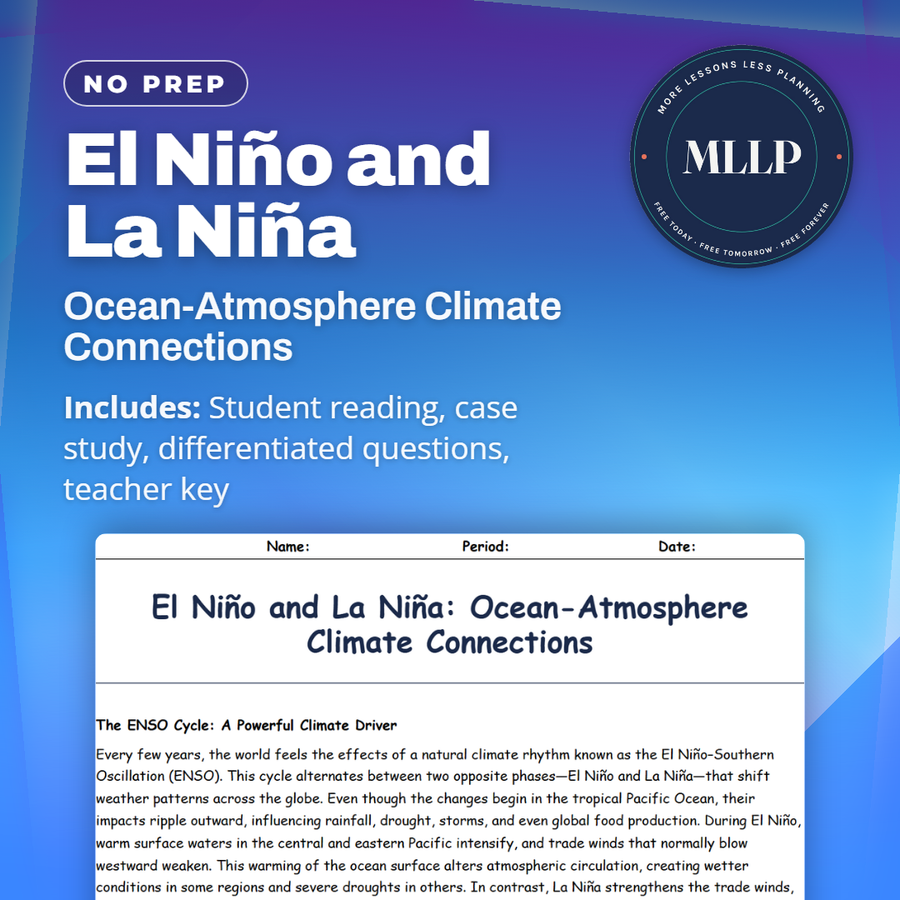
El Niño and La Niña: Ocean-Atmosphere Climate Connections
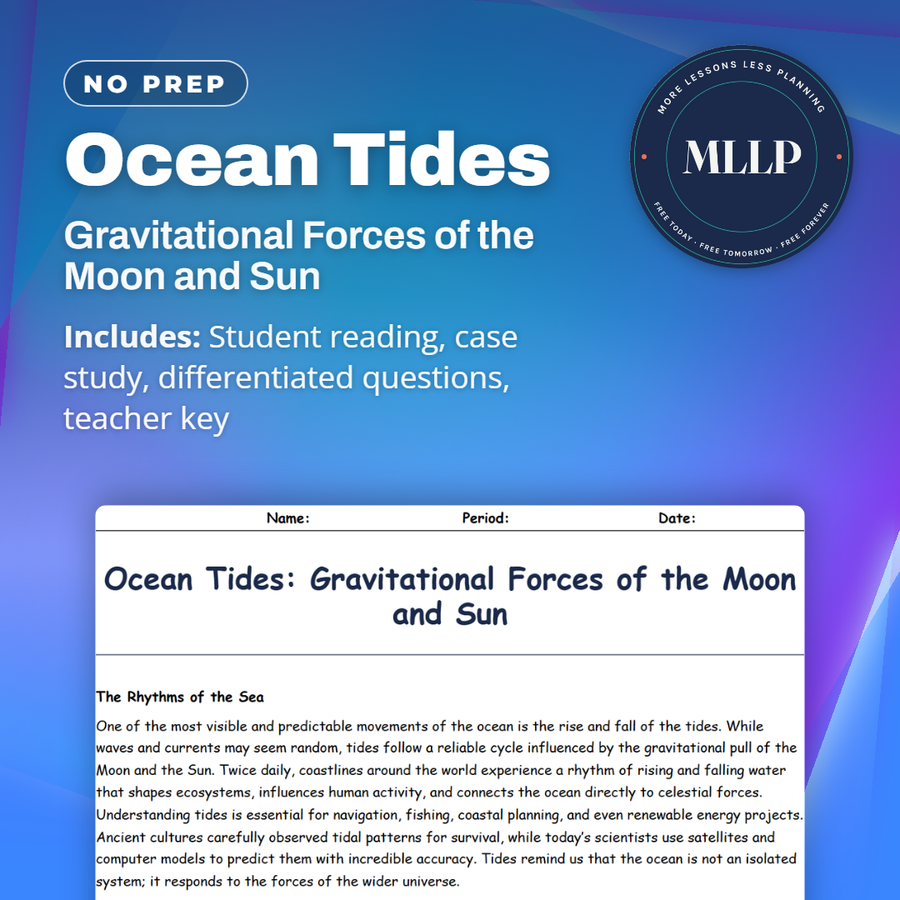
Ocean Tides: Gravitational Forces of the Moon and Sun
Properties of Seawater: Salinity, Temperature, and Density
The Role of Oceans in Weather and Climate Systems
Thermohaline Circulation and the Global Conveyor Belt
Every lesson on this site is free to download and use. If one of them saved you a prep period, you can chip in a few bucks toward my three kids' daycare fund. That's genuinely where tips go.