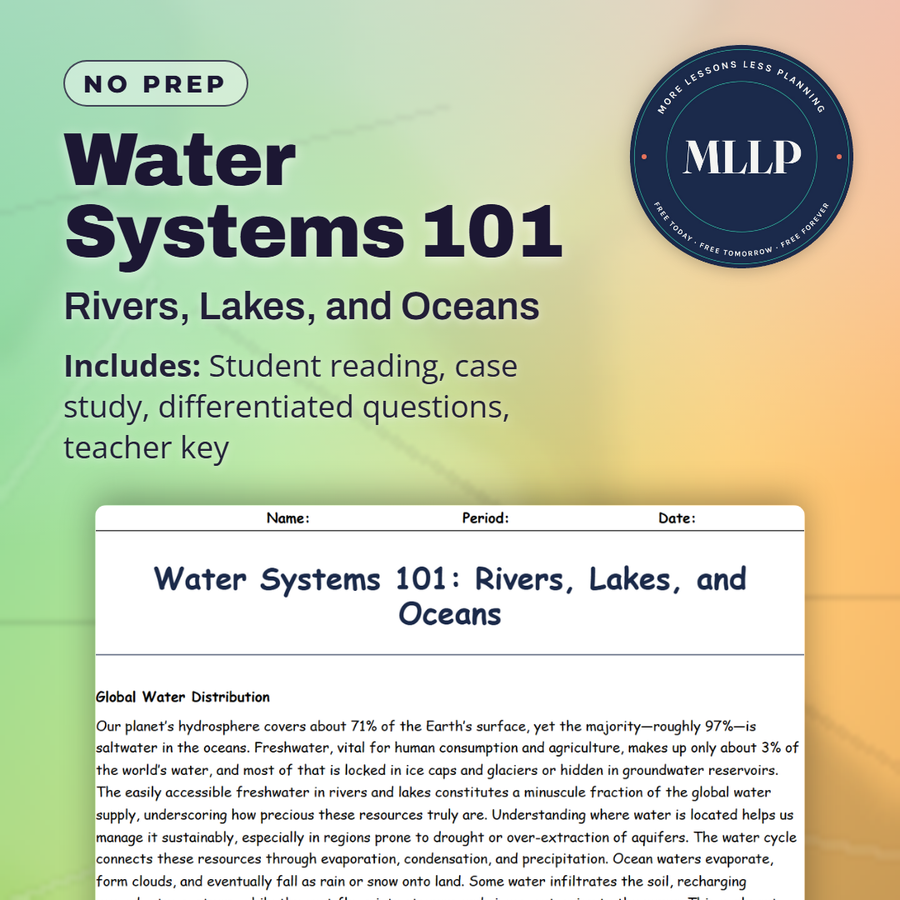
Water Systems 101: Rivers, Lakes, and Oceans
Quality reviewed September 2026
Facts verified September 14, 2026
- Subject
- Social Studies
- Grades
- Grades 9-12
- Length
- 7-page student worksheet
- Time
- About one 50-minute class period
- Great for
- Sub plans and independent work
- Includes
- Reading passage, comprehension questions + full answer key
- Format
- Print-and-go PDF
What students do
- Match terms like Tides, Aquifers, Watershed, and Delta to their correct descriptions
- Fill in the blank sentences on Lake Baikal, watersheds, and the water cycle
- Answer multiple choice questions on freshwater percentages, dam construction, and how oceans regulate climate
- Write short answers on groundwater depletion, dam effects on ecosystems, and how oceans influence weather
What it covers
- Global water distribution and the water cycle, including how little of Earth's water is accessible freshwater
- Rivers, lakes, and groundwater, from watersheds and aquifers to dams and pollution
- A case study on Lake Baikal and the environmental pressures facing the world's deepest freshwater lake
Start reading this worksheet
Global Water Distribution
Our planet’s hydrosphere covers about 71% of the Earth’s surface, yet the majority (roughly 97%) is saltwater in the oceans. Freshwater, vital for human consumption and agriculture, makes up only about 3% of the world’s water, and most of that is locked in ice caps and glaciers or hidden in groundwater reservoirs. The easily accessible freshwater in rivers and lakes constitutes a minuscule fraction of the global water supply, underscoring how precious these resources truly are. Understanding where water is located helps us manage it sustainably, especially in regions prone to drought or over-extraction of aquifers. The water cycle connects these resources through evaporation, condensation, and precipitation. Ocean waters evaporate, form clouds, and eventually fall as rain or snow onto land. Some water infiltrates the soil, recharging groundwater systems, while the rest flows into streams and rivers, returning to the ocean. This cycle not only sustains ecosystems but also influences weather patterns and climate around the globe. Pollution and climate change threaten to upset this delicate balance, making it crucial to study water systems at local, regional, and global scales.
Rivers: Lifelines of the Continents
Rivers play a key role in redistributing water and nutrients across landscapes. They begin at a source (often a spring, glacier, or mountain lake) and flow downhill, merging with other streams known as tributaries. Together, these interconnected waterways form a watershed or drainage basin, ultimately exiting through a mouth into another water body: an ocean, sea, or lake. Along their course, rivers shape landforms, carving valleys and depositing sediment. Fertile river valleys have historically been sites of major civilizations, from the Nile in Egypt to the Tigris-Euphrates in Mesopotamia. Modern societies depend on rivers for drinking water, irrigation, transportation, and hydropower. Dams and levees offer flood control and energy production but can disrupt ecosystems and displace communities. Moreover, dams reduce sediment flow, which can lead to coastal erosion downstream. Balancing these demands requires careful watershed management, public policy, and community engagement. Scientists track river health by measuring flow rates, sediment loads, and water quality indicators, detecting signs of pollution or ecological stress before they become crises.
Lakes and Groundwater
While lakes may appear more static than rivers, they are dynamic systems that support abundant life. Lakes form when water collects in depressions, caused by geological activity, glacial erosion, or even man-made dams, where it cannot easily drain away. Many lake basins owe their existence to ancient glaciers, which scoured and dammed landscapes. Lakes serve as reservoirs for freshwater, providing drinking water, recreation, and habitat for fish and wildlife. However, they are also vulnerable to pollution from agricultural runoff, industrial waste, and invasive species that can disrupt local ecosystems. Beneath the surface, groundwater fills the pores and fractures of subsurface materials, forming aquifers. This resource is essential for areas lacking abundant surface water. Wells tap into aquifers for drinking water and irrigation, but overuse can lead to groundwater depletion, causing land subsidence or reduced water availability for future generations. Pollution can also percolate into aquifers, making cleanup extremely difficult and expensive. This underscores the importance of integrated water resource management that considers both surface water (rivers, lakes) and subsurface water (aquifers).
Like what you read? The full reading, the case study, and every question set are in the free download below, along with the answer key.
Why this matters
Ask a class to guess what share of Earth's water they could actually drink, and most guesses land far too high. This reading corrects that before moving into watersheds, aquifers, and the dams and pollution that put freshwater at risk, treating rivers, lakes, oceans, and groundwater as one connected system.
Lake Baikal is the reading's best hook, the world's deepest freshwater lake, home to species found nowhere else, already showing changes in its fish populations as warming temperatures and runoff shift the water around it. I use it to make groundwater depletion feel less like a statistic and more like something happening to a specific, named place.
From one teacher to another
This worksheet ties together rivers, lakes, groundwater, and oceans as one connected system instead of separate topics. The reading makes clear how small a share of Earth's water is actually accessible freshwater. The case study on Lake Baikal covers its record depth and unique species, then shows how warming temperatures and runoff are already changing its fish populations. Good lead-in to a broader water systems or hydrology unit.
What you get
Download
Where should I send the next one?
Everything here is free and it stays that way. Leave your email and I'll send you the new lessons as they go up. You can unsubscribe from any one of them.
Related resources
Biomes & Ecosystems: Life Across Earth’s Habitats
Climate vs. Weather: Understanding the Difference
Convergent Boundaries: Where Plates Collide
Deserts: Survival in the Harshest Climates
Divergent Boundaries: Where Plates Pull Apart
Earth’s Layers: From Crust to Core
Every lesson on this site is free to download and use. If one of them saved you a prep period, you can chip in a few bucks toward my three kids' daycare fund. That's genuinely where tips go.