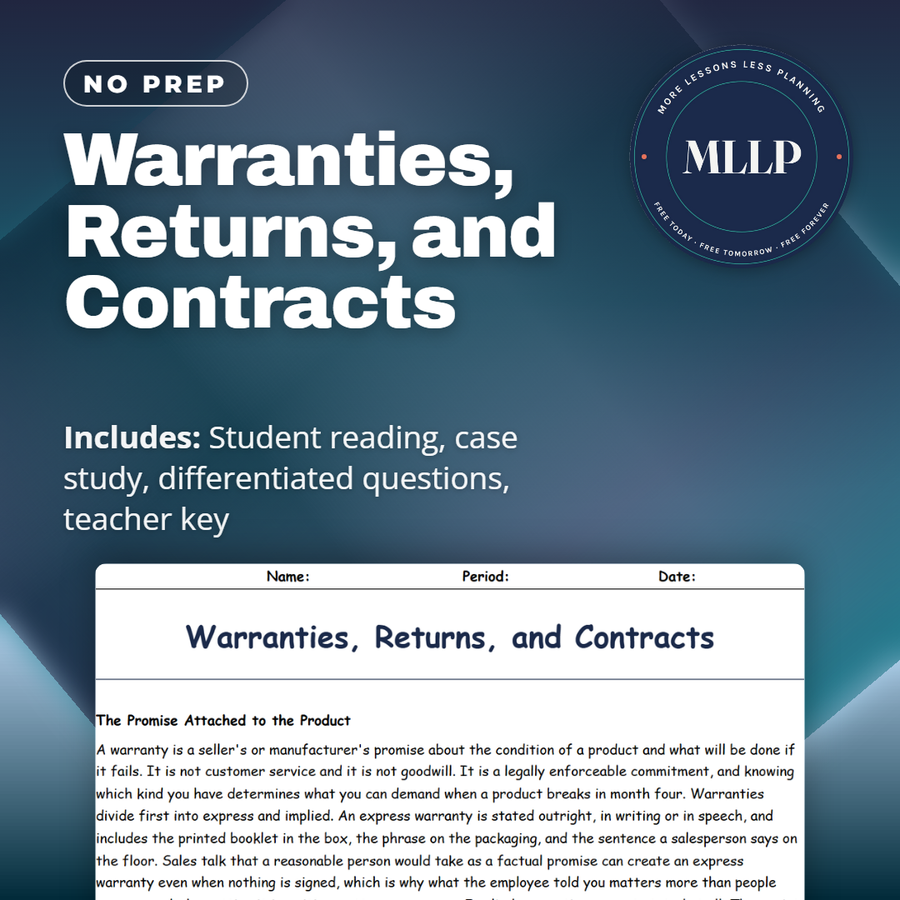
Warranties, Returns, and Contracts
Quality reviewed September 2026
Facts verified September 23, 2026
- Subject
- Career & Life Skills
- Grades
- Grades 9-12
- Length
- 8-page student worksheet
- Time
- About one 50-minute class period
- Great for
- Sub plans and independent work
- Includes
- Reading passage, comprehension questions + full answer key
- Format
- Print-and-go PDF
What students do
- Express warranty and implied warranty get paired with the definitions the reading actually gives them
- Selena's blender warranty gets checked against the store's actual written terms
- Explain why a signed document with a blank line is a warning sign in the reading
- A change of mind return and a defective product get tested against the reading's different legal treatment of each
What it covers
- Express and implied warranties, and the difference between a full and limited warranty
- Why a store's return policy is voluntary, with the FTC cooling off rule as one exception
- Selena's blender case study and the blank line she signed without reading
Start reading this worksheet
The Promise Attached to the Product
A warranty is a seller's or manufacturer's promise about the condition of a product and what will be done if it fails. It is not customer service and it is not goodwill. It is a legally enforceable commitment, and knowing which kind you have determines what you can demand when a product breaks in month four. Warranties divide first into express and implied. An express warranty is stated outright, in writing or in speech, and includes the printed booklet in the box, the phrase on the packaging, and the sentence a salesperson says on the floor. Sales talk that a reasonable person would take as a factual promise can create an express warranty even when nothing is signed, which is why what the employee told you matters more than people assume, and why getting it in writing matters even more. Implied warranties are not stated at all. They exist automatically under state law in nearly every sale. The implied warranty of merchantability promises that a product will do what such products ordinarily do, meaning a refrigerator will keep food cold and a toaster will not catch fire on its first use. The implied warranty of fitness for a particular purpose applies when a buyer describes a specific need and relies on the seller's recommendation. If you tell a clerk you need a paint that will hold up on outdoor metal and they hand you a can, that recommendation carries a promise. Both of these exist without anyone printing anything.
Reading the Warranty You Were Given
Written warranties are further divided by federal law into full and limited, and the label is required to appear on the document itself. A full warranty means defective products are repaired or replaced free within a reasonable time, the buyer does not have to do anything unreasonable to get service such as shipping a refrigerator across the country, and if it cannot be fixed after reasonable attempts the buyer may choose a refund or replacement. A limited warranty is anything less, and the great majority of warranties are limited. Limited does not mean worthless, it means the specific terms decide everything, so the terms have to be read. Look for four things. What is covered, since parts and labor are often treated differently and a warranty covering parts only can still leave a large bill. How long coverage lasts, and whether different components carry different periods, which is common in appliances and vehicles. What voids it, typically unauthorized repair, misuse, or commercial use of a residential product. And what the buyer must do, since some warranties require registration, professional installation, or proof of maintenance. Beware the phrase lifetime warranty, which usually means the expected service life of the product as the manufacturer defines it, not the life of the owner. As-is means the seller disclaims warranties entirely and the buyer accepts all risk, and some states restrict that language on consumer goods.
Return Policies Are Not a Right
A widespread misconception deserves correcting directly, because it produces a lot of angry conversations at customer service counters. There is no general federal right to return a product simply because you changed your mind. Return policies are set voluntarily by the retailer, and they are contract terms rather than consumer protections. Stores offer generous policies because they increase sales, not because they are required to. What the law does guarantee is different and narrower: a remedy when a product is defective, misrepresented, or fails to match what was promised. That is why a change-of-mind return can be refused while a defective product cannot simply be ignored. Read the policy before buying anything you might return, and note the window, which is frequently shorter for electronics, opened software, and seasonal merchandise. Note also whether a receipt is required, whether refunds are issued to the original payment method or as store credit, and whether a restocking fee applies, which can reach fifteen or twenty percent on large items. Final sale and clearance items typically cannot be returned at all. A few narrow federal rules do exist. The Federal Trade Commission's cooling-off rule allows cancellation within three business days for sales of twenty-five dollars or more made at your home, or one hundred thirty dollars or more made at a workplace or a temporary location such as a hotel conference room, though it does not apply to purchases made at a seller's permanent place of business. Some states add their own protections, particularly for vehicles, gym memberships, and door-to-door sales.
Like what you read? The full reading, the case study, and every question set are in the free download below, along with the answer key.
Why this matters
Most teenagers will sign a phone contract, a lease, a gym membership, or a clickwrap agreement on a screen well before anyone formally teaches them what a contract actually requires, which is exactly the gap this reading is built to close. Selena's blender case study, where a spoken promise from a salesperson turns out to mean nothing once the written terms are checked, is the same mistake that shows up in phone upgrades and streaming trials that renew themselves without anyone deciding to keep them. Knowing that a blank line on a form, a missing copy of what was signed, or an unread cooling off rule can decide a dispute is the kind of specific, checkable knowledge that a general warning to read the fine print never actually provides.
From one teacher to another
Selena buys a blender under a five year limited warranty for her mother's catering side business, and fourteen months later the motor burns out on a promise the salesperson made but never put in writing. The reading separates express warranties, stated outright, from implied ones that exist automatically under state law, then explains the difference between a full warranty and the far more common limited one, where the written terms decide everything. Students learn that a store's return policy is a voluntary business decision rather than a federal right, with one real exception in the FTC's cooling off rule for certain door to door and workplace sales, and walk through what makes a contract binding once a person turns eighteen. Selena also signed a form with a blank line on it, which the reading treats as one of the clearest warning signs in the whole unit.
What you get
Download
Where should I send the next one?
Everything here is free and it stays that way. Leave your email and I'll send you the new lessons as they go up. You can unsubscribe from any one of them.
Related resources
Advertising Tactics: How You Get Persuaded
Building a Household Budget
Comparison Shopping and Unit Pricing
Consumer Rights and Responsibilities
Grocery Shopping on a Budget
Making a Major Purchase
Every lesson on this site is free to download and use. If one of them saved you a prep period, you can chip in a few bucks toward my three kids' daycare fund. That's genuinely where tips go.