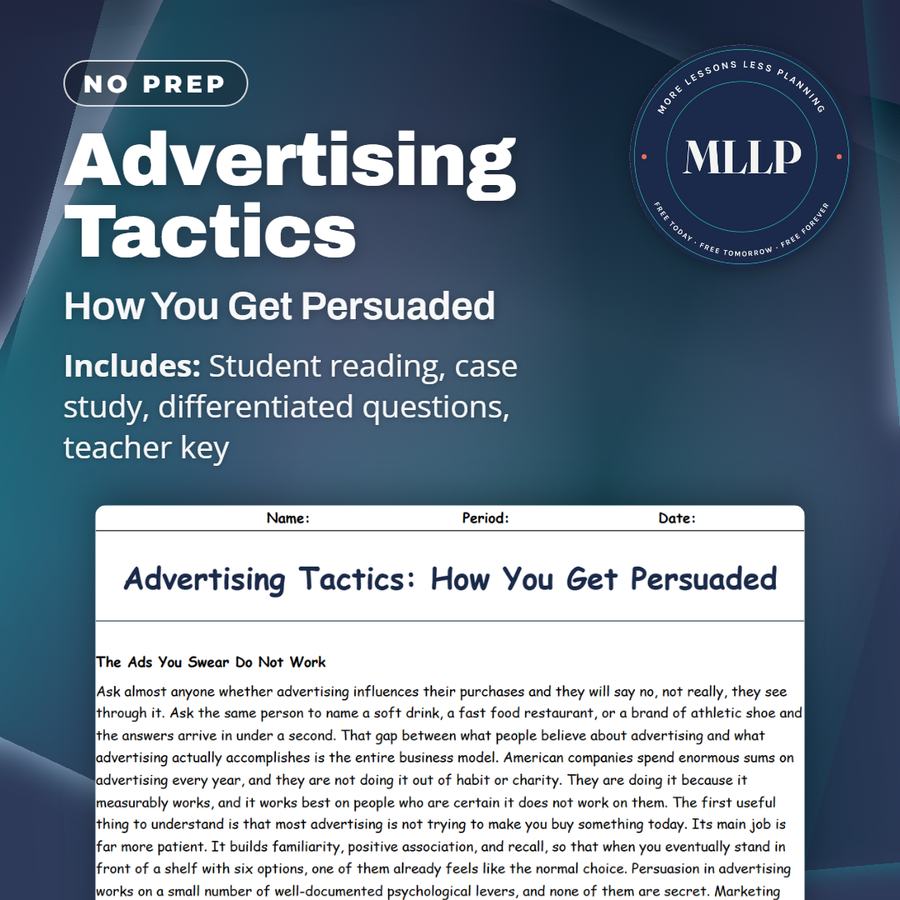
Advertising Tactics: How You Get Persuaded
Quality reviewed September 2026
Facts verified September 23, 2026
- Subject
- Career & Life Skills
- Grades
- Grades 9-12
- Length
- 9-page student worksheet
- Time
- About one 50-minute class period
- Great for
- Sub plans and independent work
- Includes
- Reading passage, comprehension questions + full answer key
- Format
- Print-and-go PDF
What students do
- Match five advertising terms to their definitions, from bandwagon to native advertising
- Priya's two hour countdown timer gets checked against the reading's own defense of waiting it out
- Identify which technique the crossed out $200 price is performing on the jacket example
- Helps fight cavities gets tested against the reading's own method for spotting a real claim
What it covers
- Documented advertising techniques, from emotional appeal to native advertising and retargeting
- A case study tracing one shopper through an influencer ad, retargeting, and a fake countdown
- The FTC disclosure rule behind the tiny hashtag ad label on sponsored posts
Start reading this worksheet
The Ads You Swear Do Not Work
Ask almost anyone whether advertising influences their purchases and they will say no, not really, they see through it. Ask the same person to name a soft drink, a fast food restaurant, or a brand of athletic shoe and the answers arrive in under a second. That gap between what people believe about advertising and what advertising actually accomplishes is the entire business model. American companies spend enormous sums on advertising every year, and they are not doing it out of habit or charity. They are doing it because it measurably works, and it works best on people who are certain it does not work on them. The first useful thing to understand is that most advertising is not trying to make you buy something today. Its main job is far more patient. It builds familiarity, positive association, and recall, so that when you eventually stand in front of a shelf with six options, one of them already feels like the normal choice. Persuasion in advertising works on a small number of well-documented psychological levers, and none of them are secret. Marketing students learn them in a semester. The reason they keep working anyway is that recognizing a technique in the moment is much harder than recognizing it in a classroom, especially when you are tired, hungry, scrolling, or standing in a store trying to finish an errand. Consumer education cannot make you immune to persuasion. What it can do is slow you down at the moment a technique is being used, which is usually enough.
Selling the Feeling, Not the Product
The single most common approach in modern advertising is emotional appeal, which connects a product to a feeling rather than to any claim about the product itself. A truck commercial showing a father and daughter at a job site is not making an argument about towing capacity. It is attaching the truck to competence, family, and pride, so those feelings arrive later along with the brand. Insurance advertising runs on fear, showing what happens to the family that did not plan. Fragrance and fashion advertising runs almost entirely on desire and status, frequently without making a single factual claim, which is convenient because unfalsifiable claims cannot be challenged. Closely related is the bandwagon appeal, the message that everybody is already doing this and you are the exception. Phrases like America's favorite, the number one choice, and joining millions of satisfied customers all work on the same instinct, which is the powerful human preference for not being left out. Testimonials and endorsements add a face to the same idea. A celebrity endorsement borrows credibility that has nothing to do with the product, since a basketball player has no special knowledge of insurance. Influencer marketing is the current and more effective version, because it looks like a recommendation from a person you chose to follow rather than an advertisement you were shown. The Federal Trade Commission requires paid endorsements to be disclosed, which is why hashtag ad appears in posts, and the disclosure is easy to miss by design.
Claims That Sound Like Facts
A second family of techniques works by imitating evidence. The most reliable is the weasel word, a qualifier that removes all meaning from a claim while leaving it sounding scientific. Helps fight cavities promises nothing, because helps has no measurable definition. Up to fifty percent off means the store has one item at fifty percent off. Virtually spotless, fights signs of aging, and clinically proven to improve appearance all belong to the same family. Read the sentence again with the qualifier removed and see whether anything remains. The unfinished comparison works similarly. More absorbent, better tasting, and lasts longer all raise the same question, which is longer than what. When the comparison target is missing, there is no claim to evaluate. Pseudoscience adds a lab coat, invented technical vocabulary, and percentages that describe consumer surveys rather than laboratory results. Nine out of ten dentists recommend usually means nine out of ten dentists in a small paid survey listed the brand among several acceptable options. Health and food labeling has its own version, where natural is largely unregulated on most products, while organic is legally defined and enforced by the Department of Agriculture. Multigrain simply means more than one grain, which is not the same as whole grain. The defense is the same in every case: convert the marketing sentence into a specific factual claim, and if it cannot be converted, it was not a claim. A statement that cannot be tested also cannot be proven false, which is precisely why so much advertising copy is written that way on purpose.
Like what you read? The full reading, the case study, and every question set are in the free download below, along with the answer key.
Why this matters
Every student in the room is already inside an advertising system built specifically for their phone, their feed, and their spending money. A first paycheck spent on a flash sale or a subscription that renewed itself is not a failure of willpower, it is the outcome the ad was designed to produce. Recognizing a weasel word or an artificial countdown before a purchase, rather than after, is one of the few consumer habits that keeps paying off long after this reading is finished.
From one teacher to another
Priya is two hours from buying headphones she never wanted on Wednesday, and the reading walks through exactly how that happened. Five passages explain the psychological levers behind modern advertising, from emotional appeal and bandwagon pressure to weasel words like helps and up to that promise nothing. Students see how anchoring makes a crossed out price do the persuading, how scarcity timers manufacture urgency, and how targeted ads and native advertising use personal data to disguise a sale as content. The case study follows Priya through an influencer endorsement, a retargeted feed, and a countdown that resets when the page reloads. By the end, students have a short list of habits, noticing the emotion, waiting a day, checking a disclosure, that defuse most of it.
What you get
Download
Where should I send the next one?
Everything here is free and it stays that way. Leave your email and I'll send you the new lessons as they go up. You can unsubscribe from any one of them.
Related resources
Building a Household Budget
Comparison Shopping and Unit Pricing
Consumer Rights and Responsibilities
Grocery Shopping on a Budget
Making a Major Purchase
Needs vs. Wants: How Consumers Decide
Every lesson on this site is free to download and use. If one of them saved you a prep period, you can chip in a few bucks toward my three kids' daycare fund. That's genuinely where tips go.