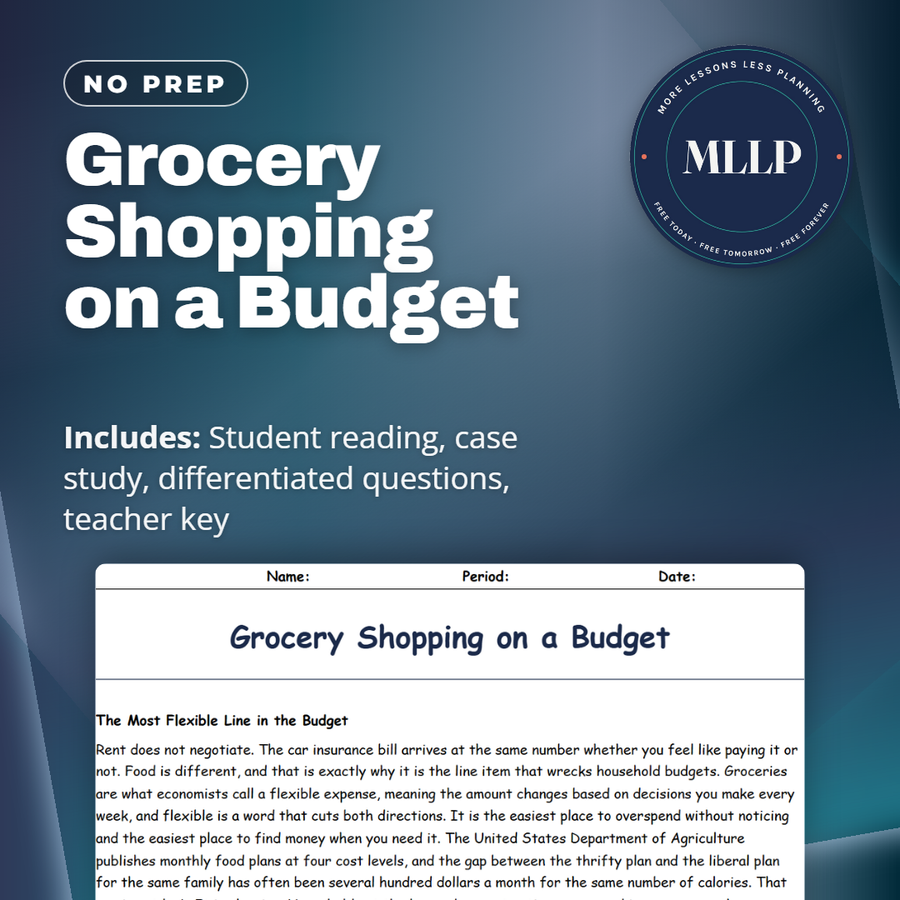
Grocery Shopping on a Budget
Quality reviewed September 2026
Facts verified September 23, 2026
- Subject
- Career & Life Skills
- Grades
- Grades 9-12
- Length
- 9-page student worksheet
- Time
- About one 50-minute class period
- Great for
- Sub plans and independent work
- Includes
- Reading passage, comprehension questions + full answer key
- Format
- Print-and-go PDF
What students do
- A duplicate jar of salsa and a bag of spoiled spinach get traced back to two habits that would have prevented them
- The Ortega family's receipt tally reveals where the real grocery overspending was happening
- Explain two store layout tricks, like eye level shelving, and the habit that defeats each one
- A date label gets read correctly to decide whether food already in the fridge is still good
What it covers
- Meal planning and a pantry inventory as the first line of defense against overspending
- How supermarket layout, from end caps to eye level shelves, is built to add items to a cart
- The Ortega family's two week receipt audit and what it revealed about takeout spending
Start reading this worksheet
The Most Flexible Line in the Budget
Rent does not negotiate. The car insurance bill arrives at the same number whether you feel like paying it or not. Food is different, and that is exactly why it is the line item that wrecks household budgets. Groceries are what economists call a flexible expense, meaning the amount changes based on decisions you make every week, and flexible is a word that cuts both directions. It is the easiest place to overspend without noticing and the easiest place to find money when you need it. The United States Department of Agriculture publishes monthly food plans at four cost levels, and the gap between the thrifty plan and the liberal plan for the same family has often been several hundred dollars a month for the same number of calories. That gap is not luck. It is planning. Households at the low end are not eating worse, and in many cases they are eating better, because the habits that reduce grocery spending are mostly the same habits that reduce processed food and waste. The starting point is knowing your actual number. Most people underestimate their food spending badly, because groceries arrive in a dozen small transactions plus convenience store runs plus takeout that never gets counted as food. Track every dollar spent on food for two weeks, including the gas station snack, and the real figure usually lands well above the guess. You cannot manage a number you have never measured.
Planning Before Shopping
Almost all of the savings in a grocery budget are captured before anyone gets in the car. Meal planning means deciding what the household will actually eat for a defined period, then building the shopping list backward from those meals. It sounds like extra work and it replaces a larger amount of work, because it eliminates the daily question of what is for dinner, which is the question that produces takeout. A workable plan starts with two inventories. First, look at what is already in the freezer, pantry, and refrigerator, because most households own more food than they think and buy duplicates of things sitting in the back. Second, check the store's weekly advertisement, since building meals around what is already discounted is far more effective than clipping coupons for things you would not otherwise buy. Then plan meals that share ingredients, so a bunch of cilantro or half a head of cabbage gets used three times instead of rotting after one recipe. Plan for realistic nights too. A plan with seven complicated dinners fails on the first evening someone works late, so experienced planners deliberately schedule one leftovers night and one very simple meal. From that plan comes the list, organized by section of the store, which shortens the trip and reduces the number of aisles you walk down. Every unnecessary aisle is an opportunity to buy something that was not on the list.
How Stores Are Built to Take Your Money
A supermarket is not laid out for your convenience. It is laid out by people who study, in detail, how shoppers move and what makes them add items. Staples such as milk, eggs, and bread are placed at the back and often at opposite corners, guaranteeing you walk past thousands of products to reach them. The most profitable items sit at eye level, which is why store brands and larger economy sizes are frequently found on the very top or bottom shelves where you have to look for them. Children's cereal is shelved at a child's eye level, which is not an accident. End caps, the displays at the ends of aisles, are prime advertising space that manufacturers pay for, and merchandise there is often not discounted at all despite feeling like a sale. The checkout lane is stocked with candy and magazines because it targets shoppers who are tired, finished deciding, and standing still. Bakeries near the entrance push the smell of bread through the store because scent drives appetite, and hungry shoppers buy measurably more. None of this is illegal or even dishonest, and knowing it is most of the defense. Two habits neutralize the majority of it. Eat before you shop, since shopping hungry reliably increases both the total and the share of impulse items. And shop the perimeter first, where produce, dairy, meat, and bread live, treating the center aisles as a targeted trip for specific list items rather than a tour.
Like what you read? The full reading, the case study, and every question set are in the free download below, along with the answer key.
Why this matters
Food is one of the only expenses a teenager already controls firsthand, whether that is a grocery run for the household or the gas station snack that never gets counted as food at all. The reading notes that food waste estimates have run around thirty percent of what a household buys, a number that connects directly to a refrigerator most students have already opened and found something forgotten in the back of. Planning meals before shopping and reading a date label correctly are small habits that free up real money without cutting a single meal, which matters most for a household working with a fixed weekly amount.
From one teacher to another
The Ortega family tapes two weeks of receipts to their refrigerator and discovers the grocery store was never the real problem, gas station runs and two takeout nights were. That discovery opens a reading built around the habits that actually move a food budget, starting with meal planning before anyone leaves the house and a pantry inventory that catches the duplicate jar already in the cabinet. Students walk through how a supermarket's own layout, from eye level shelves to a bakery smell near the entrance, is built to add items to a cart, and which two habits neutralize most of it. A closing passage on food waste explains why storage, date labels, and a rotation habit can matter more than any coupon.
What you get
Download
Where should I send the next one?
Everything here is free and it stays that way. Leave your email and I'll send you the new lessons as they go up. You can unsubscribe from any one of them.
Related resources
Advertising Tactics: How You Get Persuaded
Building a Household Budget
Comparison Shopping and Unit Pricing
Consumer Rights and Responsibilities
Making a Major Purchase
Needs vs. Wants: How Consumers Decide
Every lesson on this site is free to download and use. If one of them saved you a prep period, you can chip in a few bucks toward my three kids' daycare fund. That's genuinely where tips go.