Building a Household Budget
Quality reviewed September 2026
Facts verified September 23, 2026
- Subject
- Career & Life Skills
- Grades
- Grades 9-12
- Length
- 8-page student worksheet
- Time
- About one 50-minute class period
- Great for
- Sub plans and independent work
- Includes
- Reading passage, comprehension questions + full answer key
- Format
- Print-and-go PDF
What students do
- Car insurance billed twice a year gets tested against the reading's definition of a periodic expense
- Devon's paycheck math gets corrected once gross and net income are told apart
- Devon's insurance bill gets named as the exact budgeting tool his aunt is describing
- The fifty thirty twenty guideline gets tested against a household spending seventy percent of income on housing alone
What it covers
- The real difference between gross income and net take home pay
- Fixed, variable, and periodic expenses, including how a sinking fund handles a periodic bill
- Devon's case study, where a first apartment budget falls short by the third week
Start reading this worksheet
A Plan, Not a Punishment
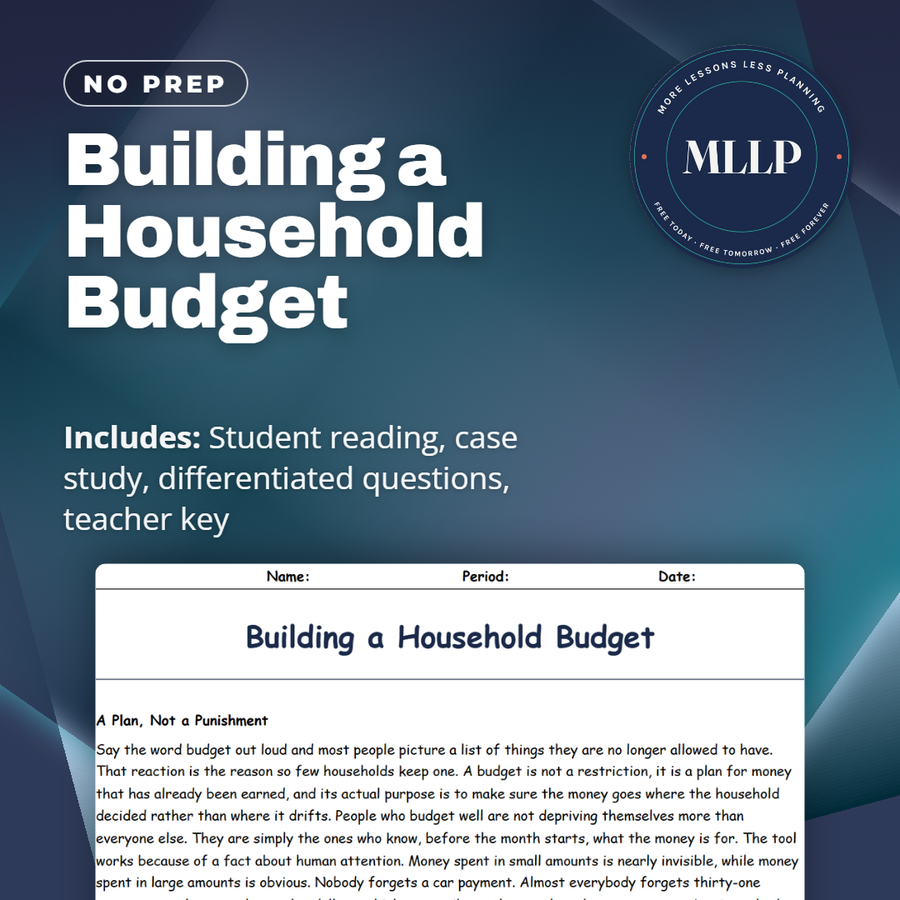
Say the word budget out loud and most people picture a list of things they are no longer allowed to have. That reaction is the reason so few households keep one. A budget is not a restriction, it is a plan for money that has already been earned, and its actual purpose is to make sure the money goes where the household decided rather than where it drifts. People who budget well are not depriving themselves more than everyone else. They are simply the ones who know, before the month starts, what the money is for. The tool works because of a fact about human attention. Money spent in small amounts is nearly invisible, while money spent in large amounts is obvious. Nobody forgets a car payment. Almost everybody forgets thirty-one separate purchases under twelve dollars, which can easily total more than the car payment. A written budget makes the invisible spending visible, and visibility alone changes behavior before any rule is imposed. There is one non-negotiable rule of budgeting that everything else depends on. A budget must be built on real numbers, not aspirational ones. A household that actually spends four hundred dollars a month on food and writes two hundred fifty on the budget line has not saved a hundred fifty dollars. It has written a lie and guaranteed the plan fails in week two, at which point everyone concludes budgets do not work.
Starting With What Actually Arrives
Every budget begins with income, and the number that matters is net income, not gross income. Gross income is what you earn before anything is taken out. Net income, often called take-home pay, is what actually lands in the account after federal and state taxes, Social Security and Medicare, health insurance premiums, and retirement contributions are withheld. The difference surprises first-time workers badly. A job advertised at eighteen dollars an hour for forty hours looks like seven hundred twenty dollars a week and deposits meaningfully less. Budgeting on gross income is one of the most common mistakes people make, and it produces a plan that is short from the first day. Households with irregular income face a harder version of the same problem. Servers working for tips, hourly workers whose schedules change, and anyone doing seasonal or gig work cannot count on the same deposit twice. The standard approach is to budget on the lowest month from the past year rather than the average, treating anything above that as surplus to be assigned deliberately. That surplus is where an emergency fund gets built. Financial educators generally recommend eventually holding three to six months of essential expenses in accessible savings, though the first meaningful milestone is far smaller. A starter fund of five hundred to one thousand dollars is what stops an ordinary car repair from turning into credit card debt that takes two years to clear.
Sorting Where It Goes
Expenses divide into three practical groups, and the sorting is what makes a budget usable. Fixed expenses stay the same every month, such as rent, a car payment, or an insurance premium. They are predictable and easy to plan for, but they are also the hardest to change quickly, since you cannot reduce rent this month by deciding to. Variable expenses change with behavior, including groceries, gasoline, utilities, and household supplies. They are less predictable and far more controllable, which is why nearly all short-term budget repair happens here. Periodic expenses are the ones that wreck otherwise sensible plans, because they arrive a few times a year rather than monthly. Car registration, insurance paid in six-month blocks, holiday gifts, school fees, and annual subscriptions all feel like emergencies when they hit, and none of them are surprises. The fix is a sinking fund, which means dividing the known annual cost by twelve and setting that amount aside every month so the bill is already paid when it arrives. A six hundred dollar insurance premium becomes fifty dollars a month rather than a crisis in March. Expenses also divide a second way, into essential and discretionary, and this is where the needs and wants vocabulary returns. Essentials keep the household running and safe. Discretionary spending is everything chosen for enjoyment. When income drops, discretionary is where the cuts have to come from, and knowing in advance which line items sit there makes that decision fast instead of frantic.
Like what you read? The full reading, the case study, and every question set are in the free download below, along with the answer key.
Why this matters
A budget is the first financial document most teenagers will ever build on their own, usually right around the same year they sign a lease, start a job with real withholding, or take on a phone contract. The gap between the number on a job posting and the number that actually lands in an account catches almost everyone off guard the first time, and it is exactly the mistake Devon makes in this reading. Learning to sort a periodic bill like car insurance into a monthly plan, instead of discovering it as a surprise, is the difference between a budget that survives its second month and one that gets abandoned.
From one teacher to another
Devon signs his first apartment lease at nineteen and builds a budget using his hourly wage times his hours, which the reading calls one of the most common mistakes a first budget makes. The reading works through the real difference between gross and net income, then sorts expenses into fixed, variable, and periodic so a car registration bill stops feeling like an ambush every March. Students see the fifty thirty twenty guideline used as a diagnostic rather than a rule, and zero based budgeting explained as assigning every dollar a job. Devon's aunt talks him through a sinking fund for his car insurance bill, dividing the annual cost by six so the money is already there when it comes due.
What you get
Download
Where should I send the next one?
Everything here is free and it stays that way. Leave your email and I'll send you the new lessons as they go up. You can unsubscribe from any one of them.
Related resources
Advertising Tactics: How You Get Persuaded
Comparison Shopping and Unit Pricing
Consumer Rights and Responsibilities
Grocery Shopping on a Budget
Making a Major Purchase
Needs vs. Wants: How Consumers Decide
Every lesson on this site is free to download and use. If one of them saved you a prep period, you can chip in a few bucks toward my three kids' daycare fund. That's genuinely where tips go.