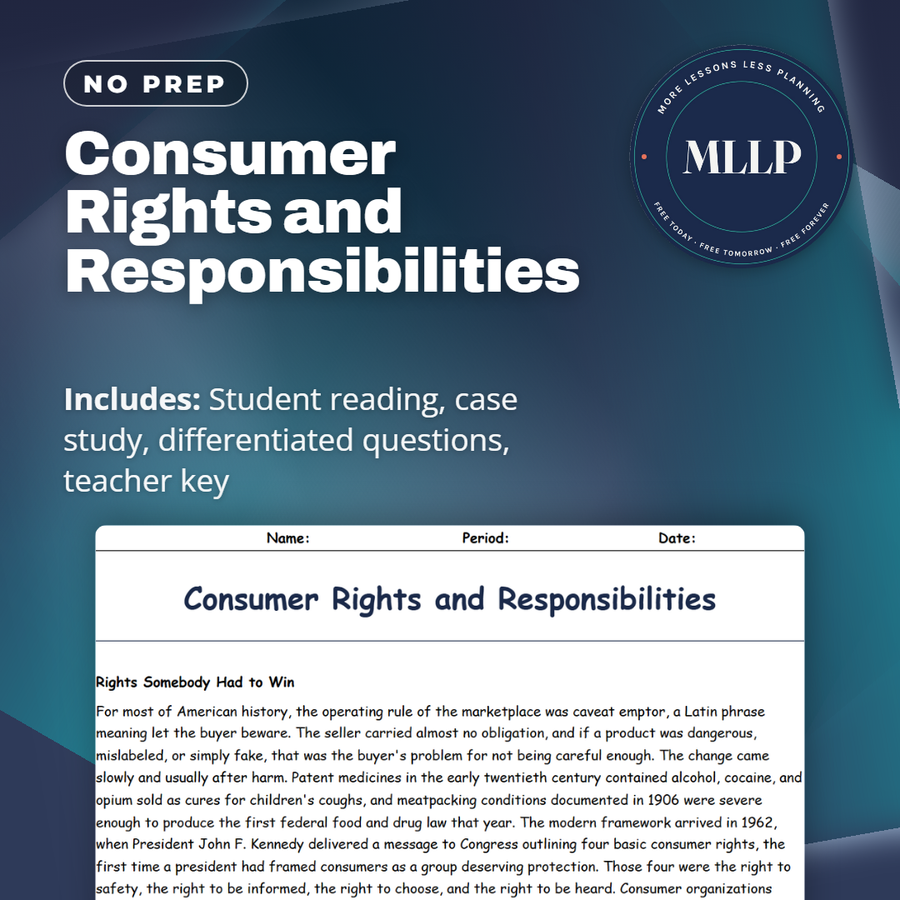
Consumer Rights and Responsibilities
Quality reviewed September 2026
Facts verified September 23, 2026
- Subject
- Career & Life Skills
- Grades
- Grades 9-12
- Length
- 8-page student worksheet
- Time
- About one 50-minute class period
- Great for
- Sub plans and independent work
- Includes
- Reading passage, comprehension questions + full answer key
- Format
- Print-and-go PDF
What students do
- Match five terms, including caveat emptor and the FTC, to their real definitions
- Renata's space heater case gets used to test which rights a faulty product actually violates
- Trace how caveat emptor gave way to Kennedy's 1962 consumer rights message
- The responsibility the reading pairs with the right to redress, keeping records and following the complaint process, gets explained
What it covers
- The eight consumer rights, from safety and redress to consumer education
- Which federal agency, from the FTC to the CPSC, handles which kind of complaint
- Renata's case study on escalating a complaint after a return window closes
Start reading this worksheet
Rights Somebody Had to Win
For most of American history, the operating rule of the marketplace was caveat emptor, a Latin phrase meaning let the buyer beware. The seller carried almost no obligation, and if a product was dangerous, mislabeled, or simply fake, that was the buyer's problem for not being careful enough. The change came slowly and usually after harm. Patent medicines in the early twentieth century contained alcohol, cocaine, and opium sold as cures for children's coughs, and meatpacking conditions documented in 1906 were severe enough to produce the first federal food and drug law that year. The modern framework arrived in 1962, when President John F. Kennedy delivered a message to Congress outlining four basic consumer rights, the first time a president had framed consumers as a group deserving protection. Those four were the right to safety, the right to be informed, the right to choose, and the right to be heard. Consumer organizations later added four more, which are the right to redress, the right to consumer education, the right to a healthy environment, and the right to satisfaction of basic needs. Eight rights is more than anyone remembers under pressure, but the underlying idea is compact. Buyers and sellers do not have equal information, and a marketplace where the seller knows everything and the buyer knows nothing does not actually function. Every one of these rights exists to close that gap somewhere.
What the Eight Rights Actually Cover
The right to safety means protection against products that are hazardous to health or life, and it is the reason recalls, safety standards, and crash testing exist at all. The right to be informed means protection against dishonest advertising and labeling, and access to the facts needed to make a decision, which is where nutrition panels, fiber content tags, interest rate disclosures, and drug warning labels come from. The right to choose means access to a variety of competing products at competitive prices, which is why antitrust law exists, since a market with only one seller sets any price it wants. The right to be heard means consumer interests receive consideration when government makes policy, and that companies provide a genuine channel for complaints rather than an unanswered phone line. The right to redress means the ability to obtain a fair remedy when something goes wrong, including refunds, repairs, replacements, and the ability to sue. The right to consumer education means access to the knowledge required to use these rights, which is the reason a course like this one exists in a school at all. The right to a healthy environment recognizes that production and disposal affect people who never bought the product. The right to satisfaction of basic needs holds that access to adequate food, clothing, shelter, health care, and sanitation is a floor rather than a market outcome. Written down they sound abstract. In practice they are the specific reason a defective space heater gets recalled instead of ignored.
Who Enforces Any of This
Rights without enforcement are decoration, so several federal agencies exist to make them operational. The Federal Trade Commission polices unfair and deceptive business practices, regulates advertising, requires disclosure of paid endorsements, and maintains the national database where fraud reports are collected. The Consumer Product Safety Commission oversees the safety of thousands of consumer products, issues recalls, and sets standards for items ranging from cribs to lithium batteries. The Food and Drug Administration regulates the safety and labeling of food, drugs, cosmetics, and medical devices. The Consumer Financial Protection Bureau handles banking, credit cards, student loans, and debt collection, and it accepts complaints directly from individuals. The Department of Agriculture regulates meat, poultry, and egg inspection and enforces the organic label. Beneath the federal layer sit state attorneys general, who bring consumer protection cases within their states and are often the fastest to respond to local patterns, and local consumer affairs offices that handle disputes with nearby businesses. The Better Business Bureau is not a government agency at all, which is a distinction worth remembering, since it is a private nonprofit that mediates complaints and publishes ratings but has no authority to compel anyone to do anything. Knowing which body handles which problem is most of the work of getting a complaint resolved. A misleading advertisement is a Federal Trade Commission matter. A crib that collapses is a Consumer Product Safety Commission matter. Sending the right complaint to the wrong agency simply wastes the effort.
Like what you read? The full reading, the case study, and every question set are in the free download below, along with the answer key.
Why this matters
Every consumer right in this reading exists because someone was harmed first, and every one of them still has to be used by an actual person filing an actual complaint to work. Most teenagers will deal with a defective product, a denied return, or a company that will not answer the phone well before they deal with almost anything else on a civics syllabus, usually over something as ordinary as a phone case or a pair of shoes. Knowing which federal agency handles which problem, and that a complaint has to be documented and escalated in order, turns a frustrating return into a solvable one instead of a story about a company that got away with something.
From one teacher to another
Caveat emptor, Latin for let the buyer beware, used to be the entire rulebook for American shoppers until a defective space heater or a poisoned patent medicine forced something to change. The reading traces that history from 1906 food and drug law through President Kennedy's 1962 message naming four consumer rights, then the four added later by consumer organizations. Students match caveat emptor, the FTC, and three other terms to their real definitions, and learn why the Better Business Bureau is a private group rather than a government office. Renata's melted space heater case study asks which rights were violated when a store refused a return two days after the window closed, and what she should do next.
What you get
Download
Where should I send the next one?
Everything here is free and it stays that way. Leave your email and I'll send you the new lessons as they go up. You can unsubscribe from any one of them.
Related resources
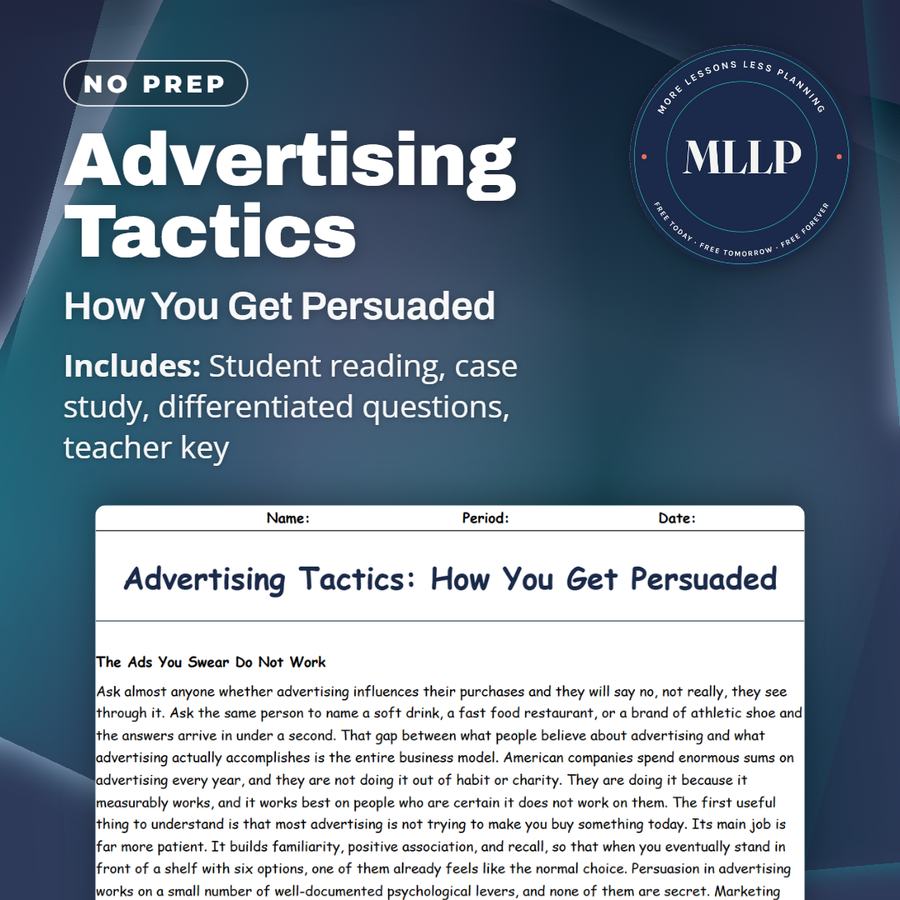
Advertising Tactics: How You Get Persuaded
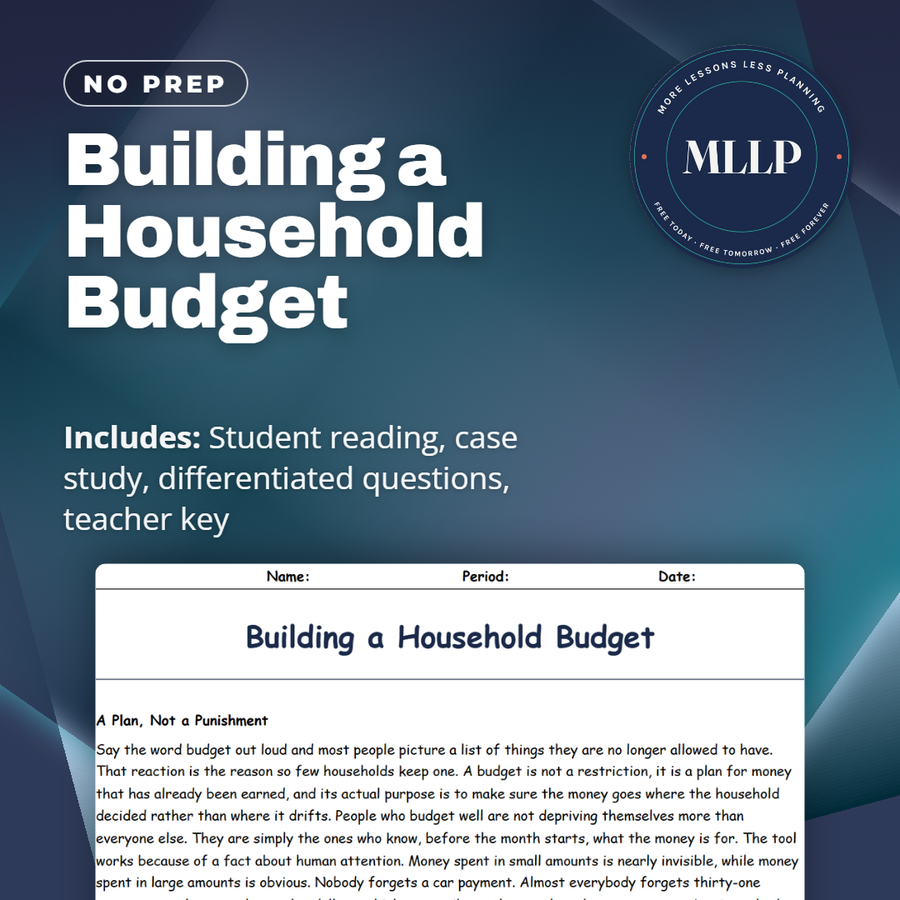
Building a Household Budget
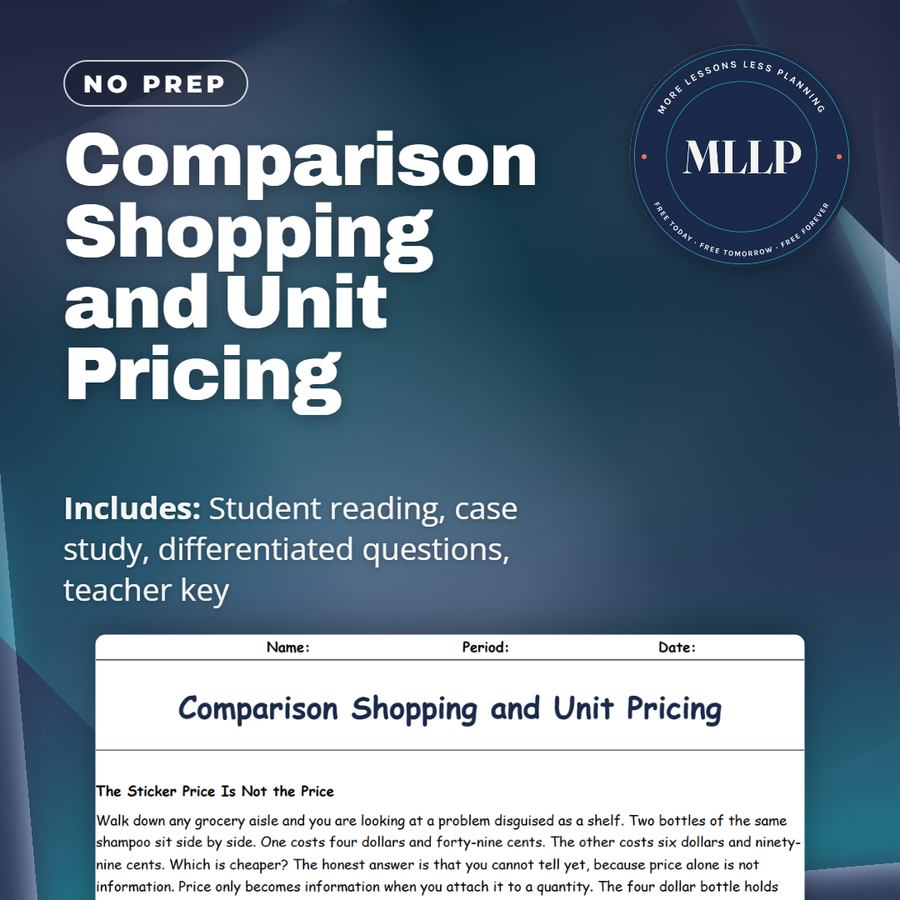
Comparison Shopping and Unit Pricing
Grocery Shopping on a Budget
Making a Major Purchase
Needs vs. Wants: How Consumers Decide
Every lesson on this site is free to download and use. If one of them saved you a prep period, you can chip in a few bucks toward my three kids' daycare fund. That's genuinely where tips go.