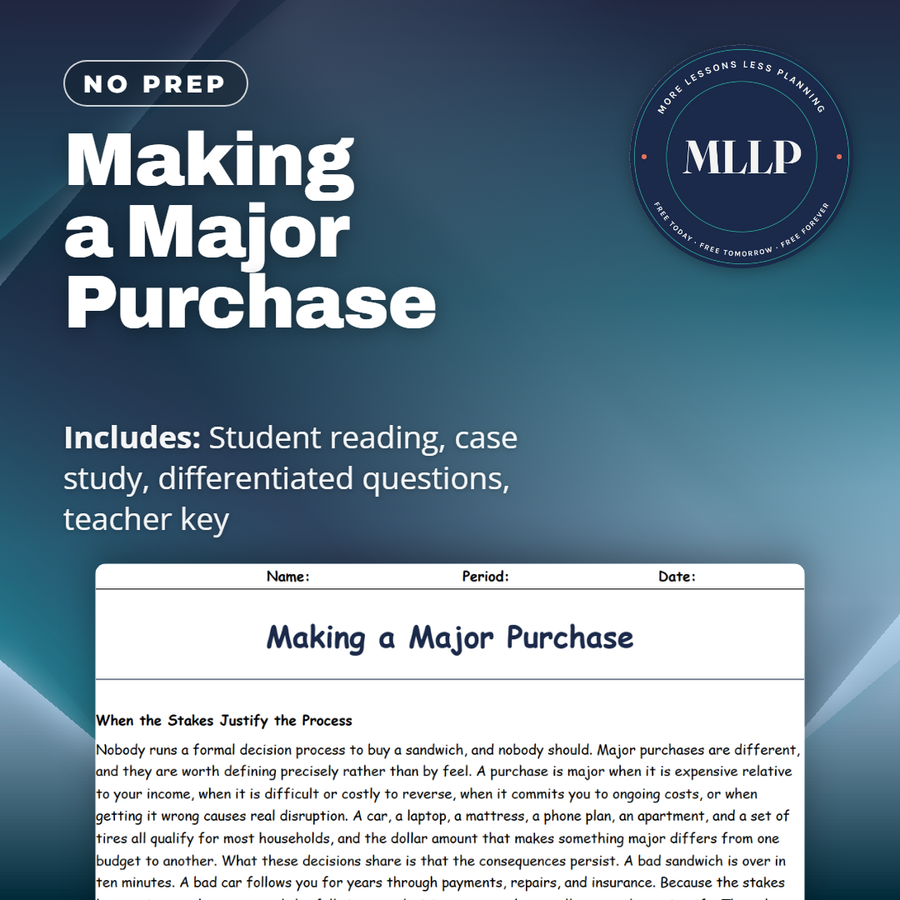
Making a Major Purchase
Quality reviewed September 2026
Facts verified September 23, 2026
- Subject
- Career & Life Skills
- Grades
- Grades 9-12
- Length
- 8-page student worksheet
- Time
- About one 50-minute class period
- Great for
- Sub plans and independent work
- Includes
- Reading passage, comprehension questions + full answer key
- Format
- Print-and-go PDF
What students do
- Repair history, fuel economy, and insurance get named as the ownership costs Jaylen's own list left out
- Jaylen's monthly payment gets checked against the loan length and rate nobody mentioned to him
- A non-negotiable requirement gets picked out from a preference using the reading's own definition
- Settling the item's price before financing or trade-ins gets tested against the reading's own negotiating rule
What it covers
- The six step decision process for a purchase that is expensive or hard to reverse
- Total cost of ownership, depreciation, and why a lower monthly payment can cost more
- Jaylen's car lot case study and the questions his own list left unanswered
Start reading this worksheet
When the Stakes Justify the Process
Nobody runs a formal decision process to buy a sandwich, and nobody should. Major purchases are different, and they are worth defining precisely rather than by feel. A purchase is major when it is expensive relative to your income, when it is difficult or costly to reverse, when it commits you to ongoing costs, or when getting it wrong causes real disruption. A car, a laptop, a mattress, a phone plan, an apartment, and a set of tires all qualify for most households, and the dollar amount that makes something major differs from one budget to another. What these decisions share is that the consequences persist. A bad sandwich is over in ten minutes. A bad car follows you for years through payments, repairs, and insurance. Because the stakes last, major purchases reward the full six-step decision process that smaller ones do not justify. They also reward time, which is the resource most shoppers refuse to spend and the one that consistently returns the most. Nearly every technique designed to separate people from money, from artificial deadlines to high-pressure sales floors to today-only financing offers, works by compressing the interval between wanting and buying. Extending that interval deliberately is the single most effective defense a consumer has. There is no legitimate major purchase that becomes a bad deal because you thought about it overnight, and any seller who tells you otherwise has answered the question for you.
Research Before Anyone Is Selling to You
Good research begins with the need rather than the product, which means writing down what the item has to accomplish before looking at any options. A student who writes that a laptop must run video editing software, last a full school day on battery, and survive four years has just built criteria that eliminate most of the market in about a minute. Separate those criteria into requirements, which are non-negotiable, and preferences, which are pleasant. Salespeople and product pages are organized around features, and features only matter when they serve a requirement you identified yourself. Sources matter as much as effort. Independent testing organizations that accept no advertising provide the most reliable comparisons. Reviews from verified purchasers are useful in aggregate rather than individually, and the informative ones are usually the three-star reviews, since one-star and five-star reviews cluster at the emotional extremes and say less about ordinary use. Read for patterns instead of anecdotes, because ten separate reviews describing the same failure at month eight is data and one furious review is not. Be alert to incentivized and fake reviews, which cluster in short bursts of similar phrasing and arrive without verified purchase markers. Ask people who own the item and have lived with it for a year, since the questions that matter most, about durability and regret, cannot be answered by anyone still inside the return window. Check total cost of ownership rather than purchase price alone. Write the findings down before you go anywhere, because research you cannot recall under pressure on a sales floor is research you did not really do.
The Price Is Not the Cost
The most expensive mistake in major purchasing is comparing sticker prices, because the sticker is only the first installment. Total cost of ownership adds every dollar the item will require across its useful life: purchase price, taxes and fees, delivery and installation, insurance, fuel or electricity, consumable supplies, maintenance, likely repairs, and eventual disposal, minus whatever it is worth when you are finished with it. A car is the clearest illustration, since two vehicles at identical prices can differ by thousands of dollars a year once insurance, fuel efficiency, repair frequency, and depreciation are counted. Depreciation, the loss of value over time, is frequently the largest single cost of owning a vehicle and it is invisible because no one ever sends a bill for it. Printers are the household version of the same trap, sold cheaply and priced permanently through ink. Consumables deserve a specific check on anything that requires them, including filters, blades, pods, and proprietary batteries, since a manufacturer that controls the supply controls the real price. Financing changes the arithmetic again. A payment amount is not a price, and stretching a loan across more months lowers the payment while raising the total paid substantially. Compare the total finance charge and the annual percentage rate rather than the monthly figure, since the monthly figure is what a seller uses to make an unaffordable purchase feel manageable. Zero-percent promotional offers are real but usually conditional, and deferred interest terms can retroactively charge the entire period if the balance is not cleared exactly on time.
Like what you read? The full reading, the case study, and every question set are in the free download below, along with the answer key.
Why this matters
A car, a laptop, or a first apartment is usually the first purchase a teenager makes that actually follows them around for years through payments, repairs, or a contract they signed without reading. The reading's warning that a payment amount is not a price shows up constantly once a person starts looking, in car lots, phone plans, and financing offers built specifically to make an unaffordable total feel manageable one month at a time. Writing down what an item actually has to do before walking into a store, the way Jaylen's own list does, is a habit that keeps working long after this particular reading is finished.
From one teacher to another
Jaylen walks onto a car lot with three thousand dollars saved and a written list, and within minutes the salesperson has him talking in monthly payments instead of price. The reading lays out a six step process for any purchase that is expensive, hard to reverse, or tied to ongoing costs, starting with separating requirements from preferences before a single product page gets opened. Students learn to calculate total cost of ownership rather than sticker price, spot how a longer loan lowers a payment while raising the total paid, and read three star reviews as more informative than the glowing or furious ones. Jaylen's own list has three unanswered questions, repair history, fuel economy, and insurance, that the reading uses to show what a monthly payment number is designed to hide.
What you get
Download
Where should I send the next one?
Everything here is free and it stays that way. Leave your email and I'll send you the new lessons as they go up. You can unsubscribe from any one of them.
Related resources
Advertising Tactics: How You Get Persuaded
Building a Household Budget
Comparison Shopping and Unit Pricing

Consumer Rights and Responsibilities
Grocery Shopping on a Budget
Needs vs. Wants: How Consumers Decide
Every lesson on this site is free to download and use. If one of them saved you a prep period, you can chip in a few bucks toward my three kids' daycare fund. That's genuinely where tips go.