Comparison Shopping and Unit Pricing
Quality reviewed September 2026
Facts verified September 23, 2026
- Subject
- Career & Life Skills
- Grades
- Grades 9-12
- Length
- 8-page student worksheet
- Time
- About one 50-minute class period
- Great for
- Sub plans and independent work
- Includes
- Reading passage, comprehension questions + full answer key
- Format
- Print-and-go PDF
What students do
- Total price divided by the number of units gets picked as the actual formula for unit price
- Marcus works out which of three detergents is cheapest once the math replaces the best value sign
- Compare cost per use against unit price to explain why a bigger package is not always smarter
- A buy one get one free sign gets tested against the reading's own definition of a real discount
What it covers
- How to calculate unit price and convert between different shelf tag units
- Cost per use as a separate measure from unit price for durable goods
- Marcus's case study weighing store brand, national brand, and club size detergent
Start reading this worksheet
The Sticker Price Is Not the Price
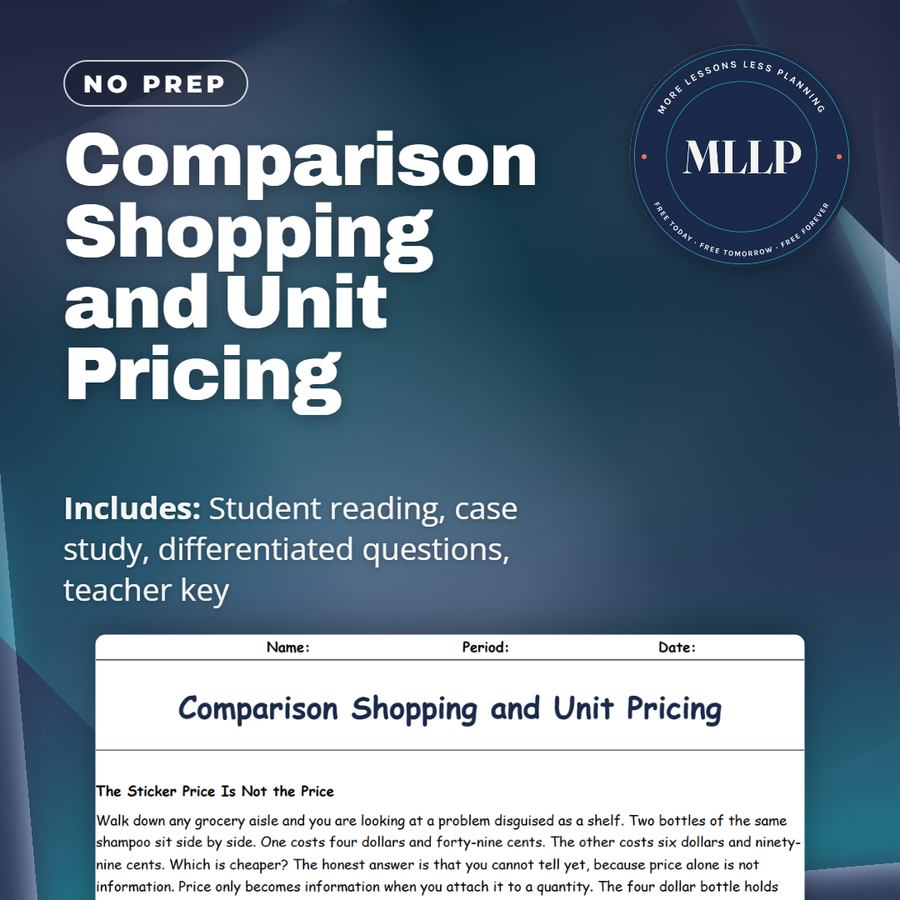
Walk down any grocery aisle and you are looking at a problem disguised as a shelf. Two bottles of the same shampoo sit side by side. One costs four dollars and forty-nine cents. The other costs six dollars and ninety-nine cents. Which is cheaper? The honest answer is that you cannot tell yet, because price alone is not information. Price only becomes information when you attach it to a quantity. The four dollar bottle holds twelve ounces and the seven dollar bottle holds twenty-five ounces, which means the cheaper-looking bottle costs about thirty-seven cents an ounce and the expensive-looking bottle costs about twenty-eight cents an ounce. The bottle that felt expensive is the better buy by roughly a quarter, and nothing on the front label told you that. This is the central skill of comparison shopping. Comparison shopping means evaluating competing products on price, quantity, quality, and terms before you buy rather than after. It is not the same thing as bargain hunting, because a bargain on something you did not need is still money gone. The comparison is only meaningful when the alternatives genuinely satisfy the same need. Stores are not hiding this from you exactly, but they are also not designing shelves to make it easy. Package sizes change, shapes are inconsistent, and the number that catches your eye is always the one the store wants catching it. Doing the math yourself takes about ten seconds and is one of the few consumer habits with a guaranteed return.
Unit Price Does the Comparing for You
The tool that solves the shampoo problem is the unit price, which is the cost of a single standard unit of a product, such as one ounce, one pound, one hundred sheets, or one fluid ounce. You calculate it by dividing the total price by the number of units in the package. A thirty-two ounce jar of peanut butter at five dollars and seventy-six cents works out to eighteen cents an ounce. An eighteen ounce jar at three dollars and sixty cents works out to twenty cents an ounce. The large jar wins by two cents an ounce, which sounds trivial until you multiply it across a year of groceries for a household. Many states require grocery stores to post unit prices on the shelf tag, usually in small print on the left side, and where it is posted you do not have to do any arithmetic at all. You do have to read carefully, because the unit itself can differ between tags. One tag may report cents per ounce while the tag directly beneath it reports cents per one hundred sheets or per pound, and comparing those two numbers produces nonsense. Convert to the same unit before you conclude anything. The other trap is the assumption that bigger is automatically cheaper per unit. It usually is, but not always, and stores know shoppers believe it. Promotional pricing on the small size, or a manufacturer quietly shrinking the large size, can flip the math with no visible change to the package.
When the Cheaper Unit Price Is the Wrong Buy
Unit price answers one question extremely well and it is important to know which question that is. It tells you the cheapest way to acquire a quantity. It does not tell you whether you should acquire that quantity. Buying the forty-eight ounce container of sour cream at a lower unit price is a loss if half of it spoils before your household finishes it, and the effective cost of food you throw away is infinite because you got nothing for it. This is why the warehouse club math is more complicated than the marketing suggests. Bulk buying rewards non-perishable goods that you reliably use, such as paper products, rice, or laundry detergent, and it punishes perishables in a small household. Storage space is a resource too. A case of forty-eight rolls of paper towels at an excellent unit price is a poor decision in an apartment with one closet. Quality has to enter the comparison as well, because unit price treats every ounce as identical when they are not. A cheaper trash bag that tears and doubles up costs more per actual use than the expensive one. Consumer researchers describe this as cost per use rather than cost per unit, and for durable goods it is the more honest number. Divide the price by the number of times you will realistically use the item. A twelve dollar pan used twice a week for six years is astonishingly cheap. A forty dollar appliance used once is not.
Like what you read? The full reading, the case study, and every question set are in the free download below, along with the answer key.
Why this matters
Grocery and household shopping is one of the few math problems a teenager solves in public, standing in an aisle with a phone and a short amount of patience. The habit of dividing price by quantity before deciding which package is cheaper, rather than trusting whichever number is printed larger, keeps paying off on every trip to a store. It also teaches a more honest kind of comparison, one that weighs storage space and whether food will actually get used before it spoils, instead of chasing the lowest number on the shelf tag alone.
From one teacher to another
Two bottles of shampoo sit on the same shelf, one at four dollars and forty nine cents, the other at six dollars and ninety nine cents, and the reading uses that pair to teach why sticker price alone answers nothing. Students learn to calculate unit price by dividing total price by quantity, then apply the same math to peanut butter jars, laundry detergent, and a warehouse club best value sign that turns out to be comparing the wrong two options. The reading separates unit price from cost per use, explaining why a lower price per ounce can still be a bad buy when food spoils or storage runs out. Marcus works through three detergent options in the case study, torn between the cheapest unit price and a detergent that will not irritate his sister's skin.
What you get
Download
Where should I send the next one?
Everything here is free and it stays that way. Leave your email and I'll send you the new lessons as they go up. You can unsubscribe from any one of them.
Related resources
Advertising Tactics: How You Get Persuaded
Building a Household Budget
Consumer Rights and Responsibilities
Grocery Shopping on a Budget
Making a Major Purchase
Needs vs. Wants: How Consumers Decide
Every lesson on this site is free to download and use. If one of them saved you a prep period, you can chip in a few bucks toward my three kids' daycare fund. That's genuinely where tips go.