War in the Pacific
Quality reviewed September 2026
- Grades
- Grades 9-12
- Time
- About two 50-minute class periods
- Includes
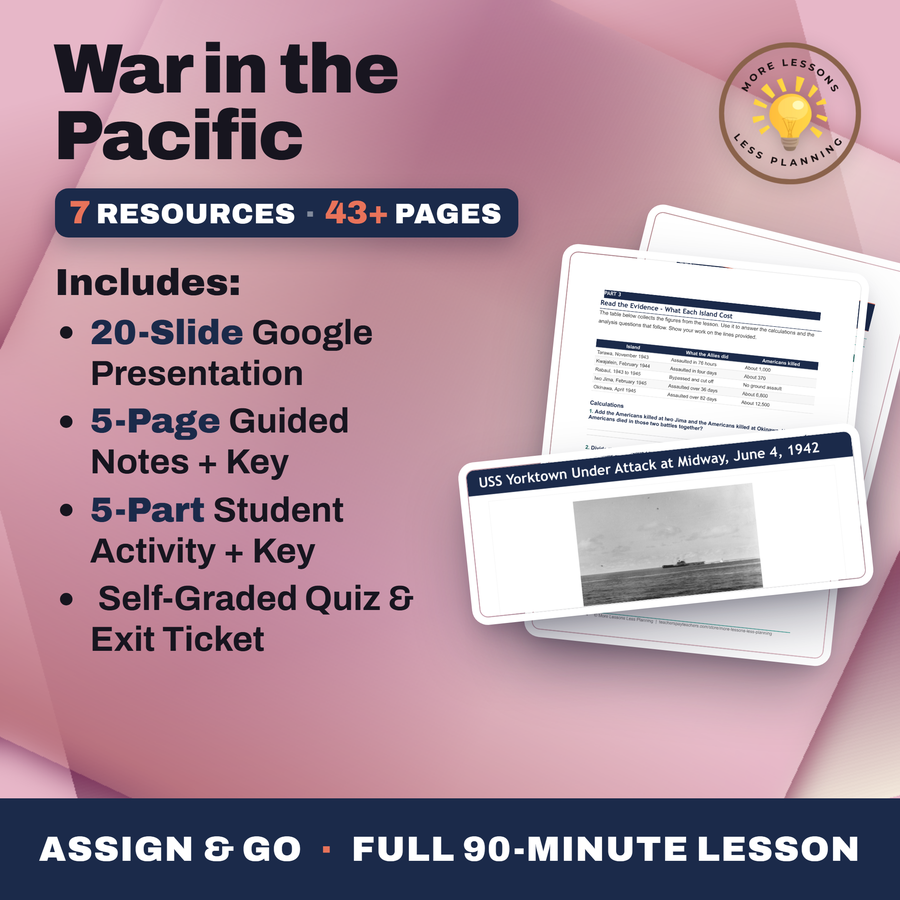
- 11 ready-to-teach files
- Format
- Word (.docx) · PowerPoint (.pptx)
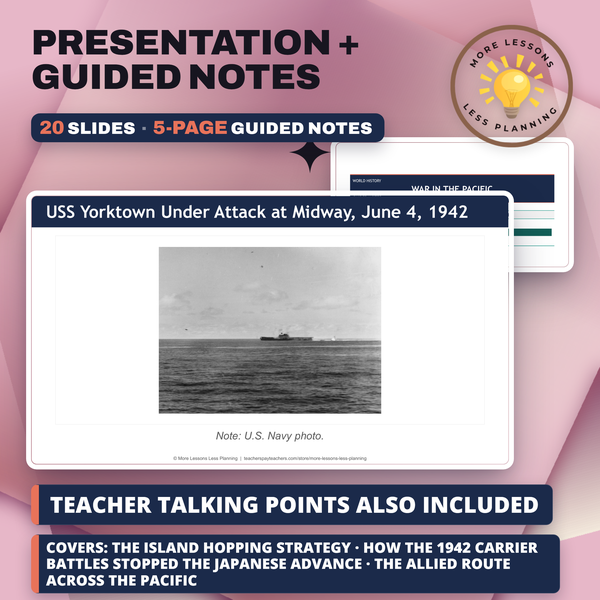
- Slide deck
- Guided notes
- Guided notes teacher key
- Activity + answer key
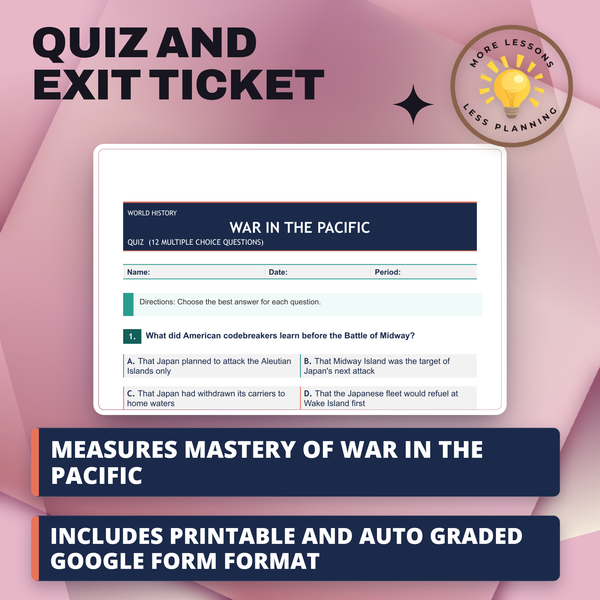
- Quiz + answer key
- Exit ticket + answer key
- Teacher guide
- Teacher presentation notes
What students do
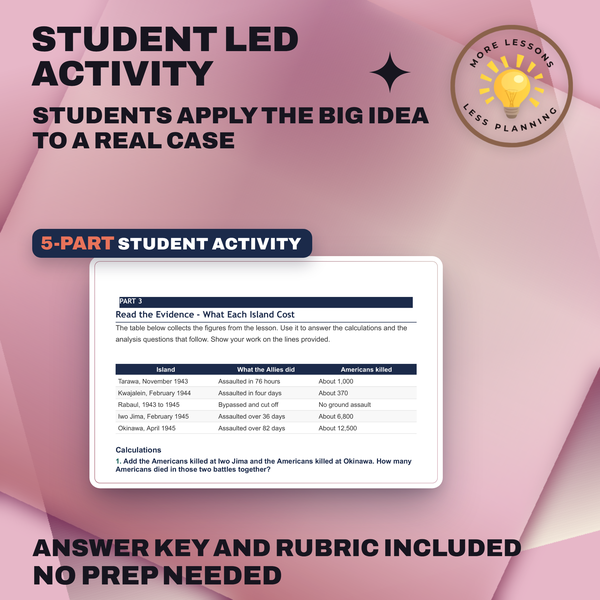
- Compare what the Allies gained by storming Tarawa against what they gained by bypassing Rabaul entirely
- Analyze Admiral Nimitz's June 6, 1942 communique announcing Midway while the battle was still being fought
- Trace the island-hopping route from Guadalcanal in 1942 to Okinawa in 1945
- Calculate the cost in American lives at Tarawa, Iwo Jima, and Okinawa using the toolkit's data table
What it covers
- Why American codebreaking let Admiral Nimitz ambush Japan's carrier fleet at Midway
- How airfield range, not island size, decided which islands got taken and which got bypassed
- What made Rabaul's 100,000 stranded troops the clearest case for the whole island-hopping strategy
Learning targets
- Explain the island hopping strategy and why the Allies used it.
- Describe how the 1942 carrier battles stopped the Japanese advance.
- Trace the Allied route across the Pacific from 1942 to 1945.
- Explain why airfields decided which islands were taken or bypassed.
- Use a 1942 U.S. Navy communique as evidence about the war at sea.
Peek inside
Japan seized the Philippines, Malaya, Singapore, and Burma in months.
The oil fields of the Dutch East Indies fell to Japan in March 1942.
Island bases guarded the empire in a ring thousands of miles wide.
Japan expected the Allies to trade for peace rather than pay the cost.
Instead the Allies chose to fight their way back across the ocean.
How Far Japan Reached
Japan seized the Philippines, Malaya, , and Burma in months.
The oil fields of the Dutch East fell to Japan in March 1942.
Japan expected the Allies to for peace rather than pay the cost.
1. The Allied strategy of taking islands with airfields and skipping the rest is called .
Why this matters
Whether an island got stormed or bypassed in the Pacific came down to airfield range, not size on a map, a colder way to explain the campaign than reciting famous battles. Rabaul held 100,000 Japanese troops the Allies simply left stranded rather than fight for, a decision that only makes sense once students see what an airfield was worth.
Lining up Tarawa, Iwo Jima, and Okinawa in a cost table makes clear some of the war's worst losses came from islands that mattered less strategically than the ones bypassed entirely. I have students argue whether storming an island was ever the only option, using the numbers instead of hindsight.
From one teacher to another
Six months after Pearl Harbor, four days of fighting at Midway turned the momentum of the whole Pacific war, and this lesson traces the island-hopping strategy that grew out of it, from Coral Sea through Guadalcanal, the Marianas, and Okinawa. Students read Admiral Nimitz's own press communique, released while Midway was still being fought, and compare what a commander could honestly claim mid-battle to what wasn't yet known when he said it. I like that it forces students to weigh a bypassed island like Rabaul against a stormed one like Iwo Jima and decide for themselves which decision was smarter.
Every file in this toolkit
Download
Where should I send the next one?
Everything here is free and it stays that way. Leave your email and I'll send you the new lessons as they go up. You can unsubscribe from any one of them.
Related resources

Every lesson on this site is free to download and use. If one of them saved you a prep period, you can chip in a few bucks toward my three kids' daycare fund. That's genuinely where tips go.