
The Atomic Bomb
Quality reviewed September 2026
- Grades
- Grades 9-12
- Time
- About two 50-minute class periods
- Includes
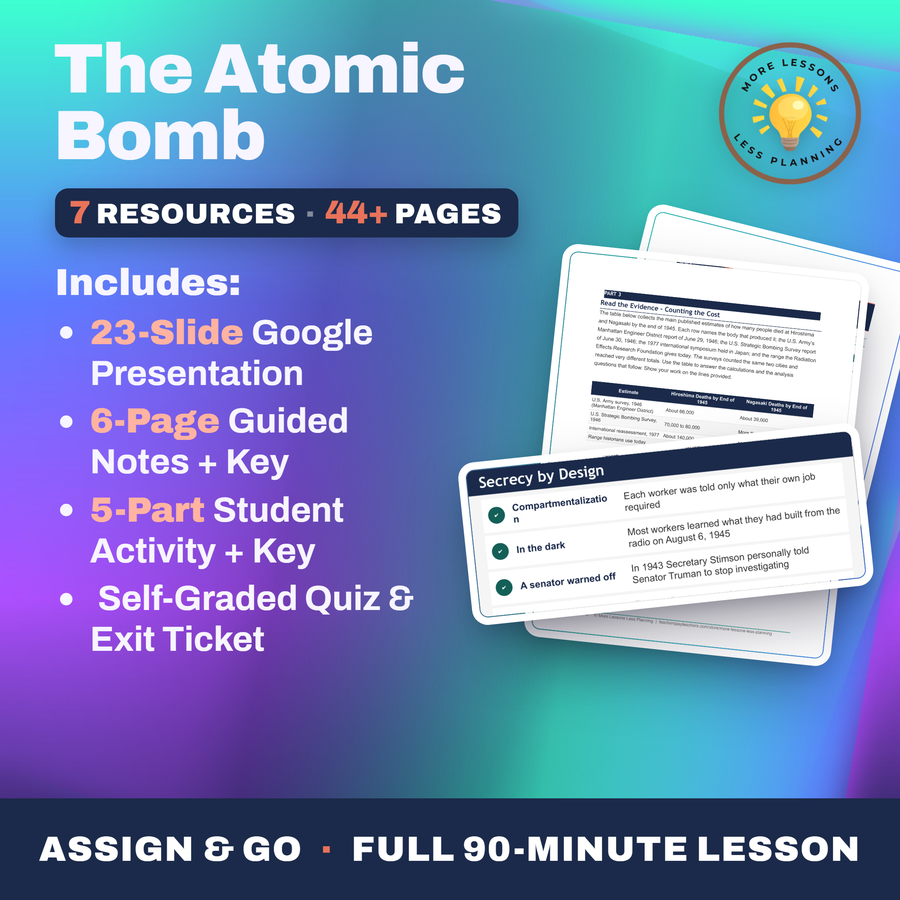
- 11 ready-to-teach files
- Format
- Word (.docx) · PowerPoint (.pptx)
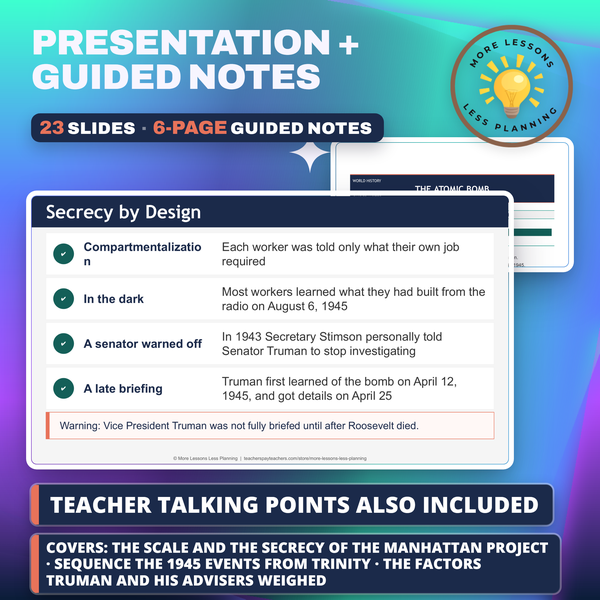
- Slide deck
- Guided notes
- Guided notes teacher key
- Activity + answer key
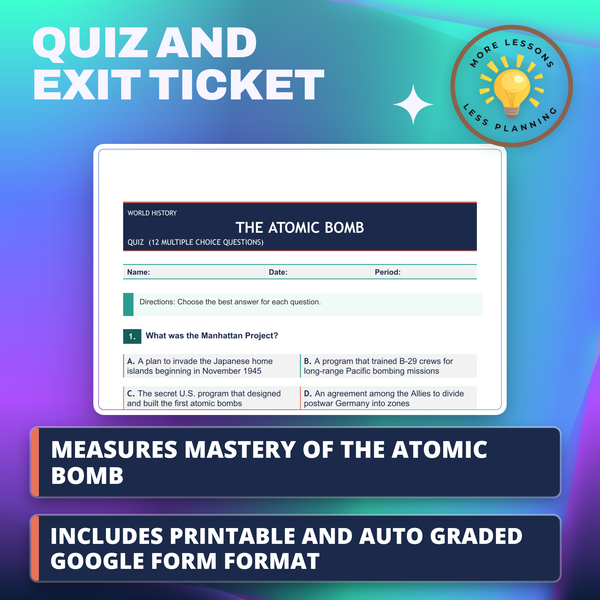
- Quiz + answer key
- Exit ticket + answer key
- Teacher guide
- Teacher presentation notes
What students do
- Trace the Manhattan Project across Oak Ridge, Hanford, and Los Alamos, and explain how compartmentalization kept it secret
- Compare the 1946 U.S. Army survey's Hiroshima death toll of about 66,000 against the 1977 international reassessment of about 140,000
- Read Truman's actual August 6, 1945 White House statement and identify what it leaves out about civilian deaths
- Write an evidence-based verdict on whether the bombings were necessary, citing the planned November 1945 invasion and Soviet entry into the war
What it covers
- The Manhattan Project's three secret sites and the compartmentalization that kept most workers in the dark
- Truman's actual August 6, 1945 White House statement and what it leaves out about civilian deaths
- Hiroshima's death toll estimates, from the 1946 U.S. Army count of about 66,000 to the 1977 reassessment of about 140,000
- Weighing the planned November 1945 invasion and Soviet entry into the war in an evidence-based necessity verdict
Learning targets
- Describe the scale and the secrecy of the Manhattan Project.
- Sequence the 1945 events from Trinity through Japan's surrender.
- Explain the factors Truman and his advisers weighed before using the bomb.
- Describe the human cost using sourced ranges instead of single numbers.
- Weigh evidence on more than one side of the debate over the decision.
Peek inside
Germany surrendered on May 8, 1945, but the war against Japan went on.
Iwo Jima and Okinawa cost tens of thousands of American casualties.
American B-29s had firebombed more than 60 Japanese cities by mid-1945.
A U.S. invasion of Japan was planned to begin on Kyushu in November 1945.
Meanwhile a secret American weapons program had been running since 1942.
The War in the Summer of 1945
Germany surrendered on 8, 1945, but the war against Japan went on.
American B-29s had firebombed more than Japanese cities by mid-1945.
A U.S. invasion of Japan was planned to begin on in November 1945.
1. Oak Ridge in Tennessee, Hanford in Washington, and Los Alamos in New Mexico were three separate secret cities thousands of miles apart, all working toward one weapon. The single program that tied all three together was code-named the .
Why this matters
Two official counts of the same event do not agree: the 1946 U.S. Army survey put Hiroshima's dead near 66,000, and the 1977 reassessment raised that figure to about 140,000. A gap that size is not a rounding error.
Workers at Oak Ridge, Hanford, and Los Alamos built pieces of a weapon without knowing what the pieces were for, a secrecy strategy called compartmentalization. I pair that with what Truman left out of his own statement once the bomb was used, since the same government that hid the project also controlled what the public was told.
From one teacher to another
The centerpiece of this lesson is a woman at Oak Ridge who read dials for two years without knowing what she'd helped build, then learned it from the radio on August 6, 1945, and that gap sets the tone for a toolkit built entirely on the documented record: no graphic imagery, no named individual casualties. Students trace the Manhattan Project's three secret sites and the compartmentalization that kept the project hidden even from most of its own workers, then read Truman's actual White House statement from that day, which calls Hiroshima "an important Japanese Army base" and never mentions civilian deaths. They compare that statement against the casualty numbers themselves, which range from the 1946 U.S. Army count of about 66,000 to the 1977 international reassessment of about 140,000, before writing a verdict on necessity that has to weigh the planned November invasion and Soviet entry into the war against the 1946 U.S. Strategic Bombing Survey's own conclusion that Japan would likely have surrendered anyway.
Every file in this toolkit
Download
Where should I send the next one?
Everything here is free and it stays that way. Leave your email and I'll send you the new lessons as they go up. You can unsubscribe from any one of them.
Related resources


Every lesson on this site is free to download and use. If one of them saved you a prep period, you can chip in a few bucks toward my three kids' daycare fund. That's genuinely where tips go.