

D-Day and the Liberation of Europe
Quality reviewed September 2026
- Grades
- Grades 9-12
- Time
- About two 50-minute class periods
- Includes
- 11 ready-to-teach files
- Format
- Word (.docx) · PowerPoint (.pptx)
- Slide deck
- Guided notes
- Guided notes teacher key
- Activity + answer key
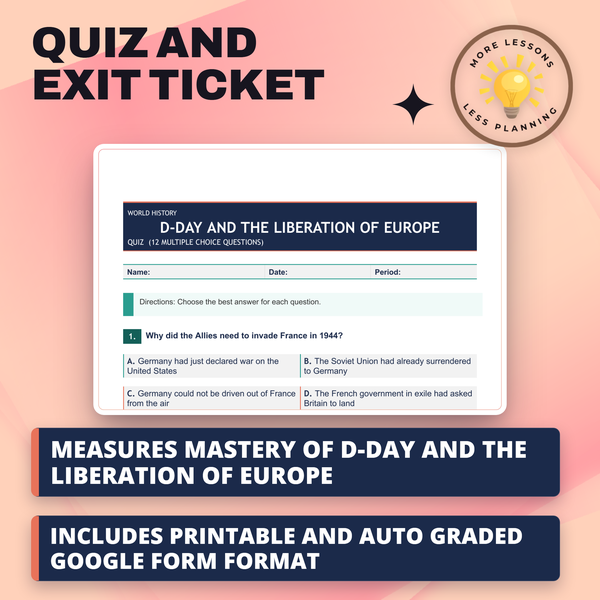
- Quiz + answer key
- Exit ticket + answer key
- Teacher guide
- Teacher presentation notes
What students do
- Compare casualty figures across the five landing beaches to explain why Omaha cost ten times what Utah did
- Analyze Operation Fortitude's fake army of dummy tanks and radio traffic that kept German divisions pinned at Calais
- Trace the advance from the Normandy beachhead to the liberation of Paris on August 25, 1944
- Read Eisenhower's June 6, 1944 Order of the Day for what it tells troops before they knew the outcome
What it covers
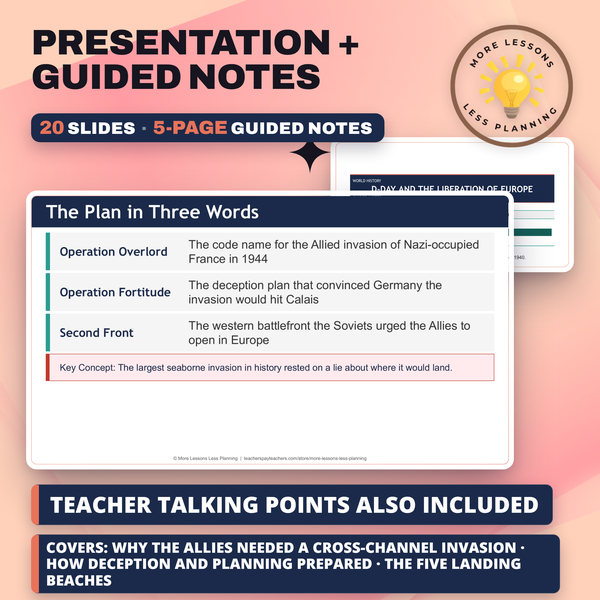
- Why the Allies waited until 1944 for a cross-Channel invasion after the failed 1942 Dieppe raid
- How the deception plan convinced Germany the real invasion would hit Calais
- What each of the five beaches cost in troops landed and casualties taken on June 6
Learning targets
- Explain why the Allies needed a cross-Channel invasion of France in 1944.
- Describe how deception and planning prepared the way for the landings.
- Compare the five landing beaches and explain why Omaha cost the most.
- Trace the advance from the Normandy beachhead to the freeing of Paris.
- Use Eisenhower's June 6, 1944 Order of the Day as historical evidence.
Peek inside
By 1940 Germany held France, Belgium, the Netherlands, and Norway.
Britain stood alone in the west until the United States entered the war.
The Soviet Union fought the German army almost by itself in the east.
Millions of people in occupied Europe lived under Nazi rule for four years.
Freeing Western Europe meant landing an army on a defended coast.
Where the War Stood in 1944
Germany held France, Belgium, the , and Norway by the summer of 1940.
The Union fought the German army almost by itself in the east.
Freeing Western Europe meant landing an army on a coast, four years after 1940.
Why this matters
Omaha Beach cost about ten times what Utah did on the same June morning, a gap that shows the same plan did not produce the same day everywhere. That unevenness traces to a hard lesson from 1942, when the failed raid at Dieppe convinced planners a cross-Channel invasion could not be attempted until the deception, timing, and firepower were all in place.
Holding the Dieppe failure beside the D-Day success matters because the two years between them is where the actual planning happened, not in the hours of June 6 itself. Placing what went right at Utah beside what went wrong at Omaha keeps the beach-by-beach reality from flattening into one story.
From one teacher to another
On June 6, 1944, about 132,000 Allied troops came ashore on five Normandy beaches in a single day, and I built this lesson around the gap between that plan and what actually happened beach by beach, because the plan didn't survive contact the same way on all five. Students trace the deception that misled Germany about the invasion site, then read Eisenhower's Order of the Day, written before anyone knew whether the operation would succeed. It runs from the beachhead at Omaha through the liberation of Paris that August, so it closes with the moment the whole gamble paid off.
Every file in this toolkit
Download
Where should I send the next one?
Everything here is free and it stays that way. Leave your email and I'll send you the new lessons as they go up. You can unsubscribe from any one of them.
Related resources





Every lesson on this site is free to download and use. If one of them saved you a prep period, you can chip in a few bucks toward my three kids' daycare fund. That's genuinely where tips go.