Aggression and Appeasement
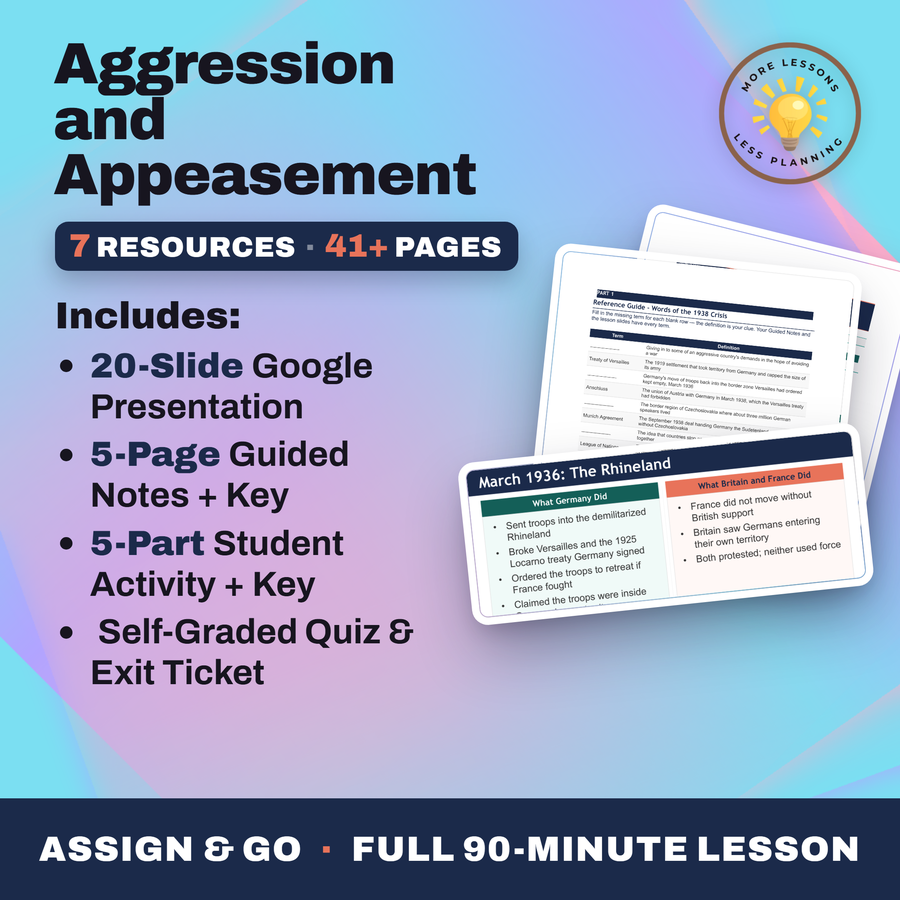
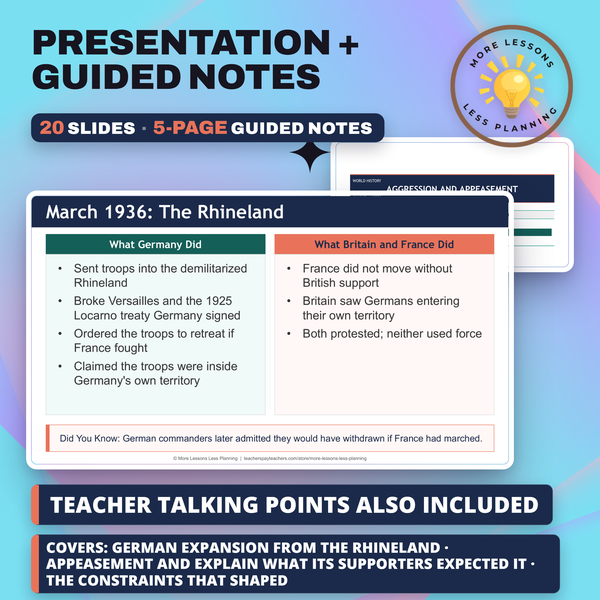
- Slide deck
- Guided notes
- Guided notes teacher key
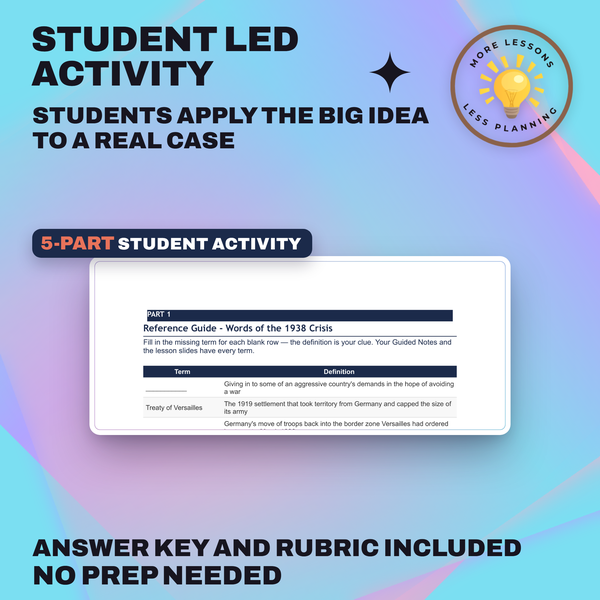
- Activity + answer key
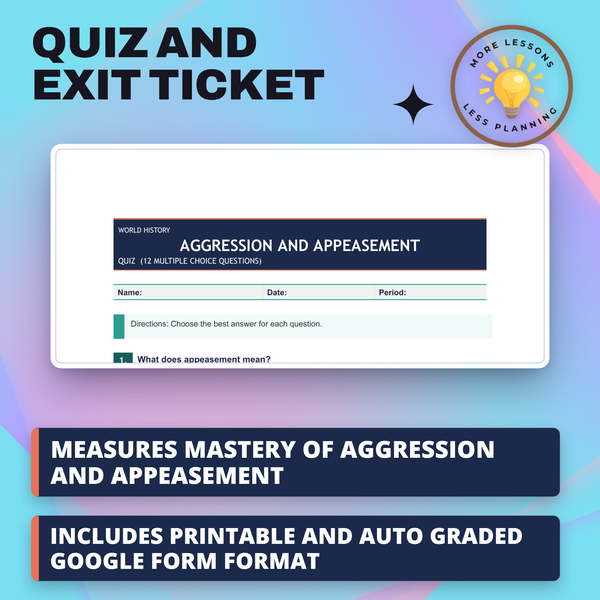
- Quiz + answer key
- Exit ticket + answer key
- Teacher guide
- Teacher presentation notes
Where should I send the next one?
Everything here is free and it stays that way. Leave your email and I'll send you the new lessons as they go up. You can unsubscribe from any one of them.
Every file in this toolkit
Related resources
Blitzkrieg and the Fall of France
D-Day and the Liberation of Europe
The Battle of Britain
The War Ends
War in the Pacific
Alliances and the Causes of WWI
What students do
- Trace German expansion step by step from the Rhineland in 1936 to Prague in March 1939
- Evaluate the case for appeasement using the constraints British and French leaders actually faced in 1938
- Analyze Roosevelt's September 26, 1938 telegram urging negotiation over force
- Explain what the Munich Agreement cost Czechoslovakia, a country that was not in the room
What it covers
- Why Britain and France gave ground at the Rhineland, Austria, and the Sudetenland before finally drawing a line
- The real constraints behind appeasement, including rearmament gaps, memory of the last war, and no reliable allies
- What changed in March 1939 when Hitler took Czech land with no German-speaker justification left to use
Learning targets
- Trace German expansion from the Rhineland in 1936 to Prague in March 1939.
- Define appeasement and explain what its supporters expected it to achieve.
- Identify the constraints that shaped the British and French decision.
- Explain what the Munich Agreement decided and what it cost Czechoslovakia.
- Evaluate the reasoning behind appeasement using evidence, not hindsight.
From one teacher to another
Every class wants to mock appeasement the second they hear the word, so I built this lesson to slow that reflex down. Britain and France were exhausted from the last war and kept giving ground to avoid another one, and getting students to see why that looked defensible in 1938, instead of simply wrong in hindsight, is the actual skill I'm after here. It opens my World War II unit, carrying the job of explaining how the war most students think they already know actually started.
Every lesson on this site is free to download and use. If one of them saved you a prep period, you can chip in a few bucks toward my three kids' daycare fund. That's genuinely where tips go.