Pearl Harbor
Quality reviewed September 2026
- Grades
- Grades 9-12
- Time
- About two 50-minute class periods
- Includes
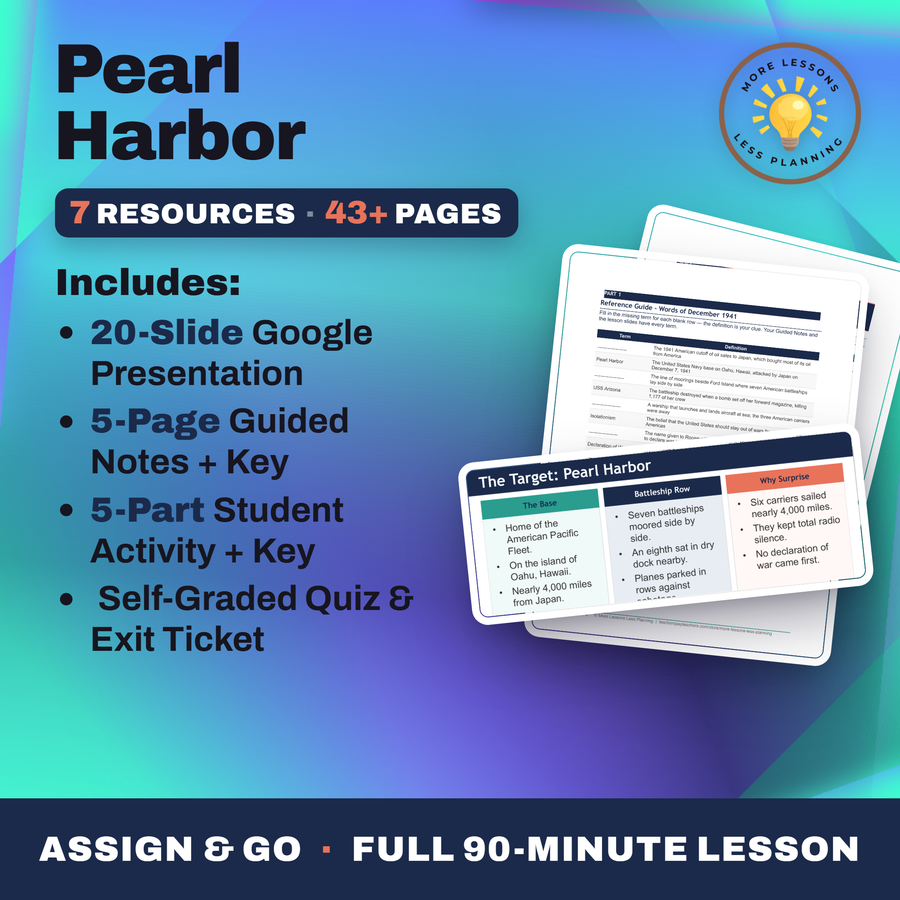
- 11 ready-to-teach files
- Format
- Word (.docx) · PowerPoint (.pptx)
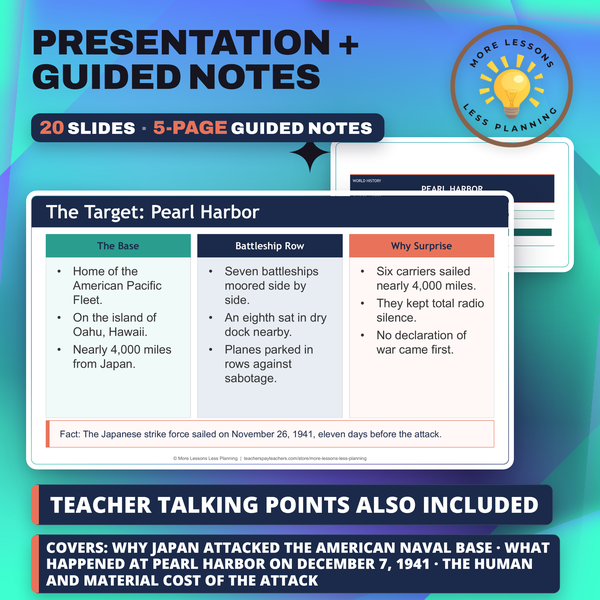
- Slide deck
- Guided notes
- Guided notes teacher key
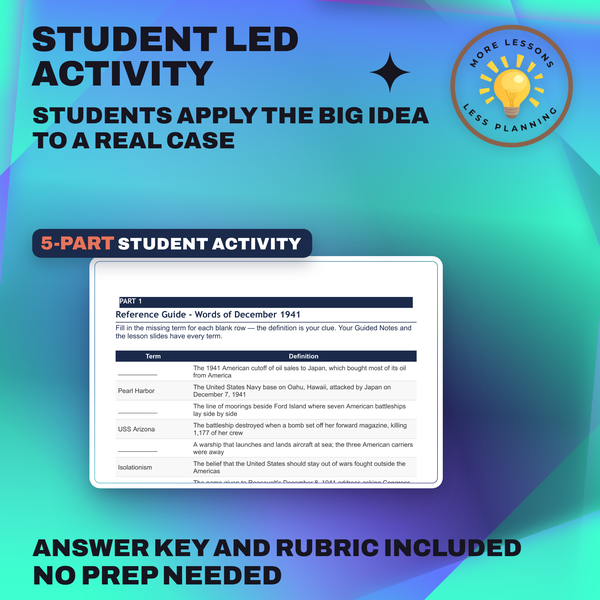
- Activity + answer key
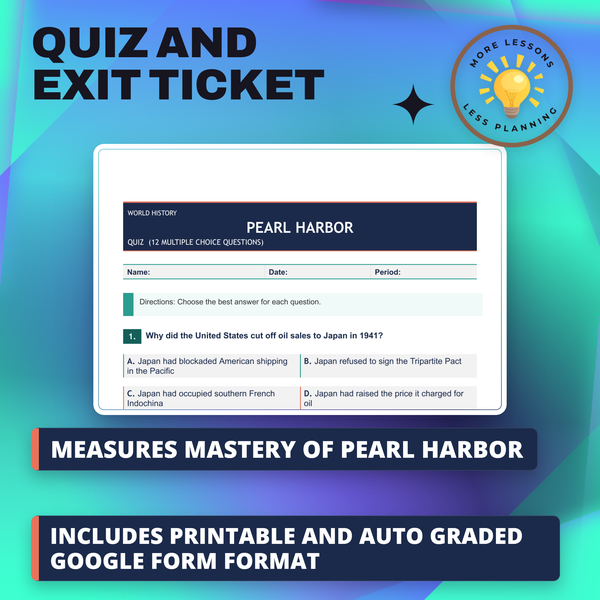
- Quiz + answer key
- Exit ticket + answer key
- Teacher guide
- Teacher presentation notes
What students do
- Trace the 110-minute attack timeline from the first wave at 7:55 a.m. to the loss of the USS Arizona
- Calculate what share of the 2,403 American dead came from one ship, the USS Arizona
- Source Roosevelt's December 8, 1941 address to Congress and explain why he asked Congress to declare a state of war had existed, not to start one
- Write an evidence-based verdict on whether the attack was a Japanese victory or a Japanese mistake
What it covers
- The 110-minute attack timeline, from the first wave at 7:55 a.m. to the sinking of the USS Arizona
- Why Japan's dependence on U.S. oil, 80 percent of its supply, shaped the decision to attack
- Roosevelt's actual December 8, 1941 address to Congress and the radio audience that heard it live
- Building an evidence-based verdict on the attack using casualty figures and the address as the two required sources
Learning targets
- Explain why Japan attacked the American naval base at Pearl Harbor.
- Describe what happened at Pearl Harbor on December 7, 1941.
- Summarize the human and material cost of the attack.
- Explain how the attack ended the American debate over isolationism.
- Use Roosevelt's December 8, 1941 address as evidence about U.S. entry.
Peek inside
Why the Pacific Was Heading for War
From Japan fought a long, costly war in China.
In July Japan occupied southern French Indochina.
Japan imported about percent of its oil from America.
1. Japanese carrier aircraft sailed nearly 4,000 miles to strike the American Pacific Fleet at its base at on a Sunday morning.
Why this matters
Roosevelt asked Congress to declare that a state of war already existed, not to begin one, and that choice of words is easy to read past on a first pass through his address. Slowing down on the phrase turns the speech from a formality into an argument, built for an audience of about 81 percent of American homes listening on the radio.
I make the closing verdict, victory or mistake, a two-source assignment on purpose, because deciding requires the casualty numbers and Roosevelt's own words together, not a gut reaction to either alone. Students who use only the numbers tend to call it an obvious mistake.
From one teacher to another
December 7, 1941 gets facts here, not drama: the 80 percent of its oil Japan imported from the United States, the 110-minute attack from first wave to the sinking of the USS Arizona, and a final count of 2,403 Americans dead. Students calculate for themselves what share of that total came from the Arizona alone, then read Roosevelt's actual address to Congress the next day, where about 81 percent of American homes were listening on the radio, to see exactly why he asked for a declaration that a state of war already existed rather than one to begin it. The closing task asks them to take a side on whether the attack was a Japanese victory or a Japanese mistake, using the casualty numbers and the address as their two required pieces of evidence, which keeps the debate grounded in the record instead of gut reaction.
Every file in this toolkit
Download
Where should I send the next one?
Everything here is free and it stays that way. Leave your email and I'll send you the new lessons as they go up. You can unsubscribe from any one of them.
Related resources

Every lesson on this site is free to download and use. If one of them saved you a prep period, you can chip in a few bucks toward my three kids' daycare fund. That's genuinely where tips go.