
The Battle of Britain
Quality reviewed September 2026
- Grades
- Grades 9-12
- Time
- About two 50-minute class periods
- Includes
- 11 ready-to-teach files
- Format
- Word (.docx) · PowerPoint (.pptx)
- Slide deck
- Guided notes
- Guided notes teacher key
- Activity + answer key
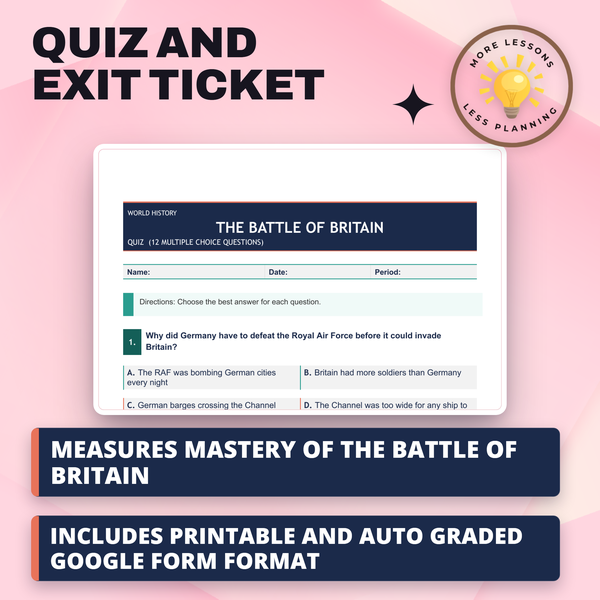
- Quiz + answer key
- Exit ticket + answer key
- Teacher guide
- Teacher presentation notes
What students do
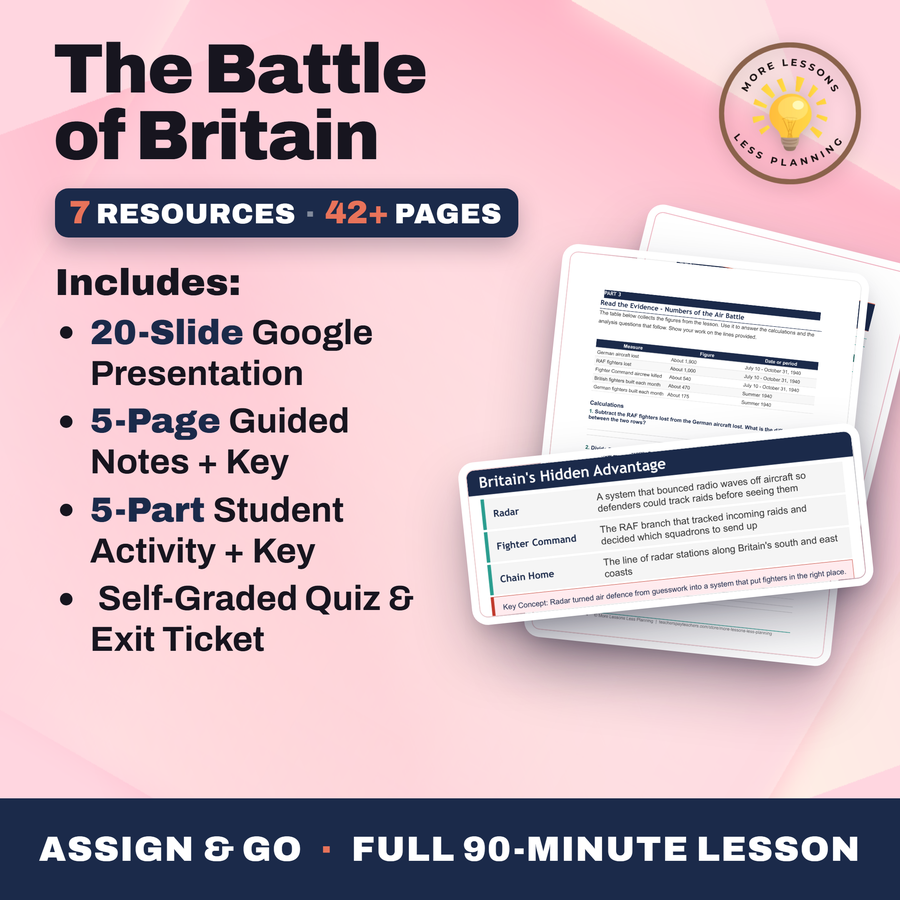
- Compare British and German monthly fighter production to explain why Britain out-replaced its losses
- Analyze Roosevelt's December 29, 1940 fireside chat calling America the "arsenal of democracy"
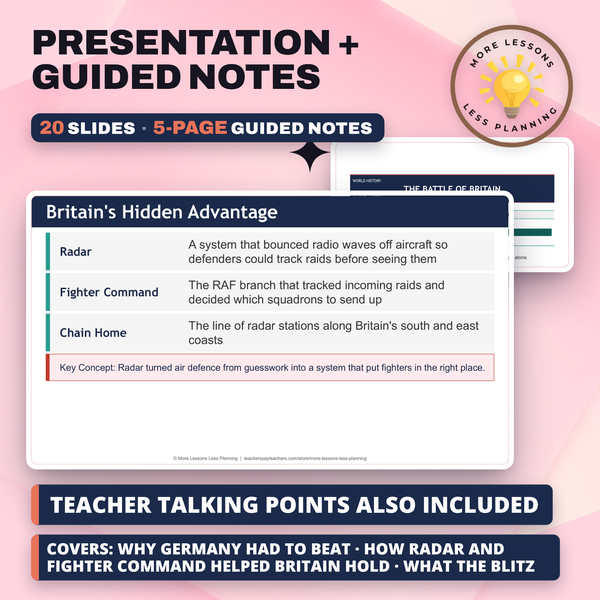
- Explain how radar and Fighter Command let a smaller air force track and intercept Luftwaffe raids
- Trace the steps from cash-and-carry to the Destroyers-for-Bases Deal to Lend-Lease
What it covers
- Why Germany needed control of the sky before Operation Sea Lion could cross the Channel
- What the Blitz targeted, and why bombing London gave the RAF time to recover
- How American isolationism and the desire to help Britain pulled against each other through 1940
Learning targets
- Explain why Germany had to beat the RAF before it could invade Britain.
- Describe how radar and Fighter Command helped Britain hold the sky in 1940.
- Explain what the Blitz was and how British civilians lived through it.
- Trace the steps the United States took to support Britain in 1940 and 1941.
- Use Roosevelt's 1940 fireside chat as evidence about American policy.
Peek inside
France surrendered to Germany on June 22, 1940.
Britain was the last major power in western Europe still fighting.
Hitler needed Britain to surrender or be invaded.
The English Channel is only 21 miles wide at its narrowest point.
The Royal Navy was far stronger than Germany's surface fleet.
The Last Power Still Fighting
France surrendered to Germany on June 22, , leaving Britain to fight alone.
The English Channel is only miles wide at its narrowest point.
The Navy was far stronger than Germany's surface fleet.
1. Pilots who scrambled from airfields in Kent to meet German bombers in August 1940 were flying for the .
Why this matters
Winning a battle in the air still required Britain to out-produce its own losses month after month, and the production numbers here explain the outcome better than any account of individual dogfights. Radar let a smaller Fighter Command see raids coming and meet them instead of guessing.
Cash-and-carry moving through the Destroyers-for-Bases Deal into Lend-Lease belongs alongside the air campaign, not after it, because American isolationism and the desire to help Britain pulled against each other the whole time. A military win in 1940 only holds if the political shift in Washington happens too.
From one teacher to another
Britain held the sky in the summer of 1940, but the fight strained ships, planes, and dollars that Parliament couldn't replace alone. I built this lesson to connect a military victory in the air to a political shift in Washington, tracing the RAF's defense through radar and Fighter Command before landing on Roosevelt's fireside chat asking Americans to become the arsenal of democracy without sending troops. It is the lesson where a battle no army fought on the ground ends up deciding what a country three thousand miles away was willing to do.
Every file in this toolkit
Download
Where should I send the next one?
Everything here is free and it stays that way. Leave your email and I'll send you the new lessons as they go up. You can unsubscribe from any one of them.
Related resources


Every lesson on this site is free to download and use. If one of them saved you a prep period, you can chip in a few bucks toward my three kids' daycare fund. That's genuinely where tips go.