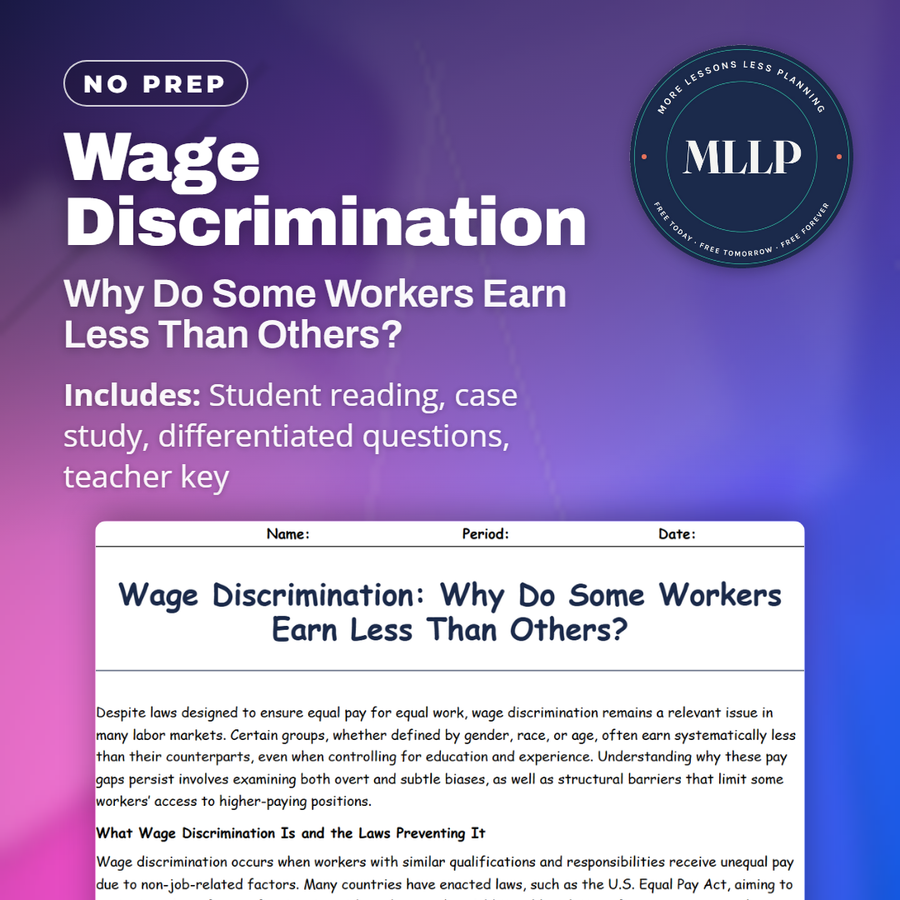
Wage Discrimination: Why Do Some Workers Earn Less Than Others?
Quality reviewed September 2026
Facts verified September 8, 2026
- Grades
- Grades 9-12
- Length
- 7-page student worksheet
- Time
- About one 50-minute class period
- Great for
- Sub plans and independent work
- Includes
- Reading passage, comprehension questions + full answer key
- Format
- Print-and-go PDF
What students do
- Understand wage discrimination as unequal pay for equal work based on protected characteristics
- Read a case study about female software engineers suing over lower starting salary offers
- Complete matching exercises on occupational segregation, motherhood penalty, and bias
- Answer questions about pay transparency requirements and legal enforcement mechanisms
What it covers
- Definition of wage discrimination and laws like the Equal Pay Act preventing unfair treatment
- Gender, race, and age effects on pay rates and promotion opportunities in labor markets
- Occupational segregation and its persistent role in causing wage gaps between groups
Start reading this worksheet
Despite laws designed to ensure equal pay for equal work, wage discrimination remains a relevant issue in many labor markets. Certain groups, whether defined by gender, race, or age, often earn systematically less than their counterparts, even when controlling for education and experience. Understanding why these pay gaps persist involves examining both overt and subtle biases, as well as structural barriers that limit some workers’ access to higher-paying positions.
What Wage Discrimination Is and the Laws Preventing It
Wage discrimination occurs when workers with similar qualifications and responsibilities receive unequal pay due to non-job-related factors. Many countries have enacted laws, such as the U.S. Equal Pay Act, aiming to protect workers from unfair treatment based on gender. Additional legislation often covers race, religion, national origin, and disability. Enforcement can be challenging, however, as wage disparities might not always result from explicit policies but from systemic biases or long-standing practices. For instance, employers might unknowingly rely on wage histories that reflect past discrimination. Legal frameworks encourage transparency and fairness, but actual cases of discrimination can be complex to prove.
How Gender, Race, and Age Influence Wages
The gender pay gap has received considerable attention, but other demographic factors also come into play. Racial wage gaps persist in many industries, with studies suggesting that individuals from certain backgrounds may have fewer networking opportunities or face unconscious bias during hiring and promotions. Age can also factor into discriminatory practices. Younger workers might be offered lower starting salaries or see limited promotion opportunities, while older employees may face ageist assumptions about adaptability or productivity. These gaps can compound over time, affecting career trajectories, retirement savings, and overall wealth accumulation.
Like what you read? The full reading, the case study, and every question set are in the free download below, along with the answer key.
Why this matters
A group of female software engineers suing over lower starting salaries than men in the same role is not a hypothetical here, it is the case study students work through directly. Occupational segregation and the motherhood penalty explain patterns a single lawsuit cannot, showing why wage gaps between groups persist even where no one signed anything discriminatory.
I let the Equal Pay Act and real enforcement questions do the arguing here, since students already arrive with strong feelings about fairness at work. Pay transparency comes up as the clearest fix, and students want to know why every employer does not simply adopt it.
From one teacher to another
I use this reading to address a topic students care deeply about: fairness in employment. The worksheet lays out real legal cases like the tech company gender pay lawsuit rather than abstract theory disconnected from reality. Students read about occupational segregation, the motherhood penalty affecting women with children, and unconscious bias in hiring, then see how pay transparency helps uncover problems. The discussion of the Equal Pay Act and civil rights enforcement grounds the reading in actual legal frameworks that exist to protect workers. My students work through questions about enforcement challenges and why wage disparities persist even with laws on the books. It's a printable worksheet that models how economists examine discrimination seriously and systematically.
What you get
- Answer Key
-
Student Worksheet
Female athletes earning less than male counterparts in the same sport have prompted public campaigns for equal prize money, a pattern the reading traces beyond its tech industry lawsuit. It flags the Equal Pay Act's limits, since disparities often trace back to systemic practice instead of one policy, and contrasts younger workers facing lower starting offers with older employees facing assumptions about adaptability.
Download
Where should I send the next one?
Everything here is free and it stays that way. Leave your email and I'll send you the new lessons as they go up. You can unsubscribe from any one of them.
Related resources
How Labor Markets Work: Supply, Demand, And Wages
How Technology Is Changing The Workforce And Wages
Labor Market Trends: The Future Of Jobs And Employment
Labor Unions And Collective Bargaining: How Workers Gain Power
Minimum Wage Laws: Pros, Cons, And Economic Impact
The Role Of Human Capital: Why Skills And Education Matter
Every lesson on this site is free to download and use. If one of them saved you a prep period, you can chip in a few bucks toward my three kids' daycare fund. That's genuinely where tips go.