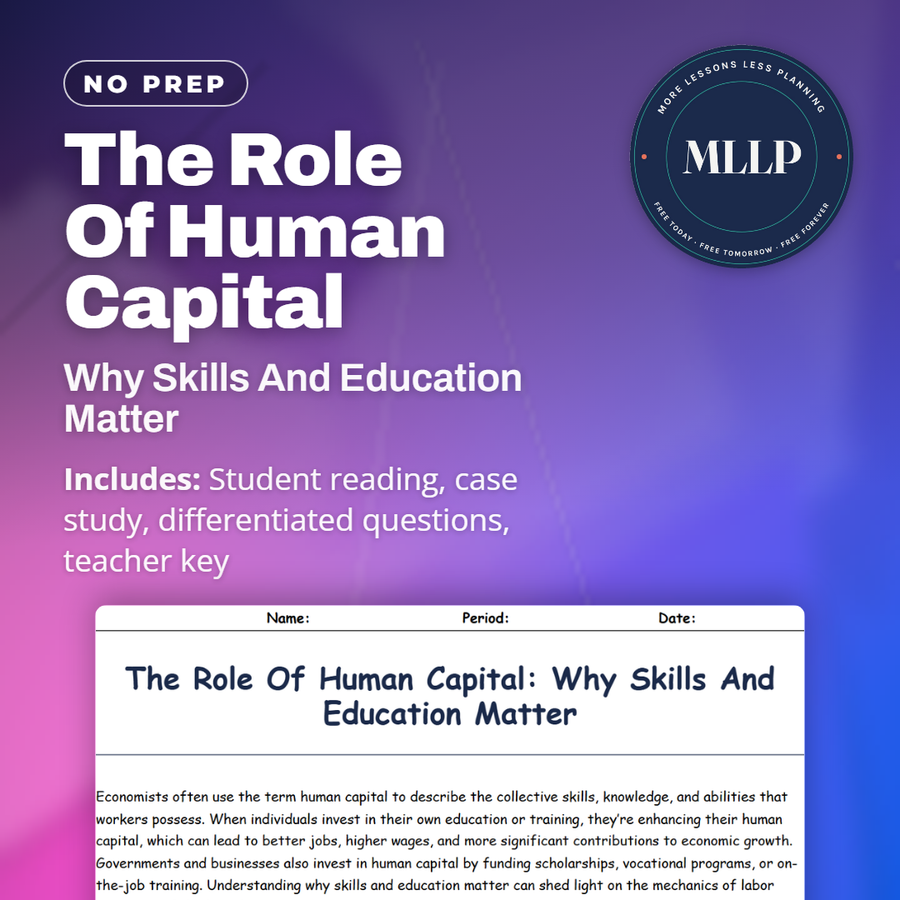
The Role Of Human Capital: Why Skills And Education Matter
Quality reviewed September 2026
Facts verified September 8, 2026
- Grades
- Grades 9-12
- Length
- 7-page student worksheet
- Time
- About one 50-minute class period
- Great for
- Sub plans and independent work
- Includes
- Reading passage, comprehension questions + full answer key
- Format
- Print-and-go PDF
What students do
- Define human capital as the skills, knowledge, and abilities workers bring to their jobs
- Read how an IT firm invested in employee certifications to improve database capabilities
- Complete matching exercises on vocational programs, trade schools, and formal degrees
- Answer questions about continuous professional development and career adaptability
What it covers
- Human capital definition and role in economic growth and productivity
- Education and training pathways including trade schools and vocational programs
- Return on investment for specialized skills and professional certifications
Start reading this worksheet
Economists often use the term human capital to describe the collective skills, knowledge, and abilities that workers possess. When individuals invest in their own education or training, they’re enhancing their human capital, which can lead to better jobs, higher wages, and more significant contributions to economic growth. Governments and businesses also invest in human capital by funding scholarships, vocational programs, or on-the-job training. Understanding why skills and education matter can shed light on the mechanics of labor markets and the broader economy.
Defining Human Capital and Its Importance
Human capital encompasses more than just formal schooling; it includes on-the-job experience, technical certifications, and even soft skills like communication and teamwork. Economies thrive when a substantial share of their workforce is highly skilled, as workers become more productive, generate higher-value output, and are better able to adapt to technological changes. On a personal level, individuals with advanced human capital often enjoy greater job security and higher earning potential. By contrast, a lack of relevant skills may trap workers in low-paying, unstable jobs. This gap in human capital can also contribute to income inequality if some groups have less access to education or training.
Education, Training, and Earning Potential
It’s a straightforward concept that workers with more specialized or advanced skills typically command higher wages. Attending college or completing a vocational program can drastically improve one’s opportunities, but not all education paths are identical. Some fields, such as software engineering or healthcare, tend to offer substantial returns on educational investment. Others may not yield high wages unless paired with experience or a strong professional network. Beyond formal degrees, employers often value continuous training—the idea that workers keep learning throughout their careers to remain competitive. Certifications in project management, foreign languages, or specialized software can differentiate an employee in a crowded market.
Like what you read? The full reading, the case study, and every question set are in the free download below, along with the answer key.
Why this matters
Plenty of students assume a four-year degree is the only route to a good paycheck, and this reading interrupts that by putting electricians, plumbers, and welders next to engineers as equally serious options. The case study of a tech firm training its own employees in database management shows human capital keeps growing well past graduation.
Career conversations happen at home long before economics class does, and this reading sits right at that intersection. Watching a company invest real money in an existing employee, rather than hiring someone new, reframes education as an asset that keeps earning. Some tell me it is the first time a trade school sounded like a real plan.
From one teacher to another
I use this reading as a bridge between economics class and career guidance conversations. The worksheet directly connects education choices to earning potential without suggesting college is the only path forward. Students read about apprenticeships, IT certifications, and vocational programs alongside traditional degree options. The case study shows a tech firm training existing employees in database management and business intelligence tools, demonstrating how skills increase a worker's market value and prospects for promotion. My students see that electricians, plumbers, and welders deserve serious consideration as career pathways alongside engineering roles. It's a printable worksheet that validates multiple routes to stable employment and higher wages.
What you get
- Answer Key
-
Student Worksheet
Some trade skills are location bound, so a region facing a shortage of electricians, plumbers, or welders often sees employers respond with premium wages or relocation incentives to draw workers in. A different section follows a mid-sized firm that spent six months certifying its own staff instead of hiring outside help, and employees came away with higher job satisfaction and real prospects for internal promotion.
Download
Where should I send the next one?
Everything here is free and it stays that way. Leave your email and I'll send you the new lessons as they go up. You can unsubscribe from any one of them.
Related resources
How Labor Markets Work: Supply, Demand, And Wages
How Technology Is Changing The Workforce And Wages
Labor Market Trends: The Future Of Jobs And Employment
Labor Unions And Collective Bargaining: How Workers Gain Power
Minimum Wage Laws: Pros, Cons, And Economic Impact
Wage And Income Inequality: Why Some Earn More Than Others
Every lesson on this site is free to download and use. If one of them saved you a prep period, you can chip in a few bucks toward my three kids' daycare fund. That's genuinely where tips go.