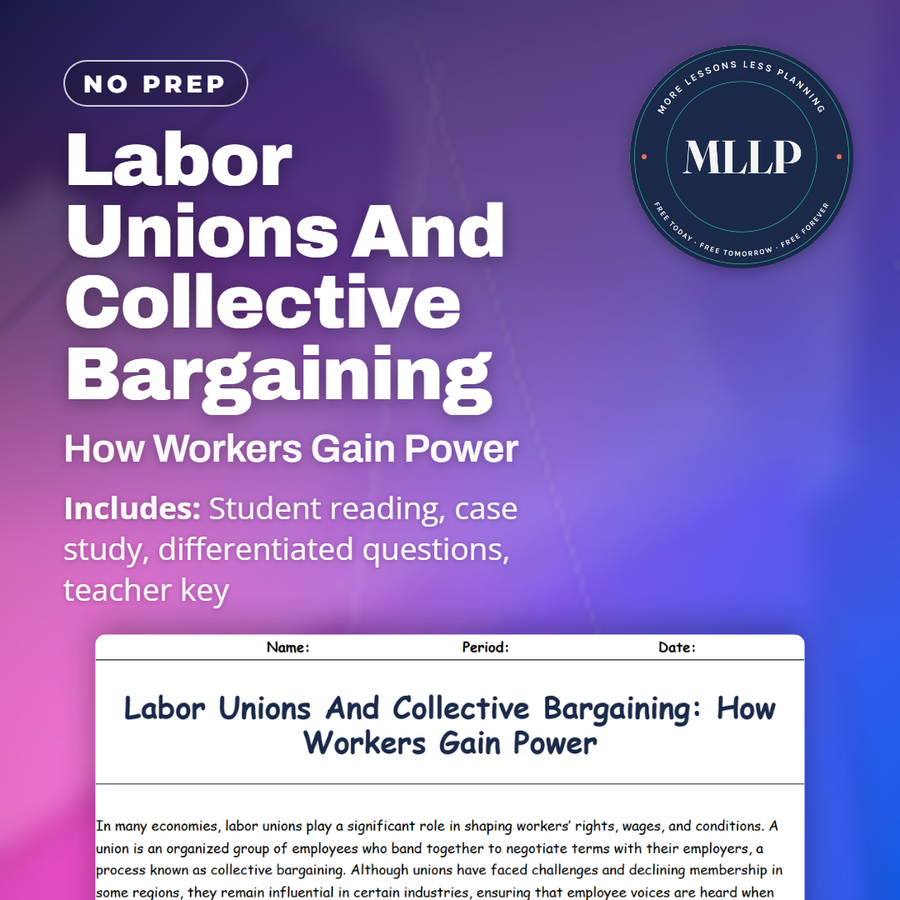
Labor Unions And Collective Bargaining: How Workers Gain Power
Quality reviewed September 2026
Facts verified September 8, 2026
- Grades
- Grades 9-12
- Length
- 6-page student worksheet
- Time
- About one 50-minute class period
- Great for
- Sub plans and independent work
- Includes
- Reading passage, comprehension questions + full answer key
- Format
- Print-and-go PDF
What students do
- Read about the history of labor unions and why they formed during unsafe industrial conditions
- Understand how collective bargaining gives workers negotiating power compared to individual deals
- Complete matching exercises on strikes, lockouts, mediation, and contract agreements
- Analyze a case study where flight attendants used strike threats to win safety concessions
What it covers
- Purpose and history of labor unions and worker rights movements in industrial settings
- How collective bargaining works and negotiation tactics like strikes and lockouts
- Trade-offs between union protections and potential economic impacts on competitiveness
Start reading this worksheet
In many economies, labor unions play a significant role in shaping workers’ rights, wages, and conditions. A union is an organized group of employees who band together to negotiate terms with their employers, a process known as collective bargaining. Although unions have faced challenges and declining membership in some regions, they remain influential in certain industries, ensuring that employee voices are heard when discussing pay, benefits, and workplace policies. This reading explores the history, impact, and debates surrounding labor unions.
Purpose and History of Labor Unions
Labor unions arose during industrial expansion periods when workers lacked any formal protection against exploitative labor practices. In the late 19th and early 20th centuries, factory conditions could be harsh: long hours, unsafe equipment, and extremely low wages were common. Unions gave workers a collective voice, enabling them to push for laws that regulated work hours, established safety standards, and banned child labor. Over time, these unions developed into more formal organizations with elected leadership, dues-paying memberships, and specific negotiation strategies. While union membership in certain countries has declined, unions still play crucial roles in sectors like construction, public service, and transportation.
How Collective Bargaining Works
When employees negotiate as a single group, they gain more leverage than they would individually. Collective bargaining involves representatives from the union sitting down with management to discuss wages, healthcare benefits, retirement plans, and working conditions. The aim is to reach an agreement, often documented in a formal contract, that sets the rules and pay scales for a specified period. If negotiations stall, unions might vote to strike, withholding their labor to press for their demands. Conversely, employers can lock workers out, halting operations. These tactics can lead to intense standoffs, but they also provide a framework for reaching compromises that might not be possible without collective action.
Like what you read? The full reading, the case study, and every question set are in the free download below, along with the answer key.
Why this matters
A flight attendant threatening to strike over unsafe rest periods is not abstract labor history, it is the same leverage that built unions a century ago in unsafe factories. This reading sets that history beside a recent contract fight, so bargaining reads as a live tool, not a textbook relic. Strikes and mediation stop being vocabulary once attached to an outcome workers actually won.
Students walk in with a side already picked, often from a parent's opinion at dinner. The reading sets real gains, like the flight attendants' safety concessions, beside real costs to competitiveness. Working through both sides before debating forces them to argue with evidence, not an inherited opinion.
From one teacher to another
I use this reading when we cover labor markets and explore power dynamics between workers and employers. The worksheet presents both support for unions and criticisms fairly, avoiding one-sided messaging. Students read about strikes that actually happened, like teacher strikes over class sizes and working conditions, which they recognize from local news coverage. The case study about flight attendants negotiating for safety improvements and better rest periods makes the reading feel relevant to their lives. My students debate whether unions help or hurt economies after working through the multiple-choice and short-answer questions. It's a solid printable resource for unpacking how workers organize collectively to improve conditions.
What you get
- Answer Key
-
Student Worksheet
Autoworkers striking in the mid-20th century won lasting wage and benefit gains, a tactic the reading follows into more recent teacher walkouts over funding and staffing levels. It shows what collective bargaining looks like inside a negotiation room, union representatives across the table from management, and explains how a government-appointed mediator can end a standoff before it becomes a strike.
Download
Where should I send the next one?
Everything here is free and it stays that way. Leave your email and I'll send you the new lessons as they go up. You can unsubscribe from any one of them.
Related resources
How Labor Markets Work: Supply, Demand, And Wages
How Technology Is Changing The Workforce And Wages
Labor Market Trends: The Future Of Jobs And Employment
Minimum Wage Laws: Pros, Cons, And Economic Impact
The Role Of Human Capital: Why Skills And Education Matter
Wage And Income Inequality: Why Some Earn More Than Others
Every lesson on this site is free to download and use. If one of them saved you a prep period, you can chip in a few bucks toward my three kids' daycare fund. That's genuinely where tips go.