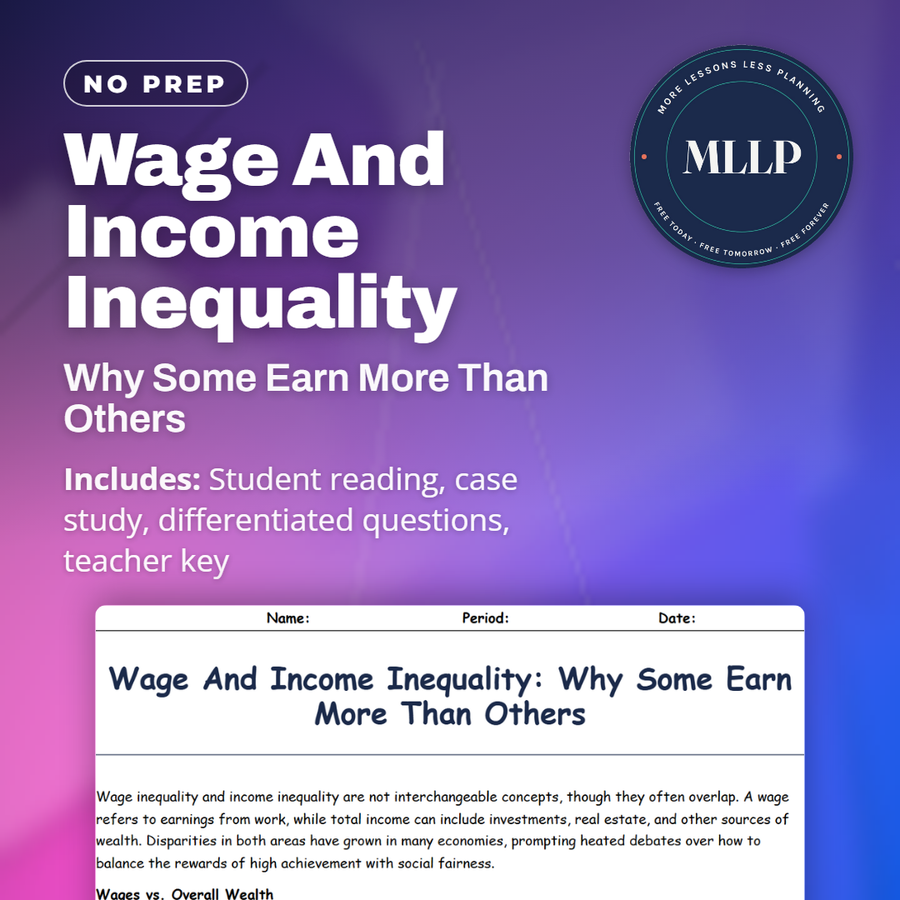
Wage And Income Inequality: Why Some Earn More Than Others
Quality reviewed September 2026
Facts verified September 8, 2026
- Grades
- Grades 9-12
- Length
- 6-page student worksheet
- Time
- About one 50-minute class period
- Great for
- Sub plans and independent work
- Includes
- Reading passage, comprehension questions + full answer key
- Format
- Print-and-go PDF
What students do
- Distinguish between wage inequality from different job types and income inequality from investments
- Read about a community investment program that narrowed wage gaps but not overall wealth gaps
- Answer multiple-choice questions on progressive taxation and wealth accumulation patterns
- Match concepts like redistribution programs with specific examples like affordable housing
What it covers
- Sources of wage inequality and income inequality from different economic activities
- Government policies including progressive taxation, minimum wage, social welfare programs
- Effects of globalization and capital mobility on earning patterns and wealth concentration
Start reading this worksheet
Wage inequality and income inequality are not interchangeable concepts, though they often overlap. A wage refers to earnings from work, while total income can include investments, real estate, and other sources of wealth. Disparities in both areas have grown in many economies, prompting heated debates over how to balance the rewards of high achievement with social fairness.
Wages vs. Overall Wealth
Wage reflects what someone earns, typically measured by the hour or year. Income can encompass wages plus any returns from capital or businesses. Extremely high-income individuals often draw large shares of their earnings from investments, leading to wealth accumulation that outpaces typical wage growth. In some societies, a small percentage of the population controls a significant portion of wealth, exacerbating economic disparity. Even if wages rise for the middle class, rapid capital gains for the wealthy may widen the overall income gap.
Factors Contributing to Wage Gaps
Many of the forces that determine wage levels, like education, skill requirements, and labor supply, also drive inequality. Individuals in high-demand, specialized fields can command premium wages, pulling further away from workers in low-demand roles. Globalization may create upward mobility for some professionals who can work across borders, but downward wage pressure on others who compete globally. Technology shifts can do the same, disproportionately rewarding those who possess advanced digital skills. Additionally, location matters. Urban centers with vibrant industries may offer higher wages than rural areas, intensifying regional disparities.
Like what you read? The full reading, the case study, and every question set are in the free download below, along with the answer key.
Why this matters
Wage gaps and income gaps are not the same thing, and this reading keeps them separate on purpose: a barista and a lawyer differ by job type, while a property owner can pull further ahead through real estate appreciation with no paycheck involved. A city program that narrowed wage gaps through job training still left rising housing values benefiting people who already owned property.
Inequality is harder for students to reason about, because the fix for one gap does nothing for the other. The city's training success, paired with its failure to touch the housing wealth gap, forces them to hold two true results at once instead of naming a single villain.
From one teacher to another
I use this reading when students ask why wealth inequality keeps growing even as some wages rise or minimum wages increase. The worksheet walks them through real distinctions: a barista and a lawyer have a wage gap, but property owners see even bigger income gaps from investment returns and real estate appreciation. Students see how a city invested in job training programs and slightly narrowed wage gaps, yet rising housing values still benefited the already-wealthy disproportionately. My students work through pros and cons of different redistribution approaches like tax policy and public programs without heavy-handed messaging pushing one view. It's a printable worksheet that treats inequality as the complex economic problem it really is rather than oversimplifying it.
What you get
- Answer Key
-
Student Worksheet
Multinational corporations and wealthy individuals can shift operations and assets across borders to dodge taxes in any one country, which is why globalization complicates closing income gaps through taxation alone. Critics of higher taxes on top earners argue the policy can discourage investment or push capital abroad, a trade-off set against minimum wage laws and welfare programs as competing tools for narrowing the gap.
Download
Where should I send the next one?
Everything here is free and it stays that way. Leave your email and I'll send you the new lessons as they go up. You can unsubscribe from any one of them.
Related resources
How Labor Markets Work: Supply, Demand, And Wages
How Technology Is Changing The Workforce And Wages
Labor Market Trends: The Future Of Jobs And Employment
Labor Unions And Collective Bargaining: How Workers Gain Power
Minimum Wage Laws: Pros, Cons, And Economic Impact
The Role Of Human Capital: Why Skills And Education Matter
Every lesson on this site is free to download and use. If one of them saved you a prep period, you can chip in a few bucks toward my three kids' daycare fund. That's genuinely where tips go.