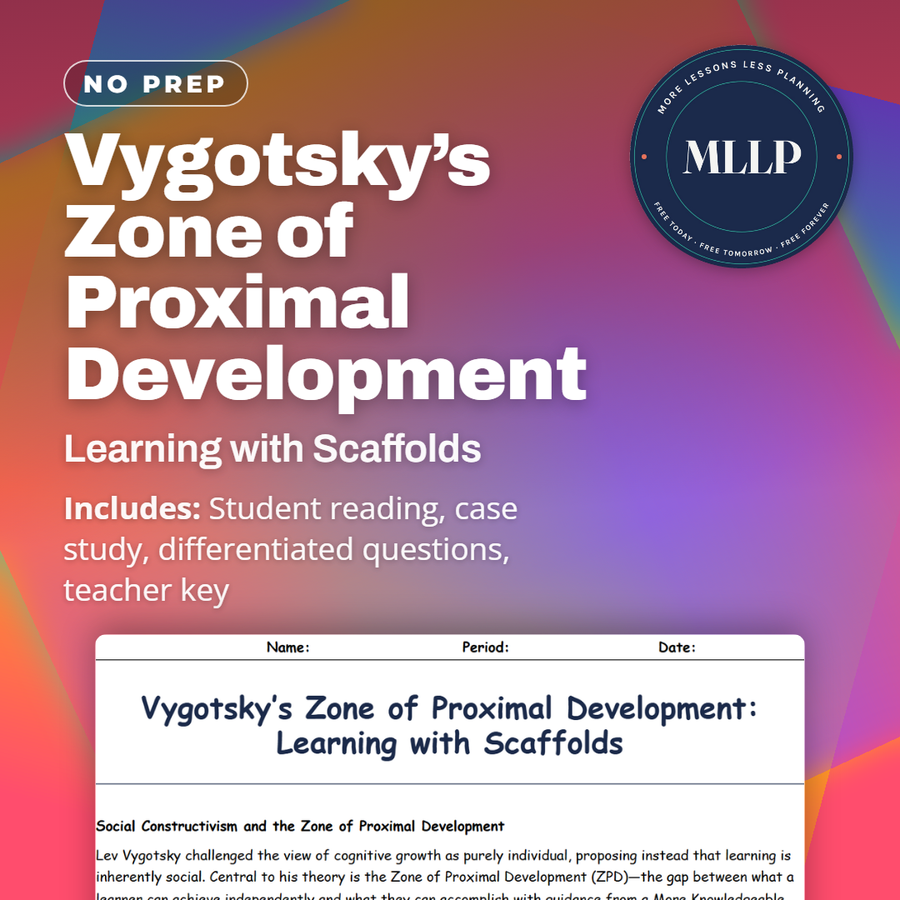
Vygotsky’s Zone of Proximal Development: Learning with Scaffolds
Quality reviewed September 2026
Facts verified September 10, 2026
- Subject
- Social Studies
- Grades
- Grades 9-12
- Length
- 7-page student worksheet
- Time
- About one 50-minute class period
- Great for
- Sub plans and independent work
- Includes
- Reading passage, comprehension questions + full answer key
- Format
- Print-and-go PDF
What students do
- Match terms like modeling, prompting, coaching, fading, and ZPD to their definitions
- Fill in the blank sentences about learning as a social process, inner speech, and working within each other's ZPD
- Answer short answer questions on why identifying a student's ZPD matters for instruction and how peer tutoring reflects social constructivism
- Read a case study about peer scaffolding in a biology lab and answer questions about the coaching strategy Jamal used with Maria
What it covers
- The Zone of Proximal Development and the role of the More Knowledgeable Other
- The stages of scaffolding, including modeling, prompting, coaching, and fading support
- How Vygotsky's social constructivism contrasts with Piaget's individual constructivism, and its use in differentiated instruction
Start reading this worksheet
Social Constructivism and the Zone of Proximal Development
Lev Vygotsky challenged the view of cognitive growth as purely individual, proposing instead that learning is inherently social. Central to his theory is the Zone of Proximal Development (ZPD): the gap between what a learner can achieve independently and what they can accomplish with guidance from a More Knowledgeable Other (MKO). Tasks within the ZPD are just beyond solo competence but attainable through scaffolding: supportive interactions such as modeling, questioning, and feedback. This perspective positions teachers, peers, and mentors not as dispensers of facts, but as co-constructors of knowledge, guiding students to internalize higher-order thinking. In contrast to Piaget’s emphasis on self-discovery, Vygotsky underscores the power of collaboration, dialogue, and cultural tools (language, symbols) in mediating learning.
Scaffolding: Guiding Learners to Independence
Scaffolding involves providing temporary supports that are gradually removed as learners gain mastery. Early in instruction, an MKO might offer direct modeling, performing a task step-by-step while verbalizing strategies. Next, the MKO shifts to guided practice, prompting the learner with questions (“What would you try next?”) or cues (“Remember how we started?”). As competence grows, supports fade; prompts become subtler, and learners take on increasing responsibility until they perform the task independently. Effective scaffolding requires the MKO to assess the learner’s current ZPD, tailor assistance to their needs, and adjust supports in real time. This dynamic process ensures that challenges remain optimal: neither too easy to bore nor too difficult to frustrate.
MKO and Cultural Tools
Vygotsky emphasized that learning occurs within a cultural context rich in tools (language, symbols, texts, technology) that mediate thought. The MKO, familiar with these tools, introduces them into the learner’s practice. For instance, in mastering essay writing, a teacher (MKO) might first co-construct an outline using specialized vocabulary and graphic organizers, then encourage students to adopt those tools in their own drafts. Peers can also serve as MKOs when they share domain expertise or greater skill. Through dialogic interaction, learners internalize external dialogues, transforming social language into inner speech, which underpins self-regulation and higher mental functions.
Like what you read? The full reading, the case study, and every question set are in the free download below, along with the answer key.
Why this matters
In the biology lab case study, Jamal does not hand Maria and her lab partner the answer. He works through writing the hypothesis with them, coaching Maria in particular, the kind of support this reading calls the More Knowledgeable Other. Modeling, prompting, coaching, and fading are the stages the reading covers, not just labels to memorize.
Piaget comes first in my unit, then this, so students hold two competing ideas at once: a learner figuring things out alone versus one working inside what a More Knowledgeable Other can support. Watching Jamal coach Maria through that hypothesis is what finally lets them explain why knowing a student's ZPD changes how a teacher steps in.
From one teacher to another
I use this reading right after Piaget so students can contrast individual and social constructivism side by side. The biology lab case study, where one student scaffolds two classmates through writing a hypothesis, makes the ZPD concept concrete instead of theoretical. They match modeling, prompting, coaching, and fading to their definitions, then answer short answer questions about why identifying a student's ZPD actually matters for teaching. It works well for a unit review before a test.
What you get
Download
Where should I send the next one?
Everything here is free and it stays that way. Leave your email and I'll send you the new lessons as they go up. You can unsubscribe from any one of them.
Related resources
Bandura’s Social Learning: Modeling Behavior and Self-Efficacy
Behaviorism Basics: How B.F. Skinner Shaped Learning Theory
Carl Jung’s Archetypes: Exploring the Collective Unconscious
Erikson’s Stages: Identity and Development Across the Lifespan
Maslow’s Motivation Theory

Milgram’s Obedience Study: Power, Authority, and Ethics
Every lesson on this site is free to download and use. If one of them saved you a prep period, you can chip in a few bucks toward my three kids' daycare fund. That's genuinely where tips go.