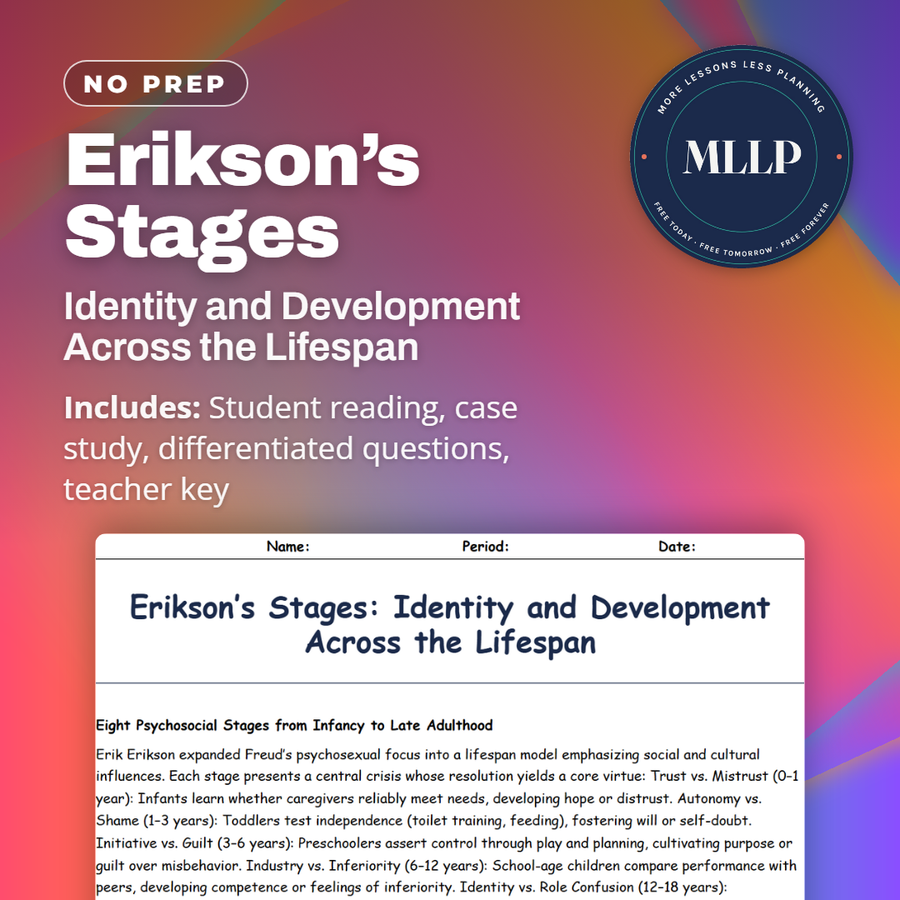
Erikson’s Stages: Identity and Development Across the Lifespan
Quality reviewed September 2026
Facts verified September 10, 2026
- Subject
- Social Studies
- Grades
- Grades 9-12
- Length
- 7-page student worksheet
- Time
- About one 50-minute class period
- Great for
- Sub plans and independent work
- Includes
- Reading passage, comprehension questions + full answer key
- Format
- Print-and-go PDF
What students do
- Match psychosocial stages like trust vs. mistrust, autonomy vs. shame, and identity vs. role confusion to their virtues
- Fill in the blank sentences about the virtue gained from resolving intimacy vs. isolation and Erikson's lifespan model
- Answer short answer questions on how culture can shift the timing of Erikson's stages and how to support someone in identity vs. role confusion
- Read a case study about a senior choosing between art and engineering and answer questions about her identity exploration
What it covers
- All eight of Erikson's psychosocial stages from infancy through late adulthood, with their crises and virtues
- Identity vs. role confusion in adolescence and how supportive environments shape it
- How counselors and educators apply the stages to career exploration and life transitions
Start reading this worksheet
Eight Psychosocial Stages from Infancy to Late Adulthood
Erik Erikson expanded Freud’s psychosexual focus into a lifespan model emphasizing social and cultural influences. Each stage presents a central crisis whose resolution yields a core virtue: Trust vs. Mistrust (0–1 year): Infants learn whether caregivers reliably meet needs, developing hope or distrust. Autonomy vs. Shame (1–3 years): Toddlers test independence (toilet training, feeding), fostering will or self-doubt. Initiative vs. Guilt (3–6 years): Preschoolers assert control through play and planning, cultivating purpose or guilt over misbehavior. Industry vs. Inferiority (6–12 years): School-age children compare performance with peers, developing competence or feelings of inferiority. Identity vs. Role Confusion (12–18 years): Adolescents explore identities, roles, and values, emerging with fidelity (a coherent sense of self) or confusion. Intimacy vs. Isolation (18–40 years): Young adults form deep relationships, attaining love or experiencing isolation. Generativity vs. Stagnation (40–65 years): Midlife adults invest in future generations through work and family, achieving care or stagnating. Integrity vs. Despair (65+ years): Elders reflect on life with wisdom or regret, feeling either fulfillment or despair. Erikson’s framework highlights that healthy development depends on successful navigation of each crisis; failure can reverberate into later stages, shaping personality and relationships.
Identity vs. Role Confusion in Adolescence
During adolescence, individuals explore career, ideology, and relationships. Success yields fidelity, the ability to commit to values despite contradictions, while failure leads to role confusion and vulnerability to peer pressure. Supportive environments (mentorship, extracurriculars, open dialogue) facilitate healthy identity formation.
Resolution and Virtue Development
Erikson stressed that virtues are not fixed; they strengthen through practice and reflection. For example, an adolescent experiment with leadership roles (e.g., student council) can bolster competence and fidelity. In adulthood, generative acts (mentoring interns, volunteering) reinforce care, whereas isolation hinders emotional growth.
Like what you read? The full reading, the case study, and every question set are in the free download below, along with the answer key.
Why this matters
Identity vs. role confusion is the stage that resonates most with juniors and seniors, and the case study puts a real dilemma behind it: a senior choosing between art and engineering. The reading walks through all eight of Erikson's stages and their virtues before asking students to work through her decision.
Culture bends the timeline of Erikson's stages more than most students expect, since the age when identity gets resolved is not fixed the way a textbook implies. Comparing when their own families expected them to have things figured out against the model's timing usually turns up mismatches that make identity vs. role confusion stick as more than a stage name.
From one teacher to another
I use this with juniors and seniors right when identity vs. role confusion is the most relatable stage for them. They match all eight stages to their virtues, then work through a case study about a senior torn between art and engineering that mirrors what a lot of my own students are going through. The short answer questions ask them to think about how culture changes the timing of the stages, which usually gets a real discussion going.
What you get
Download
Where should I send the next one?
Everything here is free and it stays that way. Leave your email and I'll send you the new lessons as they go up. You can unsubscribe from any one of them.
Related resources
Bandura’s Social Learning: Modeling Behavior and Self-Efficacy
Behaviorism Basics: How B.F. Skinner Shaped Learning Theory
Carl Jung’s Archetypes: Exploring the Collective Unconscious
Maslow’s Motivation Theory
Milgram’s Obedience Study: Power, Authority, and Ethics
Pavlov and Classical Conditioning: The Salivating Dog Explained
Every lesson on this site is free to download and use. If one of them saved you a prep period, you can chip in a few bucks toward my three kids' daycare fund. That's genuinely where tips go.