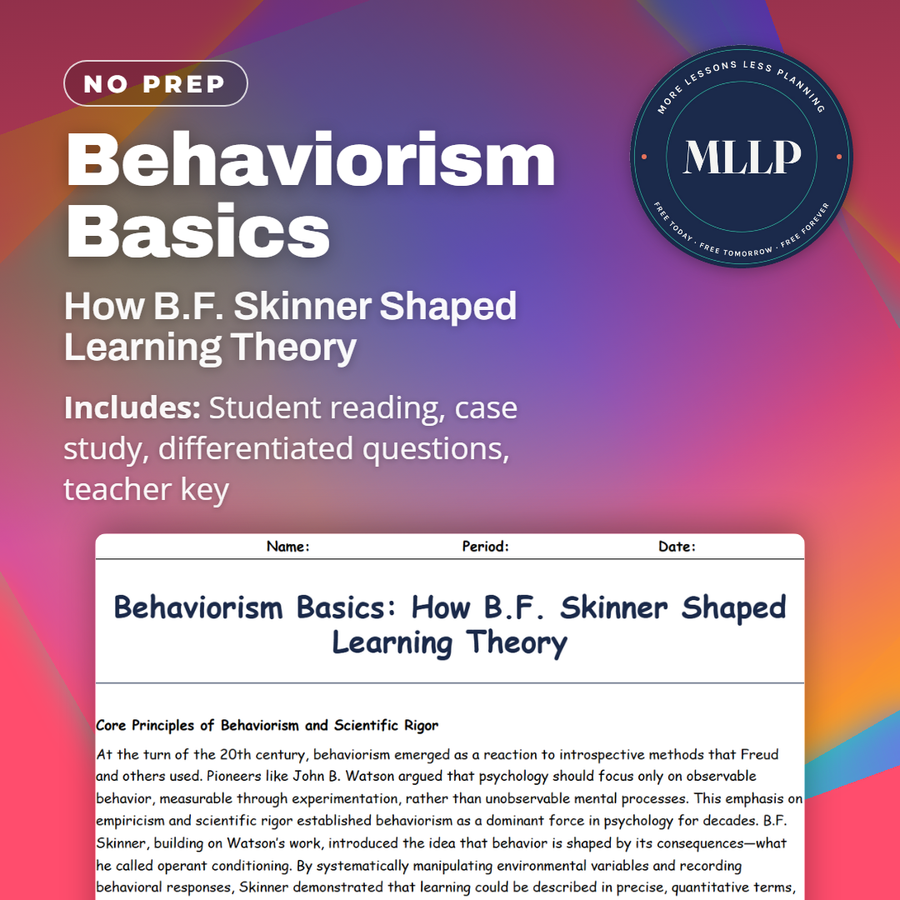
Behaviorism Basics: How B.F. Skinner Shaped Learning Theory
Quality reviewed September 2026
Facts verified September 10, 2026
- Subject
- Social Studies
- Grades
- Grades 9-12
- Length
- 8-page student worksheet
- Time
- About one 50-minute class period
- Great for
- Sub plans and independent work
- Includes
- Reading passage, comprehension questions + full answer key
- Format
- Print-and-go PDF
What students do
- Match terms like positive reinforcement, negative reinforcement, positive punishment, and variable-ratio schedules to their definitions
- Answer short answer questions on why Skinner favored variable schedules and one ethical concern with behavior modification
- Fill in the blank sentences about fixed-ratio schedules, operant conditioning consequences, and Skinner box rewards and punishments
- Read a case study on a token economy in a middle school classroom and answer questions about sustaining student engagement
What it covers
- Operant conditioning and the difference between reinforcement and punishment
- Skinner box experiments and the four schedules of reinforcement
- Classroom applications like token economies, programmed instruction, and Applied Behavior Analysis
Start reading this worksheet
Core Principles of Behaviorism and Scientific Rigor
At the turn of the 20th century, behaviorism emerged as a reaction to introspective methods that Freud and others used. Pioneers like John B. Watson argued that psychology should focus only on observable behavior, measurable through experimentation, rather than unobservable mental processes. This emphasis on empiricism and scientific rigor established behaviorism as a dominant force in psychology for decades. B.F. Skinner, building on Watson’s work, introduced the idea that behavior is shaped by its consequences: what he called operant conditioning. By systematically manipulating environmental variables and recording behavioral responses, Skinner demonstrated that learning could be described in precise, quantitative terms, laying the groundwork for applications in education, therapy, and behavior modification programs.
Operant Conditioning: Reinforcement vs. Punishment
Skinner distinguished reinforcement, which increases the likelihood of a behavior, from punishment, which decreases it. Positive reinforcement involves presenting a rewarding stimulus after a desired behavior, like praise following a correct answer. Negative reinforcement removes an aversive stimulus, such as canceling a homework assignment when students perform well, to strengthen behavior. Conversely, positive punishment adds an unpleasant consequence (e.g., extra chores), and negative punishment withdraws a positive stimulus (e.g., taking away video game privileges). Skinner emphasized that reinforcement schedules (how and when consequences follow behavior) are crucial: fixed-ratio, variable-ratio, fixed-interval, and variable-interval schedules each produce distinct response patterns, from rapid bursts to steady rates.
Skinner Box Experiments and Schedules of Reinforcement
To study operant conditioning under controlled conditions, Skinner designed the “Skinner box”: a chamber containing levers or discs that an animal could manipulate to receive rewards (like food) or avoid mild shocks. By varying the schedule of reinforcement, he observed striking differences: on a fixed-ratio schedule, rats pressed a lever a set number of times for each pellet, producing high response rates followed by pauses; on a variable-ratio schedule, where pellets appeared unpredictably after an average number of presses, animals responded persistently, much like gamblers on slot machines. Fixed-interval schedules yielded scalloped response patterns (animals paused after a reward, then increased pressing as the interval elapsed) while variable-interval schedules produced steady, moderate rates. Skinner’s quantitative analyses of these patterns solidified behaviorism’s experimental precision.
Like what you read? The full reading, the case study, and every question set are in the free download below, along with the answer key.
Why this matters
Slot machines and Skinner boxes share a principle: unpredictable rewards keep a subject pulling the lever longer than rewards that arrive every time. Skinner mapped that into four schedules of reinforcement, and the fixed-ratio and variable-ratio schedules here explain why some habits break easily and others do not.
Reinforcement and punishment are not stand-ins for good and bad, they only describe whether a behavior increases or decreases. The token economy example forces students to sort real classroom rewards into the correct category, and that is usually where behavior modification's ethical concerns finally get real discussion.
From one teacher to another
I pull this out when we get to Skinner in the behaviorism unit. It walks students through reinforcement versus punishment, then the Skinner box schedules, which always sparks a good conversation about why variable-ratio rewards feel like a slot machine. The token economy case study gives them a concrete classroom example to analyze. My students like matching the schedule names to real examples before we move to the quiz.
What you get
Download
Where should I send the next one?
Everything here is free and it stays that way. Leave your email and I'll send you the new lessons as they go up. You can unsubscribe from any one of them.
Related resources
Bandura’s Social Learning: Modeling Behavior and Self-Efficacy

Carl Jung’s Archetypes: Exploring the Collective Unconscious

Erikson’s Stages: Identity and Development Across the Lifespan
Maslow’s Motivation Theory

Milgram’s Obedience Study: Power, Authority, and Ethics

Pavlov and Classical Conditioning: The Salivating Dog Explained
Every lesson on this site is free to download and use. If one of them saved you a prep period, you can chip in a few bucks toward my three kids' daycare fund. That's genuinely where tips go.